A Wish List That Lets Users Vote on What We Build Next
This is the second post in our series on the small design decisions that make Eventist easier to use. The first one covered four ways we help you use the software you already have: search that walks you to a button, an AI assistant, in-page videos, and a wish list. This post is a closer look at that last one, because it answers a different question than the others. Those features help you use what exists. The Wish List decides what should exist, through event software feature voting that actually moves development.
Key takeaways
- Every Eventist dashboard includes a Wish List page where you can request features, vote on other people's requests, report bugs, and see the real development roadmap.
- Event software feature voting works like a Reddit upvote board, except vote counts are private, so people vote for what they need rather than what is already winning.
- Requests are sorted by event type (Studio, Regular Events, Festivals & Conferences, Competitions, and General), so you only vote on what applies to you.
- Bug reports capture what happened, when it happened, and optionally your device and browser in one form, while the context is fresh.
- Scheduled features appear on a public roadmap timeline, so you can watch your request move from idea to planned to shipped.
The problem with "contact support with feedback"
Most software has a black hole labelled "feedback". You email an idea, it disappears, and months later you have no idea whether anyone read it, whether other people wanted the same thing, or whether it's ever getting built. That black hole is a design failure too. It tells users their opinion is a formality.
We wanted the opposite: a place where your idea is visible the moment you submit it, where you can see what everyone else is asking for, and where you can watch the good ideas turn into scheduled work. So every Eventist organizer has a Wish List page built into the dashboard.
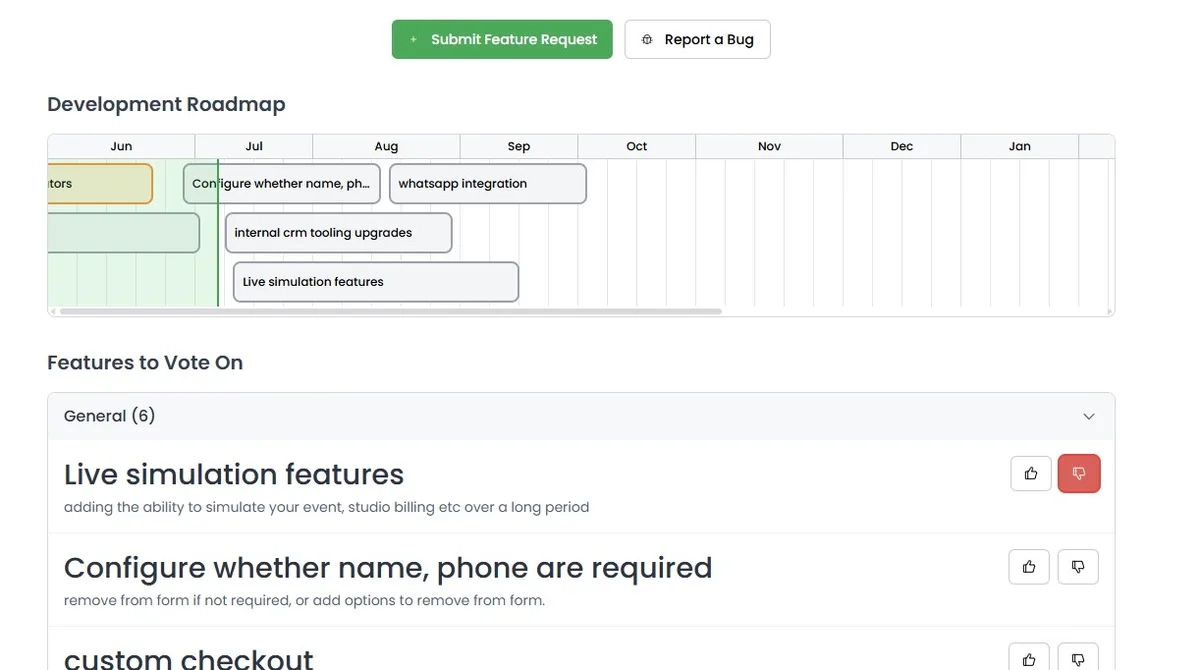
It does four things: request a feature, vote on other people's requests, report a bug, and see our actual development roadmap.
Feature voting, borrowed from the best idea on Reddit
If you have ever spent time on Reddit, you already understand the core mechanic here. A community surfaces its best ideas by letting everyone upvote, so the things the most people care about float to the top without a manager deciding for them. That upvote model is the single best thing about those communities, and it's exactly what a public product roadmap needs.
So we built event software feature voting as a Reddit-style board, with two deliberate differences that matter for a product:
- Votes are private. Unlike a public forum, you can see what's been requested but not the running tally. There's no bandwagon to jump on. People vote for what they genuinely need, not for whatever is already winning, which means the totals we see are honest signal instead of a popularity contest.
- A vote is one plain-English idea, tied to your kind of event. Requests are sorted into categories (Studio, Regular Events, Festivals & Conferences, Competitions, and General) so a studio owner isn't voting on competition scorecards and a festival director isn't wading through class-pack requests.
Anyone can submit a request in a few seconds. It lands in front of us as "pending", we approve the ones that make sense as features, and approved requests open up for everyone to vote on. The autonomy is the point: you are not filing a ticket into the void, you are adding a candidate that the whole community gets to weigh in on.
Found a bug? That goes here too
The same page has a "Report a Bug" button, because the person who just hit a problem is the person with all the useful context, and that context evaporates fast. The bug form asks for the things we actually need to reproduce it: what happened, when it happened, and optionally your device and browser. No back-and-forth email thread, no "can you tell me exactly what you clicked" two days later. You report it while it's fresh, we get everything at once.
The roadmap is public, on a real timeline
Here is the part that closes the loop. When we decide to build a requested feature, we schedule it, and it appears on a development roadmap that every user can see, laid out on a real calendar with a marker showing today. If you asked for something, you can watch it move from an idea, to a planned block on the timeline, to shipped.
A public product roadmap costs us something: it means committing publicly to what we're working on and when. We think that's a feature, not a risk. A roadmap you can actually see is a promise you can hold us to, and it turns "I hope they build this someday" into "I can see it's planned for next month."
Why we build this way
A surprising amount of Eventist started life as a Wish List entry. User driven product development is the cheapest, most honest research tool we have ever built, better than surveys, better than guessing, better than a sales call, because it's the real people running festivals, competitions, and dance studios telling us in real time what's missing.
And it reflects a belief that runs through this whole series: the people using the software should have a say in where it goes. Search remembers where every button lives so you don't have to. The assistant knows the steps and shows them to you. The videos explain each page in place. And the Wish List makes sure that what we build next comes from you, with a vote attached.
Frequently Asked Questions
How do I request a feature in Eventist?
Open the Wish List page in your dashboard and submit the idea in plain English. It lands as "pending", we approve the ones that make sense as features, and approved requests open up for everyone to vote on.
Why are Wish List votes private?
So there is no bandwagon. You can see what has been requested but not the tally, which means people vote for what they genuinely need and the totals we see are honest signal rather than a popularity contest.
Can I see what other organizers have requested?
Yes. Approved requests are visible to every organizer, sorted into categories by event type so a studio owner is not voting on competition scorecards and a festival director is not wading through class-pack requests.
Where do I report a bug?
On the same Wish List page, using the "Report a Bug" button. The form asks what happened, when it happened, and optionally your device and browser, so we get everything at once.
How do I know if my request is being built?
When we schedule a requested feature, it appears on the development roadmap that every user can see, laid out on a real calendar with a marker showing today.
Want to add the first entry to your own roadmap? Take a look around or book a call and we'll show you the Wish List (and the rest) in person.
Tags
Ready to simplify your events?
Join hundreds of organizers, studios, and festival directors who trust Eventist to run their events.