Dance Recital Ticketing: $16–$38 Tickets, Seat Math for Studios

The fastest way to avoid ticketing chaos is to run your recital on a dedicated event-ticketing platform built for reserved seating, phased sales, barcode scanning, and transparent fees. Before you open sales, map your venue into a seating chart, set your ticket tiers, and reserve performer family allocations. Those three steps prevent most of the double bookings, pricing disputes, and door-night confusion that studios run into every season. Eventist offers event management and ticketing tools for organizers.
Key takeaways
- Audit the venue before opening sales: subtract tech space and blocked sightlines, reserve accessible and companion seats, then hold performer family allocations separately.
- Buyer fees appear at checkout, while organizer fees reduce payouts; compare total costs, since 3.5% plus $0.50 per ticket undercuts 5% plus $1.00 at volume.
- Open priority sales to performer families before public sales, set limits by dancer age, and use timed waitlist releases instead of overselling.
- Test offline barcode scanning on every device before doors open, keep a backup per entrance, and reconcile cash and card totals after doors close.
Priority feature checklist for recital ticketing
Not every ticketing feature matters equally for a recital. A few capabilities determine whether your sale goes smoothly or turns into a flood of parent emails.
- Reserved seating with drag-and-drop seating maps: Clickable charts with labeled rows and seat numbers let families choose their own spots and cut down on "where do I sit" questions at the door.
- Multi-show management: Linking inventory across matinée and evening shows stops you from overselling a seat that's actually held for a different performance.
- Barcode or QR scanning that works offline: Recital venues often have weak WiFi, so scanning needs to function without a live connection and still catch duplicate tickets.
- Tiered pricing and promo codes: Separate pricing for front-row, mid-house, and standing or overflow seats, plus coupon codes for group sales and free tickets for performers, gives you pricing flexibility without manual tracking.
- Reporting and reconciliation: Sales-by-show breakdowns, payout timing, and return tracking matter as much after the show as the seating chart does before it.
Dance-specific platforms exist because generic event tools tend to break under recital-specific demands, like hundreds of parents hitting a sale link at the same moment or needing to swap a seat for a sibling. A platform built around reserved seating and phased sales is designed to absorb that spike instead of crashing under it.
Pro tip: Test your seating map and scanner on a mock event before your real sale date, including a deliberate duplicate scan, so you know how the system behaves under pressure.
Pricing and platform fees: modeling and communicating costs
Ticket fees come in two flavors, and mixing them up is the single biggest source of parent complaints. Buyer fees are added on top of the ticket price at checkout and are visible to families. Organizer fees are deducted from your payout and never show up on the family's receipt. Both affect your bottom line, but only one affects what families see when they pay.
Recital ticket prices in 2026 commonly run $16 to $38, and reserved seating typically carries a premium of about 30% over general admission. That premium alone can determine whether your front rows sell out in a day or sit empty.
- Decide your reserved-seat premium early and apply it consistently across every show.
- Separate participation or production fees from ticket sales so families understand what they're actually paying for.
- Budget a small number of complimentary tickets per performer into your seat count, not as an afterthought.
- Check your net revenue after platform fees before finalizing prices, not after the sale closes.
Buyer fee differences compound fast. A platform charging 3.5% plus $0.50 per ticket costs noticeably less than one charging 5% plus $1.00 once you multiply that gap across hundreds of tickets, which is exactly the ticket volume most multi-show recitals move in a single weekend.
If your margin is too low after modeling fees, raise prices slightly rather than cutting your complimentary ticket allocation, since performer families expect those seats as part of the deal.
Seating and capacity planning: calculating saleable seats
A venue's advertised capacity is never the number of seats you can actually sell. Before you load a seating chart into your ticketing system, walk the room and subtract what's not available to the public.
1. Start with total capacity as listed by the venue, then physically walk the house to confirm it.
2. Subtract tech booth space, which usually removes several rows or a rear section entirely.
3. Remove sightline-obstructed seats behind pillars, speaker stacks, or lighting rigs.
4. Reserve wheelchair and accessible seating along with adjacent companion seats, and don't resell these as general inventory.
5. Hold a performer-family block separate from public inventory, with a clear release date if those seats go unclaimed.
6. Divide what's left into pricing tiers, typically front/VIP, mid-house, and economy, to support the reserved-seat premium discussed earlier.
Standard recital accounting treats these deductions as non-negotiable: a 300-seat house commonly becomes 260 to 280 saleable seats once tech and accessibility allocations are removed. If you skip this audit and list all 300 seats as sellable, you'll end up overselling by the time ADA seats and the tech booth are accounted for on show day.
Sales strategies and ticket policy best practices
Clear, written ticket policies prevent most of the disputes that flood a studio's inbox during sale week.
- Open sales in phases: give performer families a priority window before the general public can buy.
- Set ticket limits on a sliding scale by dancer age, since younger classes tend to draw bigger extended-family crowds than teen groups.
- Include a set number of free tickets per performer, built into your capacity math from the seating section above.
- Use a waitlist with timed releases instead of overselling, especially for popular evening shows.
- Flag households with dancers in multiple shows so they aren't boxed out by a single-show ticket limit.
Pro tip: Send a short email before sales open explaining exactly when each window starts and what limits apply, so families aren't guessing or refreshing a page at random times.
Communicate pricing and limits in writing well before the sale date. A short FAQ-style email covering price, seat premium, and per-family limits heads off most support questions before they're ever asked.
Show-night operations and reconciliation
Show night runs on checklist discipline, not improvisation.
1. Assign clear roles: will-call desk, barcode scanners at each entrance, a door-sales table, and one person responsible for box office reconciliation.
2. Confirm offline scanning works on every device before doors open, and bring at least one backup device per entrance.
3. Set walk-up pricing in the system beforehand so door sales draw from the same inventory as online sales, preventing a seat from being sold twice.
4. Reconcile cash and card totals against the system report immediately after doors close, while staff memory is still fresh.
5. Confirm payout timing with your platform so you know when settled funds actually land in your account.
Integrations and add-ons to increase revenue per order
Checkout add-ons raise average order value without raising ticket prices, and families often expect the option.
- Offer photo and video packages during checkout, since integrated photo upsells are a proven way to lift order value and shorten on-site merchandise lines.
- Sell paid livestreaming or on-demand recordings as their own purchasable item for out-of-town relatives.
- Collect costume sizes and accessibility needs during registration rather than through a separate form, since costume and backstage workflows are commonly built to plug directly into ticketing data.
- Connect CRM or accounting tools so post-show financial reporting and family follow-up happen automatically instead of manually.
Where Eventist fits
Everything above maps directly to how we built Eventist. Our platform includes seat map builders, automated check-in, and flat per-ticket pricing.
- Seat map builders for planning event seating.
- Recital, showcase and workshop tickets at a flat $0.75 USD per ticket, as of October 2026.
- Done-for-you setup and on-site support options for studios that want hands-on help building their first seating chart.
| Studio need | Eventist capability |
|---|---|
| Reserved seating | Drag-and-drop interactive seat maps |
| Door-night scanning | Offline barcode and QR scanning |
| Transparent fees | Flat per-ticket pricing, no stacked percentages |
| Hands-on help | Done-for-you setup and on-site support |
Compliance with local regulations and accessibility standards for dance recital ticketing
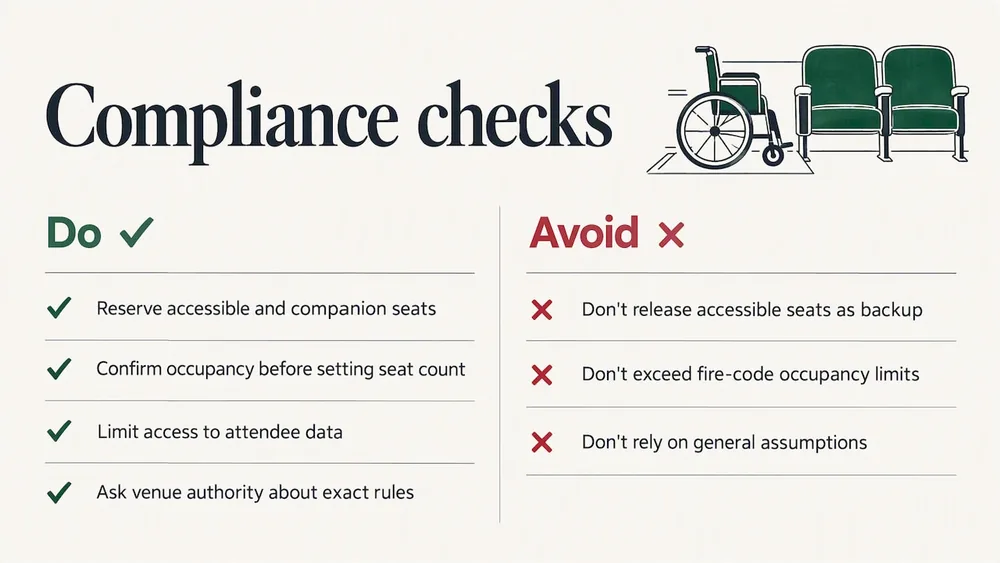
Accessibility and safety rules vary by country and by venue, so treat your local building code and accessibility law as the authority, not a general guide. In most jurisdictions, venues are required to reserve a set number of wheelchair-accessible seats along with adjacent companion seating, and these seats must stay out of general sale inventory rather than being released as a backup when the house fills up.
Fire code and occupancy limits set the hard ceiling on how many tickets you can ever sell, regardless of how many seats your chart shows. Confirm your venue's current occupancy certificate before finalizing your saleable seat count from the capacity audit above, since that number can change if the venue has made renovations since your last recital.
Privacy rules around collecting attendee information, especially for minors, also apply during registration. If you're gathering costume sizes, photos, or accessibility needs at checkout, store that data the same way you'd store any other family information, with clear limits on who can access it and why. When a specific rule affects your show, the venue's accessibility coordinator or your local building authority is the right place to confirm the exact requirement rather than relying on a general industry assumption.
Marketing and promotional tools specific to dance recitals (email campaigns, social media integration)
Recital ticket sales respond well to a short, structured promotional calendar rather than one big announcement. Start with an email to performer families announcing the priority window, since they're the audience most likely to buy immediately and fill your early inventory.
Segmented email campaigns work better than a single blast: one message for performer families with their priority link, a second for the general public once public sales open, and a reminder email a few days before each show for anyone who hasn't claimed a seat yet. Pair that with social media posts timed to each phase, a countdown post before public sales open and a "seats remaining" post if a show is selling toward capacity.
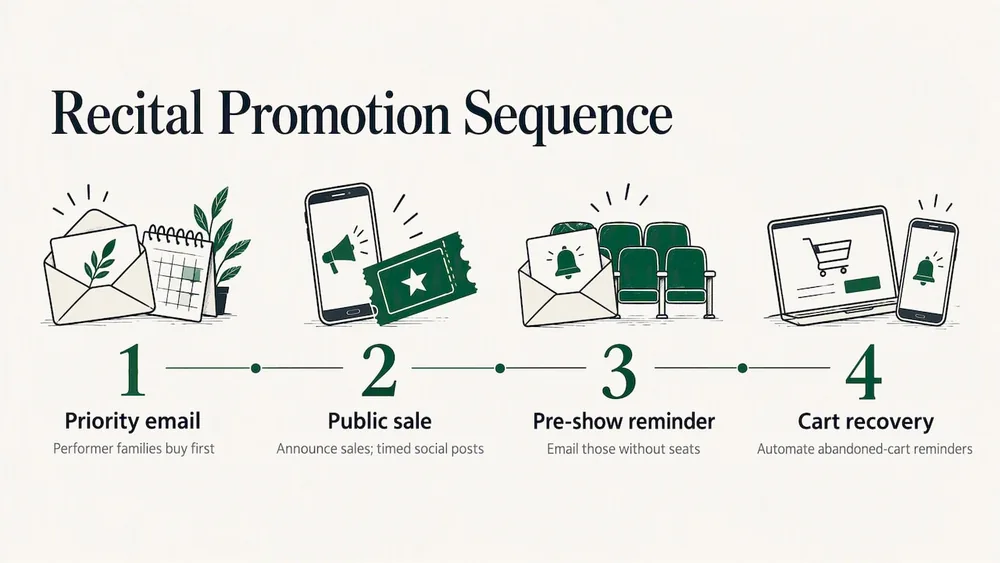
Cart-recovery messaging also matters more for recitals than most events, since parents often start checkout, get interrupted by a child, and never finish. An automated reminder to complete an abandoned purchase can recover a meaningful share of otherwise-lost sales without any extra staff time.
Customer support options and responsiveness during the sales and event days
Support needs spike at key moments, including during a public on-sale and before doors open on show night. Both moments need a different kind of help than a general contact form.
During sales, fast answers about seat selection errors, duplicate charges, or promo code issues prevent a frustrated parent from giving up on the purchase entirely. On show night, support needs shift to scanning failures, lost tickets, and will-call questions, which means your front-of-house team needs a direct line to whoever manages your ticketing platform rather than a generic email queue.
We offer on-site support for events in Canada and the United States for studios that want a technical team physically present on show night, along with done-for-you setup beforehand so your seating chart and scanning devices are tested before doors open. Our help guides also cover common scanning and checkout issues for studios handling support in-house.
Mobile ticketing and contactless entry options
Printed tickets are increasingly optional for recitals, and most families now expect to show a ticket on their phone at the door. Mobile tickets reduce the chance of a lost paper ticket becoming a last-minute crisis and let families forward a ticket to a relative without printing anything.
Contactless entry through QR or barcode scanning speeds up the door line significantly compared to checking names against a printed list, which matters most in the ten minutes before curtain when every family arrives at once. Offline-capable scanning is non-negotiable here, since many venues, especially school auditoriums and community theaters, have unreliable WiFi.
Mobile wallets add another layer of convenience: a ticket saved to a phone's wallet app doesn't require opening an email or app at the door, which cuts down on the fumbling that slows entry lines. If you're running multiple shows across a weekend, mobile tickets also make it easier for families to tell which show they're holding a seat for, since the ticket displays the show date and time directly on the phone screen rather than requiring a glance at a printed program.
Options for group sales or family packages specific to dance recital audiences
Recital audiences are built around extended families, not solo attendees, so group pricing structures matter more here than at most ticketed events. Extended families often attend together, and your ticket limits and pricing should reflect that reality rather than a one-ticket-per-person default.
Family package pricing, a bundled rate for seats bought together, can reduce the per-seat cost slightly while still protecting your margin, and it simplifies checkout for a parent buying for the whole extended family in one transaction. Group seating blocks, where a cluster of seats is held together rather than scattered across the house, also matter for recital families who want to sit together rather than split up.
Sliding ticket limits by dancer age, covered earlier in sales strategy, double as an informal group-sizing tool: larger young-performer families may need a group block, while older teen groups may need less seating flexibility. Building your seating chart with adjustable group blocks, rather than fixed pairs, gives you room to accommodate both without redesigning your chart mid-sale.
What studio owners underestimate about recital ticketing
The biggest mistake we see studios make isn't choosing the wrong platform, it's treating ticketing as a short-term task instead of a season-long one. Seat maps, pricing tiers, and performer allocations need to be locked in well before the first email goes out, not improvised the week sales open.
If you're switching tools, run one recital as a pilot season before committing fully. And whatever platform you choose, lead with clarity on pricing. Families forgive a lot, but not a surprise fee at checkout.
Frequently Asked Questions
What is the best ticket app for concerts?
The best choice depends on whether you need reserved seating, offline scanning, and multi-show management, since general concert apps don't always support recital-specific needs like performer ticket allocations. Look for a platform built around reserved seating and transparent fees rather than a generic ticketing app, since dance-specific needs differ from a single concert sale.
Do you bring gifts to a dance recital?
Bringing flowers or a small gift for a performer after a recital is a common tradition in many dance communities, though it isn't required. Many families choose to bring flowers to present after the show rather than during it, so the gesture doesn't interrupt the performance.
What are some famous dance companies?
Well-known dance companies vary widely by style and country, spanning ballet, contemporary, and cultural dance traditions around the world. Rather than a single definitive list, most dancers and studio owners reference companies specific to their discipline and region.
How much do dance instructors charge per hour?
Dance instructor rates vary significantly by region, experience level, and class type, with no single standard rate across the industry. Studios typically set rates based on local market conditions and instructor credentials rather than following a fixed national figure.
How much should dance recital tickets cost?
Recital ticket prices commonly fall between $16 and $38, with reserved seating typically priced about 30% higher than general admission.
Sources
Tags
Ready to simplify your events?
Join hundreds of organizers, studios, and festival directors who trust Eventist to run their events.