How to Set Up Your Own Event AV: Renting the Gear, Planning the Power and Running Sound Without a Production Company
Steps at a glance
- Size the system to the crowd. Match speakers, subs and coverage to attendance and venue type, and decide whether a rental package or a production company fits the event.
- Build the rental list. Specify mains, subs, mixer, microphones, DI boxes, monitors, cabling and lighting, and reserve the gear six to eight weeks out.
- Plan and map the power. Calculate the load per circuit, place generators or distribution boxes, route cable runs, and mark it all on a site map hidden from attendees.
- Set up in the right order. Power first, then PA, then line check, then lighting and video, then a full sound check with the first act's inputs.
- Run the show from a checklist. Track every task from load-in to strike with an owner and a deadline, and mark stations done on the live map as crews finish.
Audio-visual is the line in an event budget that swings most: a production company quote for a two-stage weekend can rival the entire artist budget, while a rented PA and a competent volunteer can cover a community festival for a fraction of it. This third article in the How to Run Profitable Events series is a guide to event AV setup you do yourself: what to rent for your crowd, how to plan the power and map it, the set-up order that prevents show-day surprises, and the honest line past which you should hire a production company. Electrical work has real safety and permit implications; this is general guidance, not a substitute for a licensed electrician or your local electrical safety authority.
Key takeaways
- Under about 1,500 people on a single stage, renting a PA and running it yourself is realistic; above that, or with two stages running at once, a production company's crew earns its fee.
- The rental list is short and standard: mains, subs, a mixer, microphones, DI boxes, monitors, a stage snake or digital stagebox, cabling, stands and basic lighting.
- Power is where DIY events fail: plan the load per circuit, place distribution boxes and cable runs on a map, and keep that map off the public site.
- Set up in order (power, PA, line check, lights and video, sound check) and the day runs; set up in whatever order the truck unloads and it does not.
- Everything from generator delivery to strike is a task with an owner, and the site map is where crews should be able to see what is done.
Decide: rent and run it yourself, or hire production
Three questions decide it:
1. How many people, and where? A PA for 300 people indoors is two powered speakers on stands and a subwoofer. For 1,500 people outdoors it is a small line array or a pair of large mains with subs, and someone who knows how to aim them. Past that, coverage, delay towers and stage volume become an engineering job.
2. How many stages, and do they overlap? One stage with breaks is manageable; two stages running simultaneously need two crews and a plan for bleed.
3. What do the artists need? A singer-songwriter needs two inputs. A six-piece band with a drummer needs twenty, monitor mixes and a soundcheck. A DJ needs a table, power and two channels. Ask every act for a stage plot and input list before you decide.
If you rent, ask the rental house for a package quote for your attendance and venue; most have a "300-person" and "1,000-person" outdoor package, and they will tell you if what you are asking for is below what you need.
The rental list
For a single outdoor stage up to about 1,000 people:
- Mains: two powered speakers (12- or 15-inch) on stands for smaller crowds, or a pair of larger mains or a compact line array for bigger ones.
- Subwoofers: one or two powered subs; skip them only for speech-only events.
- Mixer: a digital mixer with enough inputs for your largest act plus four spare, with an iPad app so you can mix from the crowd.
- Microphones: vocal dynamics (the standard is the Shure SM58 or equivalent), a kick and snare mic if there is a drummer, a pair of overheads, and a couple of instrument mics.
- DI boxes: two to four, for keyboards, acoustic guitars, DJs and laptops.
- Monitors: two to four wedges, or an in-ear system if the acts bring their own.
- Stage snake or digital stagebox: so the mixer can sit in the crowd rather than on stage.
- Cabling: XLRs (more than you think), speaker cables, power cables, and cable ramps for every crossing.
- Stands, clips, gaffer tape, a headlamp, spare batteries, a multi-tool.
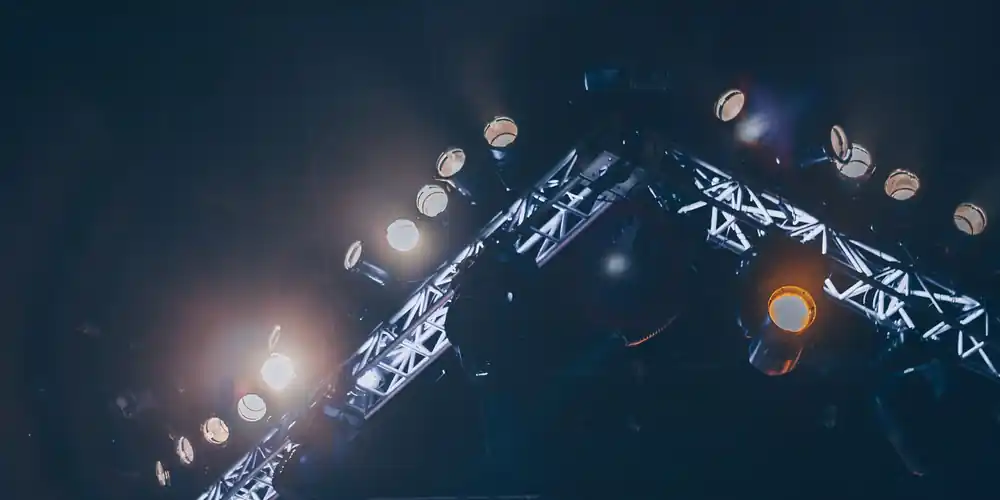
- Lighting: for evening shows, a few LED wash fixtures on a pair of stands and a small controller; anything more is a lighting designer's job.
- Video for conferences: a projector or LED screen sized to the room, a switcher or capture device, a confidence monitor, and a wireless lav and handheld for speakers.
Reserve six to eight weeks out for summer weekends, and pick the gear up the day before so you can test it in a driveway.
Plan the power before you plan anything else
Every piece of the list above needs power, and outdoor sites rarely have enough of it where you need it.
Calculate the load. Add up the rated draw of everything on each stage: powered speakers and subs (check the label; a large powered sub can draw 10 amps or more on peaks), the mixer, lighting, the DJ table, the merch tent's card readers and the food vendors' equipment, which is often the largest load on the site. A standard 15-amp circuit is safely loaded to about 12 amps continuous; a 20-amp circuit to about 16. Audio and lighting should never share a circuit with refrigeration or cooking equipment, because a compressor kicking in during the headliner is how you get a hum, a brownout or a trip.
Choose the source. Venue power with enough dedicated circuits is ideal. Otherwise, rent a generator sized with headroom (a common mistake is sizing to the average draw rather than the peak) and a distribution box that splits its output into protected circuits. Inverter generators are quieter and cleaner for audio. Place generators downwind, away from the audience, with fuel stored safely and a refuel schedule.
Route the cables. Plan every run from source to stage, vendor row and lighting position. Cable ramps at every crossing where people or vehicles pass, cables off the ground or covered where they cannot be ramped, and no daisy-chained power bars.
Know when it needs a permit or an electrician. Temporary electrical installations at public events are regulated provincially (the Electrical Safety Authority in Ontario, Technical Safety BC, and their counterparts), and generator hookups, distribution above a certain size and anything connecting to a building panel typically require a licensed electrician and may require a permit or inspection. The event permits guide covers where electrical fits in the permit list.
Map it. Draw the power plan on the site map: generator positions, distribution boxes, each cable run, every ramp, and the load on each circuit. Share it with the crew, the vendors who need power and the fire and electrical inspectors if they ask, and keep it off the public map. Eventist's festival map builder does this in the same map attendees use: operational markers for generators, power drops and cable runs are flagged as hidden from the public, so staff see the electrical plan and attendees see the stages and the food.
Set up in the right order
1. Site and power first. Generators placed and fuelled, distribution set, cable runs laid and ramped, every circuit tested with a plug tester before a single speaker is connected.
2. Stage and PA. Mains up on stands or a truss, subs placed (together in the middle for even low end, or one each side if the stage layout forces it), mixer position set, snake run, monitors in place.
3. Line check. Every input from the stage plot patched and checked for signal at the mixer, one at a time, with the input list taped to the desk.
4. Lighting and video. Fixtures aimed, controller tested, projector focused and the first slide up.
5. Sound check. The first act's inputs set, monitor mixes built, the system walked at show level from the front, the sides and the back. Then the ambient volume check with the nearest neighbours in mind, because the noise limit in your permit is measured at the property line, not the mixer.
6. Changeovers. A printed or on-phone run-of-show with set times, changeover lengths and who does what; a stage manager who owns the clock; and the next act's inputs patched while the current one plays.
Every one of these is a task with a person and a time. Eventist's task board takes checklists, attachments (the stage plots and input lists) and due times, and the festival map's markers can be linked to tasks and marked done from the live map, so the crew lead can see at a glance that the generator is fuelled, the main-stage power is tested and the ramps are down without radioing each one.
Common mistakes
- Underpowered subs and overpowered tops, which sounds thin and loud at the same time; balance the system.
- The mixer on stage, where you cannot hear what the audience hears; run a snake.
- No spare cables, batteries or a backup vocal mic. Something will fail.
- Vendors on the audio circuit. A deep fryer and a subwoofer do not share.
- Cables across a path without ramps. This is the injury that ends the event.
- No neighbour plan. Measure at the property line, know your permit's limit and the cut-off time, and tell the headliner before they start.
- Skipping the driveway test. Every rental should be powered up and checked the day before, at home, where the rental house is still open.
When to hire a production company
Hire production when any of these are true: more than about 1,500 people on a stage, two stages running at once, a touring act with a technical rider you do not fully understand, a venue that requires union or certified crew, a show that needs a lighting designer or video wall, or a permit that requires a licensed electrical contractor for the temporary installation. A good middle path is to rent the gear and hire one experienced sound engineer for the day; a freelance engineer costs far less than a full production quote and turns a rented system into a professional one.
Frequently Asked Questions
What AV equipment do I need for an outdoor event?
For a single stage up to about 1,000 people: two mains (or a compact line array), one or two subwoofers, a digital mixer, vocal and instrument microphones, DI boxes, two to four monitor wedges, a stage snake or digital stagebox, cabling and cable ramps, stands, and basic LED lighting for evening shows. Ask each act for a stage plot and input list to size the mixer and microphone count.
How much does it cost to rent event sound equipment?
Rental packages for a few hundred people typically run in the low hundreds of dollars a day, and outdoor packages for around a thousand people in the high hundreds to low thousands, before delivery and an engineer. A production company quote for the same event, with crew, is usually several times the rental price, which is the margin a competent DIY setup keeps.
How do I plan power for an outdoor event?
Add the rated draw of every device on each circuit, keep continuous loads to about 80 percent of the circuit rating, separate audio and lighting from refrigeration and cooking, size generators to peak draw with headroom, ramp every cable crossing, and draw the whole plan on a site map. Anything connecting to a building panel or above a small distribution size typically needs a licensed electrician and may need a permit or inspection.
Do I need a permit for a generator or temporary electrical at an event?
Often, yes. Temporary electrical installations at public events are regulated provincially, and municipalities may require electrical details as part of the special-event permit. Confirm with your provincial electrical safety authority and your municipality; this guide is general information, not legal advice.
How do I keep track of an AV setup?
Break load-in to strike into tasks with an owner and a time: power, PA, line check, lighting, sound check, changeovers, strike. Attach stage plots and input lists to the tasks, mark map stations done as crews finish, and keep the power map hidden from the public site. Eventist's task board and festival map are built for exactly that.
The series
This is part three of How to Run Profitable Events. The rest of the series: grants and funding, vendors and sponsorship packages, hiring event security, event permits and booking performers. For the platform side, see festival ticketing software and the festival operations guide.
Tags
Ready to simplify your events?
Join hundreds of organizers, studios, and festival directors who trust Eventist to run their events.