Dynamic Ticket Pricing for Events: How It Works and When to Use It
Dynamic ticket pricing means the price of a ticket can change after sales open, based on new information such as demand, remaining inventory or time until the event. For an organizer, the practical question is not whether the idea is clever but whether your event has enough demand, enough data and enough audience goodwill to make it pay. This guide covers how dynamic pricing differs from fixed prices and early-bird tiers, the models that suit general admission and reserved seating, the guardrails that protect your reputation, what the evidence says about revenue, and how to test a price change honestly.
TL;DR
- Dynamic pricing revises prices as demand information arrives. Early-bird tiers and other variable pricing set different prices in advance and leave them fixed.
- It works best with scarce inventory, clear demand signals and a buyer base that accepts that prices move. Small community events usually gain more from simple tiers.
- Set a floor, a ceiling, a human override and a public explanation of the policy before the first ticket sells.
- Published studies report revenue gains from under 1% to several percent, mostly in sports. Treat them as ranges to test against, not promises.
- Under a percentage fee, higher prices raise your fees. Under a flat per-ticket fee, they do not.
What dynamic ticket pricing actually is
A fixed price stays the same from first sale to door. Variable pricing, as sports economists define it, assigns different prices to pre-set categories in advance, for example a premium price for a popular fixture and a lower one for a weaker fixture, announced before sales begin. Dynamic pricing goes further: it allows prices to be revised as new information or demand conditions evolve.
The same researchers make a point organizers should take seriously: what matters is the operational definition, not the label. Ask whether revisions are automatic, discretionary or both, and what information triggers them. A person who raises prices by hand after a sell-out weekend and an algorithm that reprices hourly are both "dynamic", but they carry very different risks and workloads.
How it differs from early-bird tiers
Early-bird pricing is a schedule. You decide in advance that the first 200 tickets cost one amount, the next 500 another, and the last tickets a third. Every buyer can see the ladder, and nothing changes unless you change it. Dynamic pricing breaks the schedule: the third tier might open early because the first two sold in a day, or the price might drop if sales stall three weeks out.
In practice most organizers sit on a spectrum:
| Approach | Who decides the price | When prices change | Typical fit |
|---|---|---|---|
| Single fixed price | Organizer, once | Never | Community events, workshops, small gigs |
| Early-bird and tiered release | Organizer, in advance | On a published date or quantity | Festivals, conferences, most concerts |
| Variable pricing by event or seat zone | Organizer, in advance | Per show or per section | Venues with a season of different shows |
| Rule-based dynamic pricing | Organizer sets rules, system applies them | When a trigger is hit | Large concerts, sports, popular venues |
| Fully automated dynamic pricing | Algorithm within limits | Continuously | Very high volume, high demand events |
For most Canadian festivals, conferences and independent venues, the middle three rows deliver most of the benefit with a fraction of the complexity.
Which signals move a ticket price
The data you can use depends on the event, but the categories repeat. Sports teams have published the clearest lists: team performance, opponent record, day and time, weather, inventory and sales velocity were all named as inputs when one NBA club moved to dynamic pricing. Ticket marketplaces describe a similar set from the organizer's side: website traffic, sales velocity and waitlists, plus outside inputs such as competitor pricing or trending content.
Translated for the events this guide covers:
- Sales velocity. Tickets sold per day against the pace you planned. This is the most reliable internal signal.
- Remaining inventory. Sections or ticket types that are nearly gone justify a different price from sections with hundreds of seats left.
- Time to event. Demand often has a predictable shape: a launch spike, a quiet middle, a late rush.
- Demand indicators before sale. Waitlist sign-ups, presale registrations, page visits and email click-through.
- Context. Day of week, headliner announcements, competing events in the same city, weather for outdoor shows.
One analyst framing is useful here: the model's output is a pricing curve, not a pricing decision. The curve is evidence. You still decide whether to follow it.
If you do not know whether you are ahead or behind plan, start there. A ticket sales pace calculator shows whether your current rate will fill the room, which is the question most price changes are really answering.
Models for general admission and reserved seating
The models below are the common ways organizers structure a price that moves. They are working patterns rather than a rulebook, so adapt the thresholds to your own sales history.
General admission
General admission tickets are interchangeable, so the lever is quantity and time.
1. Quantity-triggered tiers. Release 300 tickets at the first price, then move to the next price when they sell out, whatever the date. This is dynamic in spirit because demand, not the calendar, sets the pace, and buyers can see the tier counter.
2. Time-and-pace rules. Hold the price while you are on plan. If sales run well ahead of plan, advance to the next tier. If they lag by a set margin, run a limited promotion rather than a quiet price cut.
3. Last-chance pricing. Move to a day-of price at a fixed point, such as 48 hours out, so buyers who waited have a predictable cost.
Reserved seating
Reserved seating adds a second dimension: each seat has its own value. A seat map lets you assign price zones, and you can then move those zones independently.
1. Zoned base prices. Front-centre, side and rear sections get different base prices, set before sales open.
2. Zone-level movement. Raise the price of a zone when 70 to 80% of it has sold, and leave weaker zones alone. This stops a sold-out stalls section from dragging up the price of a half-empty balcony.
3. Show-by-show pricing. A venue with a season can price each night differently: a Saturday headliner and a Tuesday comedy night should not share a ladder.
4. Held inventory. Keep a share of seats at the base price for loyal or price-sensitive buyers. This is also a recommendation from experienced festival ticketing professionals, discussed below.
A worked example
Take a 2,000-ticket general admission concert with a planned average price of $55. Compare a single fixed price with a three-step ladder that advances by sales pace:
| Scenario | Tickets | Price | Revenue |
|---|---|---|---|
| Fixed price | 2,000 | $55 | $110,000 |
| Ladder: tier 1 | 500 | $45 | $22,500 |
| Ladder: tier 2 | 1,000 | $55 | $55,000 |
| Ladder: tier 3 | 500 | $70 | $35,000 |
| Ladder total | 2,000 | $112,500 |
The ladder earns $2,500 more, or about 2.3%, if the room still sells out. That is a plausible size of gain, in line with the study ranges below, and it shows the catch: if the $70 tier stalls, the upside disappears. This is an illustration with invented numbers, not a forecast.
What the evidence says about revenue
The research is real but mostly from sports, where venues are fixed, seasons are long and data is plentiful.
- A quasi-experimental study of the NFL found that variable pricing raised primary-market ticket sales by 1.59% per game, and lower prices for less attractive games were well received.
- A 2017 study of soccer pricing by Şahin and Erol reported that dynamic models could raise total revenue by roughly 0.76 to 8.95 percent compared with static pricing.
- Vendor and marketplace sources quote larger numbers. One ticket marketplace says dynamic pricing can lift revenue by up to 24% per available seat, and a sports analytics firm reports a 27 percent increase for high-demand games for one team using forecasting across more than 50 variables. These come from companies that sell pricing or marketing services, so read them as upper bounds.
The sensible planning assumption for an independent promoter is a single-digit percentage gain on events with real demand pressure, and nothing on events that do not sell out.
Drawbacks and when to avoid it
The same sources that cite gains also name the costs: customer frustration, confusion and perceived unfairness when the strategy is not managed openly. Sports economists add that fairness concerns can weaken trust or change future buying behaviour, which matters most for events that depend on repeat attendance, such as a local festival or a venue's regular series.
The backlash can be public. Some artists opt out of dynamic pricing entirely to avoid blowback and keep control of the fan experience. That is worth asking the artist or their agent before you plan a ladder around their show.
Dynamic pricing is usually a poor fit when:
- the event is small and rarely sells out, so there is no scarcity to price;
- your audience is a close community, such as a nonprofit gala or a neighbourhood event, where a visible price jump costs more goodwill than it earns;
- you do not have past sales data to set a sensible starting range;
- nobody on staff can monitor prices during the on-sale.
Set it up with guardrails
The professional guidance is consistent. Ticketing specialists who priced a major festival season recommend pre-set minimum and maximum prices to prevent extreme swings, human oversight so pricing can be paused or adjusted in sensitive periods such as emergencies, and a portion of inventory kept at base price for loyal or price-sensitive audiences.
A practical setup checklist:
1. Build a starting ladder from comparables. Use your own past sales, and where possible pooled data from similar shows. Pre-on-sale forecasting from comparable events gives a defensible starting price ladder.
2. Set the floor and the ceiling. The floor protects your margin and the ceiling protects your reputation. Write both down before launch.
3. Define your triggers. For example: advance a tier when sales are 20% ahead of plan for three consecutive days.
4. Name an owner with override authority. One person can pause pricing without a committee.
5. Check your ticketing system can apply changes. Confirm how tier changes, price edits and seat-zone pricing work, and how refunds work for buyers who paid an earlier price.
6. Write the policy for buyers. See the next section.
Tell buyers what you are doing
Best practice is to tell customers from the start what the pricing policy is and why prices may vary. A short line on the event page works: prices are released in stages, and later stages may cost more.
Regulators are moving the same way, though rules differ by country:
- In the United Kingdom, the Competition and Markets Authority secured commitments from Ticketmaster in September 2025 on 24-hour advance notice for tiered pricing and clearer information on price ranges and availability during online queues.
- In Poland, the consumer authority required a ticket seller to include mandatory fees in displayed minimum prices, and called showing the full minimum price from the start a market standard.
- In the United States, the House-passed TICKET Act would require total price disclosure when a price is first shown, with an itemized base price and fees before purchase. In Washington State, a 2023-24 bill report proposed limiting surge pricing to 10 percent above face value.
These are examples of direction, not Canadian rules. Consumer protection and advertising rules differ across provinces and change over time, so check the current requirements for where you sell. This is general guidance, not legal advice; a lawyer who handles consumer or event law can confirm what applies to your event.
The simplest safe habit is to show the all-in price, including fees, from the first screen.
Test whether a price change worked
A price change that coincides with a rise in sales proves nothing. Marketing, an announcement or a holiday may have done the work. To judge a change fairly:
1. Record the baseline. Before any change, note daily sales, average price, conversion rate from page view to purchase and the share of abandoned carts.
2. Change one thing at a time. Move one tier or zone, not the whole ladder, and keep marketing spend steady that week.
3. Compare against plan, not against yesterday. Use the pace you forecast. Revenue per day, tickets per day and average order value each tell a different story.
4. Watch the tail. Look at refund requests, support emails and social comments for a week after a rise.
5. Ask buyers. Venue operators recommend surveys and focus groups to check pricing against how audiences perceive value. Feedback of this kind also feeds revenue strategy more broadly, as this look at customer feedback and revenue growth argues.
For a deeper look at the funnel itself, our guide on how to increase event ticket sales covers the steps that come before pricing is the bottleneck.
Why the fee model matters when prices move
If your platform takes a percentage of each ticket, dynamic pricing raises your fees along with your revenue. A flat fee per paid ticket does not move when the price does.
Eventist prices event ticketing at a flat fee per paid ticket. As of October 2026, per the Eventist pricing page, Canadian organizers pay $0.85 CAD per paid ticket for event ticketing, $4.99 CAD per paid ticket for festivals and conferences, and $9.99 CAD per paid ticket for competitions. Card processing fees are paid separately to Stripe or Square at their own rate.
Here is the arithmetic for the 2,000-ticket example above, using a hypothetical 3% platform fee purely as a comparison point:
| Hypothetical 3% fee | Flat $0.85 CAD per paid ticket | |
|---|---|---|
| Fixed price, $110,000 | $3,300 | $1,700 |
| Ladder, $112,500 | $3,375 | $1,700 |
| Extra cost of the ladder | $75 | $0 |
The flat fee is lower in both cases. The crossover for a 3% fee is about $28.33 per ticket, since $0.85 divided by 0.03 is roughly $28.33. Above that price the flat fee is cheaper, which is why Eventist is usually cheaper for mid- and higher-priced tickets. It is not always cheaper: at the festival and conference rate of $4.99 CAD, a 3% fee would be lower on tickets under about $166, so compare against your actual quotes. To run your own numbers, use the ticketing fee comparison calculator or read how ticketing fees are structured.
Venues are priced differently. Venues pay 0.5% to 1.9% of what they charge on everything they sell, single tickets included, so a flat per-ticket comparison does not apply to them.
Our perspective
We work with organizers who run festivals, conferences, trade shows, venues and everyday ticketed events, and the pattern we see is that pricing problems are rarely algorithm problems. They are visibility problems. An organizer who cannot see how many tickets sold yesterday, in which section, at which price, cannot price dynamically however sophisticated the tool.
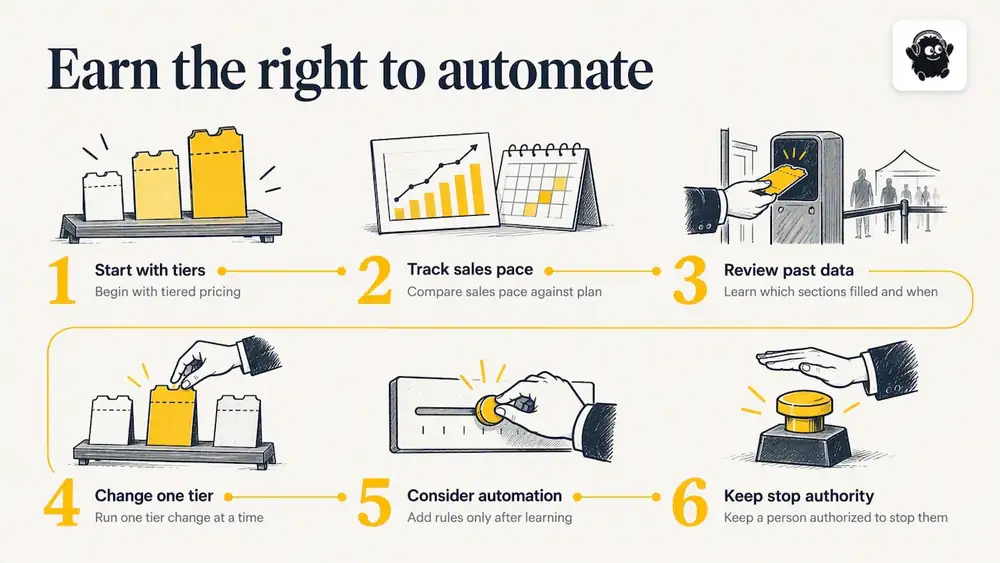
So our advice is to earn the right to automate. Start with tiers. Watch sales pace against plan. Use check-in and door data from the last event to learn which sections filled and when. Run one tier change at a time. Only then consider rules that move prices on their own, and keep a person with the authority to stop them.
We also think the fee model deserves attention before the pricing model. A platform that takes a share of every ticket quietly rewards itself for the price rises you put your audience through. We prefer a flat fee per paid ticket, so your pricing decisions are about your audience and your costs, not your platform's cut. And because a price change is only as good as the sales funnel behind it, we build tools for the whole event, not only the sale: seat maps, registration, QR check-in from any phone, a built-in point of sale for door sales, and abandoned-cart recovery emails for buyers who left at the payment step.
Where Eventist fits
If you are planning tiered or seat-zone pricing, Eventist lets you sell general admission and reserved seating with seat maps, send abandoned-cart recovery emails and SMS reminders, and take door sales through a built-in point of sale, all in one system. Organizers also get setup help from a Canadian team. See the event ticketing page for how it works, or the pricing page for current rates.
Frequently Asked Questions
Does Ticketmaster use dynamic pricing?
Ticketmaster has used dynamic pricing for some high-demand events, and its handling of one 2024 on-sale drew regulatory attention in the UK. In September 2025 the UK Competition and Markets Authority secured commitments on advance notice for tiered pricing and clearer price information during queues. Whether it applies to a given event is set per event, so check the listing.
Can artists opt out of dynamic pricing?
In practice, yes: some artists choose to opt out to avoid backlash and keep control of the fan buying experience, according to academic analysis of the concert ticketing industry. If you promote an artist's show, raise it in the contract stage. This is general guidance, not legal advice, so have a lawyer review the terms of any artist agreement.
Is dynamic pricing the same as early-bird pricing?
No. Early-bird pricing follows a schedule you publish in advance. Dynamic pricing lets prices be revised as demand information arrives, either by rules or by an algorithm. Many organizers use quantity-triggered tiers as a middle path.
How much can dynamic pricing raise revenue?
Published academic estimates are modest: about 1.59% more sales per game in an NFL study and roughly 0.76 to 8.95 percent in a soccer pricing study. Results depend on demand, and an event that does not sell out has little to gain.
What should I tell buyers about changing prices?
State the policy up front: that prices are released in stages or may change, and why. Show the full price including fees from the first screen, and tell buyers early if prices will rise.
Sources
- Ticket Pricing and Attendance, Sports Economics
- Trail Blazers tweak ticket policy, OregonLive
- Event Ticket Pricing Strategies, TickPick
- Concert Ticket Sales Data: Dynamic Pricing for Promoters
- Scoring a Touchdown with Variable Pricing, SSRN
- A Dynamic Ticket Pricing Approach for Soccer Games, MDPI
- Top 5 AI Strategies for Dynamic Ticket Pricing, Playbook
- Problems Facing the Concert Ticketing Industry, LMU
- Taking a Holistic Approach to Pricing Tickets, ACCESS
- Even Pricing at MGM Requires the Human Touch, ACCESS
- UK CMA secures changes from Ticketmaster, ICPEN
- A commitment and a fine, UOKiK
- Congressional Record, 14 May 2024
- Washington House Bill Report 1648, 2023-24
Recommended
Tags
Ready to simplify your events?
Join hundreds of organizers, studios, and festival directors who trust Eventist to run their events.