Timed Entry Ticketing: How It Works and How to Set It Up
Timed entry ticketing means each ticket is valid for a specific arrival window, such as 10:00 to 10:30, and each window has a fixed number of places. Guests book a slot, you control how many people arrive at once, and the line at the door shrinks or disappears. It suits attractions, exhibitions, light trails, tours, trade show halls and festival areas with a hard capacity limit. This guide covers how to choose slot lengths, set capacity, price by slot, run check-in and avoid the mistakes that cause queues anyway.
TL;DR
- Timed entry sells a set number of places for each arrival window, so demand is spread across the day instead of piling up at opening.
- Fifteen-minute slots give the tightest control for high-volume sites. Thirty-minute slots are usually enough for lower-touch events.
- Slot capacity should be set by what your entrance, staff and interior can absorb, not by total site capacity alone.
- Pricing by time slot is more precise than pricing by day, but it must be explained clearly to guests.
- Your ticketing platform needs per-slot inventory, fast QR scanning and a way to sell remaining places at the door.
What timed entry ticketing means
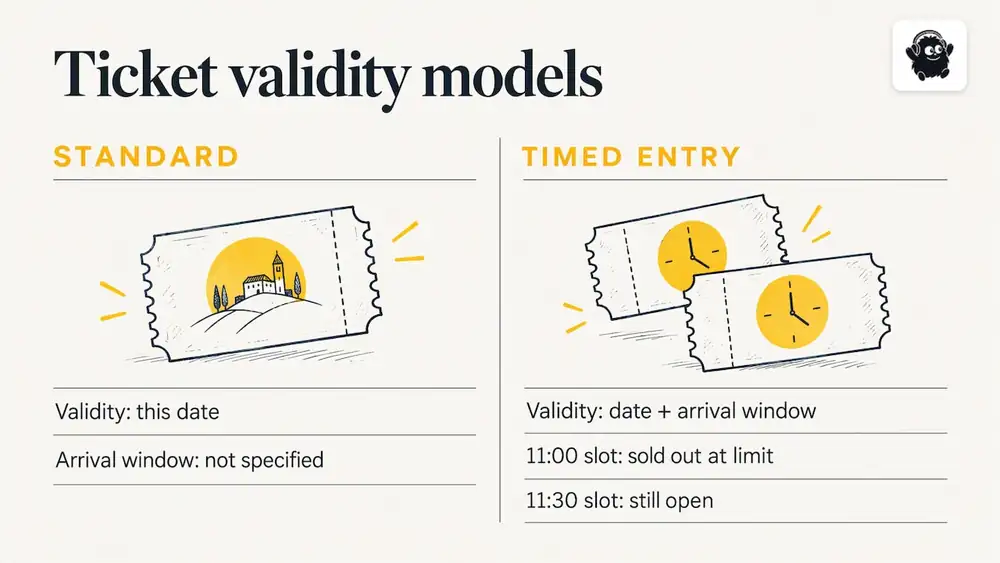
A standard ticket says "valid on this date." A timed entry ticket says "valid on this date, arriving within this window." Each window is its own inventory. When the 11:00 slot reaches its limit, it shows as sold out while 11:30 stays open.
The model comes from places where crowding is the main risk. In Canada, the best-known public example is access to Lake Louise and Moraine Lake in Banff National Park, where a reservation is required for all Parks Canada shuttles and seats typically sell out well in advance. Museums, aquariums and galleries use the same logic, and so do night markets, holiday light displays and multi-day festivals that want to control gate surges.
The benefit is not only safety and comfort. Guests who know when they will get in plan their day around it. They arrive later, spend more on site and are less likely to give up at a long queue.
Why organizers choose it
Three problems push organizers toward slots.
1. Opening-hour surges. Everyone arrives at once, the entrance jams and the first 20 minutes of the experience are wasted.
2. Hard capacity limits. Fire codes, venue licences, exhibit size or staffing set a ceiling you cannot exceed at any moment.
3. Uneven days. Midday is packed, early morning and late afternoon are empty, and staffing costs stay the same.
Research on public lands shows the idea can be accepted by guests. In a study of a pilot at Arches National Park, where visitation rose 74% between 2011 and 2021, researchers compared visitor perceptions before and during a timed entry pilot. The pilot ran for six months, and managed access was applied daily from 06:00 to 17:00. The paper's wider finding is that visitors tended to support advance reservations more than other restrictive measures, which suggests that a clearly explained slot system can read as a better experience rather than a restriction.
That acceptance depends on how you present it. Tell guests why slots exist (shorter lines, a less crowded interior), show remaining availability and make rebooking easy. If your audience is used to booking appointments online, for example with something as simple as a Google Calendar appointment schedule, the habit of choosing a time is already familiar. Your job is to make choosing one for an event equally quick.
Choosing slot length
There is no single correct interval, but there are two common ones. Operational research on attraction management points to 15-minute and 30-minute intervals as the usual choices. A pilot at the Kaiyukan aquarium in Osaka, which used pre-sold tickets to reduce congestion imbalances, identified 15-minute intervals as the most advantageous for smooth visitor inflow at a high-volume site.
| Slot length | Best for | Trade-off |
|---|---|---|
| 15 minutes | High-volume attractions, light trails, busy exhibitions | More slots to manage, more scanning staff at peak |
| 30 minutes | Open-day events, tours, trade show halls, smaller venues | Larger arrival clumps inside each window |
| 60 minutes | Guided experiences with a fixed start and long dwell time | Weak crowd smoothing at the gate |
A practical rule: pick the shortest interval your entrance staff can handle without guests waiting. If one scanner clears roughly 10 guests a minute, a 15-minute slot of 150 places will already queue. Match the interval to throughput, then set capacity.
Setting capacity per slot
Site capacity and slot capacity are different numbers. Use this sequence.
1. Start with the maximum on site at one time. This comes from your venue licence, fire code or exhibit limits. Confirm it with the venue and local authority. Permits, safety and insurance rules vary by municipality, and this article is general guidance, not legal advice.
2. Estimate how long guests stay. If the average visit is 90 minutes and your limit is 600 people, you can admit roughly 600 across each 90-minute period, not 600 every slot.
3. Divide by slots in the stay period. With 30-minute slots, that is about 200 per slot, before any buffer.
4. Hold back a buffer. Keep 5% to 10% of each slot unsold for accessibility needs, comps, partners and late corrections.
5. Cap the entrance, not just the building. If two doors each handle 120 guests per half-hour, a slot of 300 will back up whatever the interior can hold.
Review real data after the first weekend. Dwell times are almost always different from the estimate, and slot capacity can be adjusted for later dates.
Pricing by slot
Timed entry lets you price different windows differently. Research summarized from the Kaiyukan study indicates variable pricing works noticeably better when it is set per time slot instead of per day, because it moves guests more precisely and smooths flow across the whole operating day.
Options that organizers use:
- Off-peak discounts for early morning or late afternoon slots.
- Peak premiums for the most requested evening window at a light trail or night market.
- Early-bird tiers for the first release of dates, followed by standard pricing. A Wharton study of price tiers examines how tiers shape advance purchasing of event tickets.
Be careful with last-minute discounts. Secondary-market research on baseball tickets shows that prices tend to decline as game day approaches, which is a reminder that guests learn to wait if they expect a drop. If you sell primary tickets by slot, release inventory in stages and avoid a pattern that trains your audience to hold out. Any price change should apply to future sales only, with clear refund terms stated at checkout.
Check-in and door operations
Slots only work if the entrance enforces them sensibly. A few rules keep lines short.
- Scan every ticket on arrival. QR scanning from a phone is enough for most events. Deploy one scanner per expected 600 arrivals an hour as a starting point, then adjust.
- Set a grace policy. Many organizers admit guests up to 15 minutes late within the same slot and redirect others to a help desk. Decide in advance and print it on the ticket.
- Separate lanes. Use one lane for pre-booked guests, one for people with problems, and one for walk-up sales if you keep inventory back.
- Sell remaining places at the door. A built-in point of sale lets staff sell the unsold places in the current and next slot, which matters for rainy-day walk-ups.
- Brief staff. Give everyone the same answers on lateness, refunds and rebooking.
The Uffizi Gallery in Florence shows what is at stake. Researchers describe a data-driven approach to managing visitor access aimed at avoiding long lines outside the museum, which affected both guest experience and the surrounding streets. Your event may be smaller, but the principle holds: manage the queue before it forms.
What to look for in timed entry ticketing software
Many platforms advertise "timed tickets." Test these points before you commit.
| Requirement | Why it matters |
|---|---|
| Separate inventory per date and time | A sold-out 11:00 slot must not block 11:30 |
| Easy bulk creation of slots | Creating 40 slots a day for a season by hand is not realistic |
| Capacity changes after launch | You will want to open or close slots as data arrives |
| Mobile QR check-in | Staff should scan from phones without extra hardware |
| On-site sales | Walk-ups can fill unsold places |
| Rescheduling by guests | Fewer support emails and fewer no-shows |
| Transparent fees | A percentage fee grows with every price increase |
| Reports by slot | Shows which windows sell and which stay empty |
Ask the vendor to demonstrate a sold-out slot, a rescheduled ticket and a late arrival. If it cannot, you will handle those cases by spreadsheet on the day.
For a wider look at costs, see our breakdown of event ticketing fees by platform and the complete guide to event ticketing.
What it costs: a worked example
Flat per-ticket fees and percentage fees behave differently, and timed entry makes the gap visible because organizers often adjust prices by slot. Card processing is separate: it is paid to Stripe or Square at their own rate, whichever platform you choose.
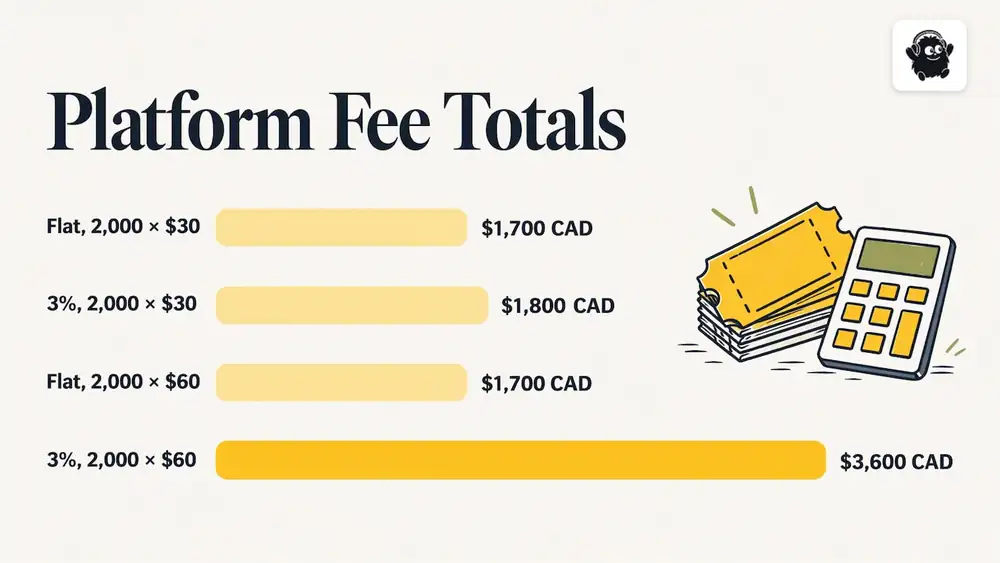
Take an exhibition selling 2,000 paid tickets over a weekend at $30 each.
- Eventist event ticketing, as of October 2026: $0.85 CAD per paid ticket on the pricing page. 2,000 × $0.85 = $1,700 CAD.
- Illustrative 3% platform fee: $30 × 3% = $0.90 per ticket. 2,000 × $0.90 = $1,800 CAD.
That is a $100 difference on this example, and the gap widens as prices rise: at $60 a ticket, 3% is $1.80, so the same 2,000 tickets cost $3,600 CAD against $1,700 CAD. The flat fee only loses to a 3% rate when the ticket price is below about $28. For that reason Eventist is usually cheaper for paid events, though not in every scenario, so run your own numbers. The 3% figure is an illustration, not a quote from any named platform.
The fees differ by event type. Festivals and conferences pay $4.99 CAD per paid ticket, competitions $9.99 CAD. Venues are priced differently: they pay 0.5% to 1.9% of what they charge on everything they sell, single tickets included. Tickets or registrations for free events run on monthly plans starting from $100 CAD. Eventist's own pricing applies to events sold in Canada; organizers in the US pay in USD and should check the pricing page. Prices are as published in October 2026 and can change.
Our perspective
We see the same pattern in the events organizers bring us: the slot setup is rarely the hard part. The hard part is that the gate, the schedule and the staff plan are managed in different places. A timed window that sells out in the ticketing tool means little if the people at the door are scanning from a printed list, or if the stage schedule inside has not been adjusted for the arrival waves.
That is why we treat ticketing as one piece of running the event. QR check-in works from any phone, door sales go through a built-in point of sale, and staff roles and the run of show live in the same system as the tickets. When a gate lead can see who is scheduled, who has been scanned and what is left to sell, the team makes better calls on the day.
Our advice for first-time timed entry organizers is simple. Keep slots long enough for your gate to clear them, hold back a little inventory, and write your late-arrival rule before you open sales. Then read the slot report after day one and change what the data tells you to change.
Where Eventist fits
If you run festivals, conferences, trade shows, venues or everyday ticketed events and want tickets, seat maps, QR check-in and door sales in one system, our pricing page lists every fee in Canadian dollars. Venues selling reserved seats can read how venue pricing works without a monthly fee for paid ticketing. Organizers who want hands-on help can see the setup and training services from our Canadian team. Confirm that any feature you need, including arrival-window inventory, fits your event before you commit.
Common mistakes to avoid
- Slots that are too short for the gate. A 10-minute slot with one scanner creates the queue you tried to prevent.
- No plan for late guests. Without a rule, staff improvise, and guests compare notes.
- Selling out every slot. Leave a buffer for accessibility requests and errors.
- Confusing communication. Put the arrival window in the confirmation email, the ticket and the reminder message.
- Ignoring the exit. If departures bunch up, the next slot arrives into a crowd. Stagger programming where you can.
- Forgetting refunds. State your policy at checkout, including what happens if weather changes the event.
If you run reserved seating alongside timed windows, for example at a venue, season ticket management is worth a look for how repeat buyers are handled.
Frequently Asked Questions
What does "timed entry" mean?
It means your ticket is valid for a particular arrival window on a particular date, not for the whole day. Each window has its own limit on places. Once you are inside, you can usually stay until closing unless the event states a maximum stay.
How long should a timed entry slot be?
Most organizers choose 15 or 30 minutes. Fifteen-minute slots give tighter control at busy sites, while 30 minutes is often enough for open-day events. Pick the shortest interval your entrance staff can clear without a queue.
Is timed entry the same as a reserved seat?
No. A reserved seat assigns you a specific place for a performance. Timed entry controls when you arrive and how many people are present, without assigning a spot. Some events combine both, for example a seated show inside a timed-entry venue.
Is early bird pricing worth it with timed tickets?
Often yes, because early sales give you cash flow and demand data. Keep the discount modest and time-limited so guests do not learn to wait for cuts. Check the tier results after each release before you set the next one.
Sources
- Parks Canada: Visiting Lake Louise and Moraine Lake
- Arches National Park timed entry pilot study (MDPI)
- Kaiyukan aquarium pilot, Journal of Disaster Research
- The Role of Price Tiers in Advance Purchasing of Event Tickets (Wharton)
- Does time matter? Baseball secondary market pricing
- Visitors flow management at the Uffizi Gallery
Recommended
Tags
Ready to simplify your events?
Join hundreds of organizers, studios, and festival directors who trust Eventist to run their events.