Best Exhibitor Management Software in 2026: How to Choose
The best exhibitor management software is the one that handles your whole show floor, from booth sales and floor plans to exhibitor communication and attendee check-in, at a cost you can calculate before you sign. Enterprise suites such as Cvent, per-event platforms such as Brella and Swapcard, and all-in-one platforms such as Eventist each fit a different kind of organizer. This guide compares them on the criteria that matter to a trade show or expo team, and shows how to work out the real cost.
TL;DR
- Exhibitor management covers booth sales, floor plans, exhibitor portals, lead capture and reporting. Check that each one exists before you compare prices.
- Cvent is an enterprise platform with custom, tiered pricing. Brella and Swapcard publish entry prices that start at $2,500 per event and $610 one-time (checked August 2026), and Swapcard may add per-attendee charges.
- A flat per-ticket fee is easier to forecast than a percentage of sales. At a $40 ticket, $0.85 CAD per paid ticket is lower than a 3% fee.
- Shortlist two or three tools, then ask each for your own show's total cost, covering booths, tickets, staff and support.
What exhibitor management software actually does
A trade show has two customers. Attendees buy tickets or register, and exhibitors buy space, send in their details and expect leads in return. Exhibitor management software covers the second group. It also has to connect cleanly to the first, because the exhibitors only renew if the attendees show up.
In practice the category breaks into five jobs:
1. Booth sales and allocation. Selling or assigning booths on an interactive floor plan, with sizes, categories and add-ons.
2. Exhibitor onboarding. A portal where exhibitors sign contracts, upload logos and descriptions, order extras and track deadlines.
3. Communication. Reminders, instructions for load-in and move-out, and updates to every exhibitor at once.
4. Lead capture and reporting. Tools for exhibitors to collect contacts on the floor, and reports for you on traffic and engagement.
5. The attendee side. Registration, ticketing, check-in and the schedule of sessions around the exhibition.
Most buyers start with job one, discover that jobs two and three eat most of the staff time, and only later notice that job five decides whether the exhibitors are happy. Judge each tool on all five.
The platforms organizers shortlist most often
Several names appear again and again in roundups for this search: Cvent, Eventbrite, Whova, Swoogo, Bizzabo, Brella, Swapcard, Eventify and EventPro, along with Eventist. They are not interchangeable. Some are built for enormous multi-day conferences, some for networking and matchmaking, and some for selling tickets quickly. The sections below cover the ones where we have sourced details, then explain how to check the rest.
Cvent
Cvent is an enterprise-grade event marketing and management platform. Gartner's product listing describes it as covering the lifecycle from sourcing and registration through onsite execution and post-event analytics, for any scale and format. The same listing records that the company was founded in 1999 and is headquartered in Tysons Corner, United States.
Pricing is subscription-based with custom tiers. According to the same Gartner page, the price depends on features, event volume, users, event size and scope, and additional modules may cost extra. That makes Cvent a fit for large organizations running many events a year with a dedicated team to configure it. It also means you cannot know your total until you have a quote. If you are weighing it against others, our comparison of Cvent alternatives and the Eventist vs Cvent conference comparison go into more detail.
Brella and Swapcard
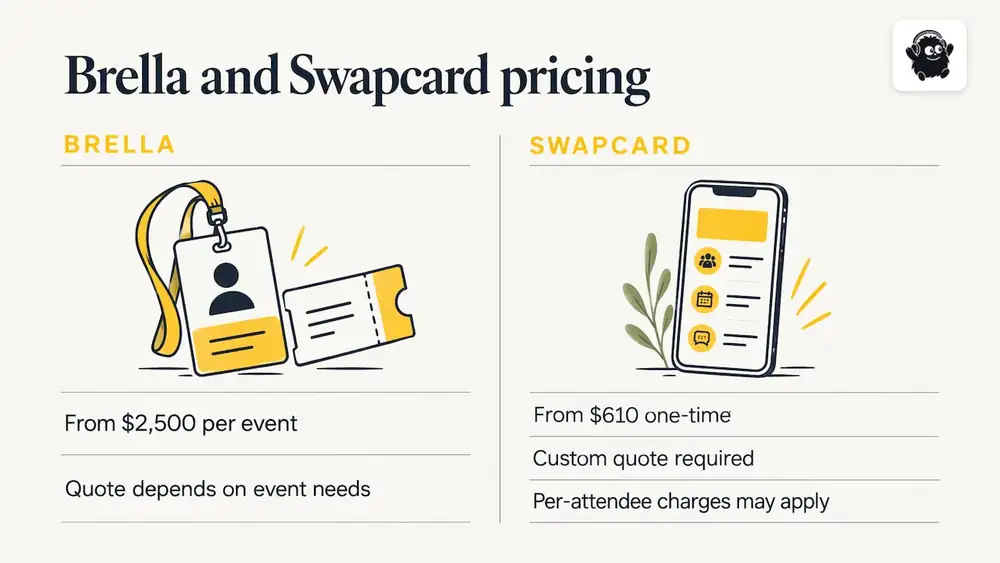
Brella and Swapcard are often considered for events where networking and meetings between exhibitors and attendees are central. A Softwr comparison with prices checked on 30 August 2026 lists Brella from $2,500 per event. It lists Swapcard from $610 one-time, but notes that a custom quote is required and per-attendee charges may be added.
Those entry prices are useful as a floor, not a budget. A starting price tells you the cheapest configuration the vendor sells. The number you will actually pay depends on attendee counts, the modules you need and the length of the contract, so ask for a quote built around your own numbers.
Eventist
Eventist is a Canadian event management and ticketing platform. For exhibition organizers, the relevant parts are vendor and exhibitor booths, seat and booth map builders, staff roles and the run of show, QR check-in from any phone, and ticketing with a flat per-ticket fee. The trade show page sets out how booth sales work. Setup help comes from a Canadian team.
Others on the list
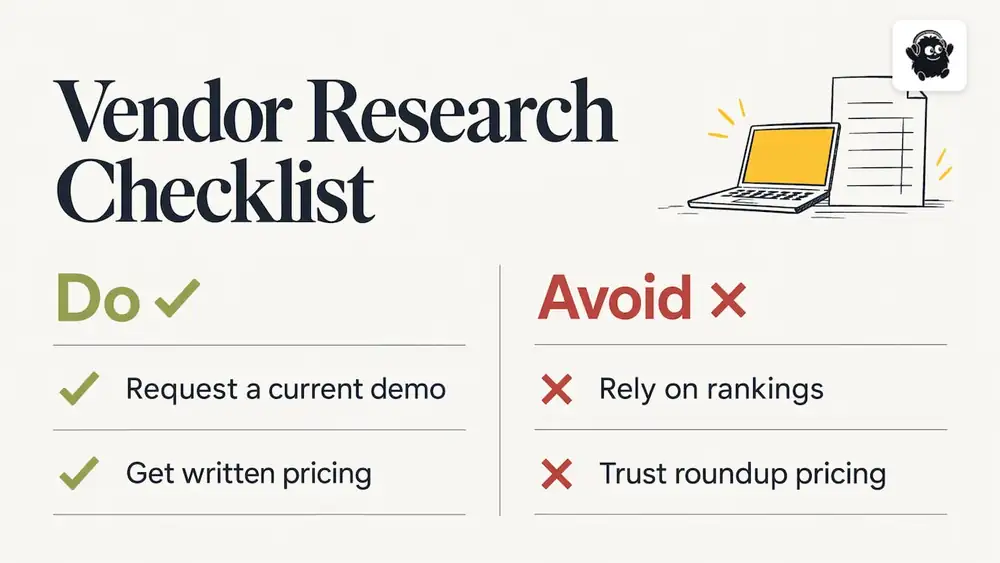
Whova, Swoogo, Bizzabo, Eventify, EventPro and Eventbrite all turn up in rankings, and each leans in a direction: engagement, registration design, all-in-one marketing, trade show specific tooling or fast public ticketing. Request a current demo and written pricing from any of them, and score them with the checklist below rather than relying on a ranking list. Pricing, features and plans change, so the vendor's own page and a written quote beat any roundup, including this one.
Comparison at a glance
| Platform | Best suited to | Pricing model | Published entry price |
|---|---|---|---|
| Cvent | Large organizations running events at scale | Custom, tiered subscription; extra modules may cost more | Custom quote |
| Brella | Networking-focused events | Per event | From $2,500 per event (checked August 2026) |
| Swapcard | Events needing attendee-exhibitor matchmaking | One-time start, custom quote, possible per-attendee charges | From $610 one-time (checked August 2026) |
| Eventist | Trade shows, festivals, conferences and venues wanting tickets and operations in one system | Flat fee per paid ticket; monthly plans for free tickets and registrations | $0.85 CAD per paid ticket for event ticketing (October 2026) |
These columns do not measure the same thing, which is the point. One vendor charges per event, another per ticket, another by quote. To compare them you have to convert each to a cost for your show.
How to evaluate exhibitor management software
A good evaluation is a short, written checklist that every vendor answers in the same format. If you also need to coordinate your own team's tasks around the show, the same logic applies to project management tools for event planners. For exhibitor software, use these criteria.
Floor plans and booth sales
Ask whether exhibitors can see the live floor plan, choose their own booth and pay online, or whether staff must assign everything manually. Check how the tool handles different booth sizes, corner premiums, sponsorship tiers and add-ons such as power or furniture. Ask what happens when the layout changes after sales have started.
Exhibitor portal and communications
The portal is where your staff members save or lose time. Look for a single place where exhibitors complete forms, sign agreements and see deadlines, and for bulk messaging that can target a group, such as all exhibitors who have not uploaded a listing. Ask how many staff logins are included and what roles they can have.
Lead capture and reporting
Exhibitors judge a show by the leads they take home. Ask how exhibitors collect contacts, whether it works on their own phones, and how they export the data. For your side, ask which reports exist for ticket sales, attendance and check-ins, and whether they update in real time.
Attendee ticketing, check-in and scheduling
An exhibition rarely stands alone. It usually has seminars, workshops, a gala or a VIP preview. The tool should sell general admission and tiered passes, check people in at the door from a phone, take door sales, and publish a schedule across stages or tracks. Ask whether it sells reserved seats if any session needs them.
Integrations, hybrid options and support
Check what connects to your CRM, email platform, accounting and payment processor. If part of the show is online, confirm what the hybrid tools do and what they cost. Then ask what support is included in the price, who answers on show day and in which time zone.
Total cost on your numbers
Turn every quote into one figure for your show. Include booth-related fees, ticket fees, monthly plans, set-up, training, on-site help and payment processing. Then compare the totals, not the headline rates.
How the cost works out
Pricing structure shapes your costs more than the headline rate. Here is a worked example using Eventist's published event ticketing fee. These are the prices on the Eventist pricing page as of October 2026.
- Event ticketing: $0.85 CAD per paid ticket.
- Festivals and conferences: $4.99 CAD per paid ticket.
- Competitions: $9.99 CAD per paid ticket.
- Tickets and registrations that are not paid run on monthly plans starting at $100 CAD per month.
- Card processing fees are paid to Stripe or Square at their own rate, under any platform.
Suppose your expo sells 1,000 paid tickets at $40 each through event ticketing. At $0.85 CAD per ticket, the platform fee is $850 CAD. A platform that charges a hypothetical 3% of the ticket price would take $1.20 per ticket, or $1,200 CAD. The flat fee is $350 CAD lower. The 3% figure here is an illustration, not a quote from any vendor, so replace it with the percentage in the quote you actually hold.
The arithmetic also shows where a flat fee stops winning. The break-even against 3% is a ticket of about $28.33. Above that price, a flat $0.85 CAD is lower, and the gap grows with every dollar you add to the ticket. That is why Eventist is usually cheaper for events with higher ticket prices, though it is not the cheapest option in every case. Run the numbers with your own average price and volume.
Exhibitor revenue works differently. Booth fees are what exhibitors pay you, so what matters is whether your software lets you sell them without a separate system. Ask each vendor whether booth sales are included, whether they carry a fee, and who gets paid when.
For venues, the structure is different again. Venues pay 0.5% to 1.9% of what they charge on everything they sell, single tickets included. Our venue pricing explainer covers what to ask.
Which tool for which organizer
- A large association with a full events team and many events a year: an enterprise suite such as Cvent is built for that scale. Budget time for a custom quote and for configuration.
- A conference where meetings between attendees and exhibitors are the product: look closely at Brella and Swapcard, and ask each for a quote at your attendee count.
- A regional trade show, expo or festival with vendors, stages and ticket sales: an all-in-one platform keeps booths, tickets, schedule and check-in in one place, so exhibitors and attendees see the same information.
- A fast, public ticketed event with no exhibitor component: a straightforward ticketing platform may be all you need. Our ticketing platform comparison and ranking per dollar cover those.
If you are still building the shortlist, the event management software buyer's guide and the best event management software guide cover the wider market.
Questions to ask before you sign
A demo is only useful if you bring a script. Take these into every call:
1. Show me a booth sale from the exhibitor's side, from choosing a space to paying for it.
2. What does my total cost look like for [your number] of attendees and [your number] of exhibitors, in writing?
3. Which modules are extra, and which fees apply per ticket, per event or per month?
4. How do exhibitors capture leads, and how do they get the data afterward?
5. Who supports my team on show day, and what does that support cost?
6. Can I export all my data at any time?
If your show involves permits, security, AV, insurance, contracts or tax, remember that software only helps you track those items. Anything here is general guidance, not legal advice, and a qualified professional should review your contracts and obligations.
Our perspective
Exhibitor management is usually sold as a separate product from ticketing, and organizers end up stitching two systems together. In our experience of how shows run, that is where the trouble starts: exhibitors ask about attendance, attendees ask about the exhibitors, and your staff members answer both from different screens.
We built Eventist around the idea that one system should run the whole event. Tickets and seat maps, registration, QR check-in from any phone, door sales, multi-track schedules, live maps, vendor and exhibitor booths, staff roles and the run of show all live in the same place. Our pricing is a flat fee per paid ticket instead of a percentage, so you can forecast your cost before the first ticket sells.
We also believe that software should come with people. Organizers get help setting up their event from a Canadian team, and the services page lists optional done-for-you setup, team training and on-site support if you want more hands.
Whatever you choose, calculate the total cost on your own numbers and compare vendors on the same basis.
— Ciara
Run your show on one system
If your exhibition sells booths and tickets and needs a schedule, staff roles and door check-in, Eventist is designed to cover those from a single account. Event ticketing is $0.85 CAD per paid ticket for Canadian organizers (October 2026), and card processing is paid to Stripe or Square at their own rate. Tickets and registrations that are not paid run on monthly plans starting from $100 CAD. See the full pricing or the services page for setup, training and on-site support.

For booth sales and exhibitor details, start with the trade show page.
Frequently Asked Questions
What is exhibitor management software?
It is software that helps organizers sell booths, manage floor plans, onboard exhibitors, communicate with them and report on results. Many platforms also include attendee registration, ticketing and check-in. The best ones put exhibitors and attendees in the same system.
How much does exhibitor management software cost?
It varies by pricing model. Cvent uses custom tiered subscriptions, per the Gartner listing. Softwr's August 2026 check lists Brella from $2,500 per event and Swapcard from $610 one-time with a custom quote. Ask for a quote based on your own attendee and exhibitor numbers.
Is a flat fee per ticket cheaper than a percentage?
It is usually cheaper once the ticket price is above the break-even point. At 3%, that point is about $28.33, so a $0.85 CAD flat fee costs less on a $40 ticket. Check your own average price, and remember that card processing is a separate charge.
Do I need separate software for exhibitors and attendees?
Not necessarily. Some platforms combine booth sales, exhibitor portals, ticketing, check-in and scheduling. Combining them saves your staff from reconciling two sets of data, but confirm each feature in a demo.
Sources
- Cvent Event Marketing and Management reviews and ratings, Gartner
- Brella vs Swapcard: events plans compared, Softwr
Recommended
Tags
Ready to simplify your events?
Join hundreds of organizers, studios, and festival directors who trust Eventist to run their events.