Data Residency in Canada: A Guide for Event Organizers

Data residency means your data is physically stored in a specific place, and for Canadian organizers that usually means servers inside Canada. For an event, the data is attendee names, emails, ticket orders, check-in scans and sometimes accessibility or dietary details. Storing it in Canada can help with some obligations, but it does not settle every question about who can access it or which laws apply. This guide explains the terms, the rules that matter, and what to ask a ticketing or event-management provider before you sign.
This is general guidance, not legal advice. For contracts, public-sector procurement or a specific privacy question, speak to a privacy lawyer or your organization's privacy officer.
TL;DR
- Data residency is about where data is stored. Data sovereignty and jurisdiction are about whose laws and whose control apply, and they are not the same thing.
- PIPEDA is the main federal privacy law for commercial activity, and Alberta, British Columbia and Quebec have their own similar private-sector laws. Public bodies can face stricter rules, such as BC's requirement for storage and access in Canada.
- Hosting in Canada does not guarantee data is out of reach of foreign law, so ask about ownership, support access and subprocessors as well as server location.
- Put the answers in writing: location, subprocessors, backups, deletion, breach notice and security controls.
What data residency means for an event
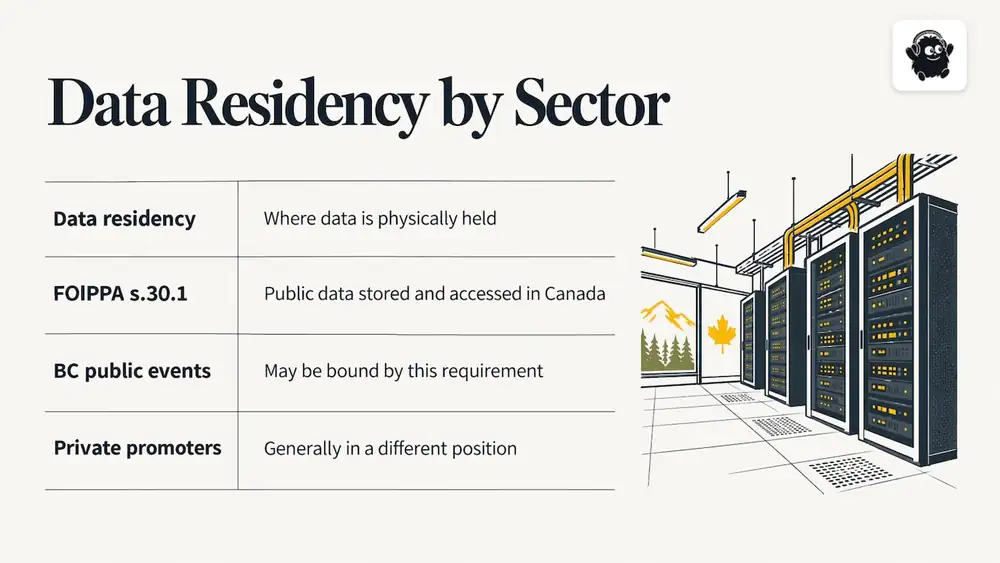
Data residency describes where your data is physically held. If a Canadian company keeps client records on servers inside Canada, that data resides in Canada. It is a statement about location, nothing more.
In the public sector the term can be a legal requirement. In British Columbia, section 30.1 of FOIPPA means personal information held by public bodies is stored and accessed in Canada. A municipal festival or a school-run conference in BC may therefore be bound by it. A private promoter or trade show company is generally in a different position, which the next sections cover.
Residency, localization, sovereignty and jurisdiction
These four terms get mixed up in vendor marketing, so it helps to separate them:
| Term | What it answers | Example for an event |
|---|---|---|
| Data residency | Where is the data physically stored? | Ticket orders sit on servers in a Canadian data centre |
| Data localization | Does a rule require the data to stay in a place? | A public body must keep records in Canada |
| Data sovereignty | Whose laws govern the data? | Canadian privacy law governs how you handle attendee data |
| Jurisdiction | Which legal system can compel access? | Depends on who controls the platform and where its owner is incorporated |
Legal jurisdiction is not decided by physical location alone. Who controls the platform, where the parent company is incorporated and which laws govern that company all count. A Canadian server run by a foreign-owned provider can sit in a different position from the same server run by a Canadian-owned one.
What data an event actually holds
Under PIPEDA, personal information covers any factual or subjective information about an identifiable individual, including names, ID numbers, credit records and medical records. For organizers, that reaches further than a ticket buyer's email:
- Ticketing: buyer name, email, phone, billing postal code, order history, seat selections.
- Registration: job titles, employers, dietary and accessibility requests, session choices.
- Check-in and door sales: scan times, who attended, who bought at the door.
- Marketing: abandoned-cart emails, SMS reminder lists, referral link activity.
- Staff and vendors: contact details, roles, booth assignments and signed contracts.
Card numbers are normally handled by the payment processor rather than by you, but the order records that sit beside them are yours to protect. If you run a conference with accessibility or dietary requests, treat that field with the same care as any other sensitive detail.
What Canadian law says
Federal and provincial private-sector rules
The Office of the Privacy Commissioner of Canada says PIPEDA is the primary federal law, while Alberta, British Columbia and Quebec have their own substantially similar private-sector legislation. These laws apply to commercial activities, and PIPEDA also governs cross-border transfers of personal information. A ticketed concert, a trade show with paid admission and a paid conference are commercial activities. A volunteer-run community event may fall differently, so a nonprofit should confirm its position.
Does the law say data must stay in Canada?
For most private-sector organizers, no general rule forces attendee data to stay in the country. A long-standing professional view is that where a law requires records to be kept in Canada, copies may sit elsewhere but the sole copy cannot be outside Canada. Some sector rules, public-sector rules and contracts with government or institutional clients can add their own conditions, so read the terms of any grant, venue agreement or sponsor contract.
Using a provider outside Canada
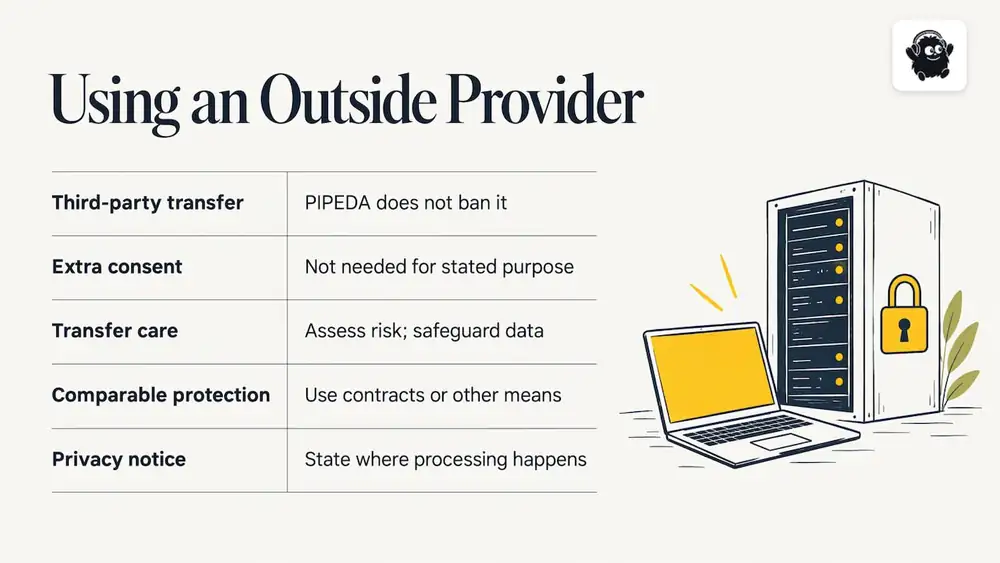
PIPEDA does not ban it. The Privacy Commissioner's guidance treats passing information to a third-party processor in another jurisdiction as a use of the information, so extra consent is not required when the purpose is the one originally stated. What you do owe is care: assess the risk of the transfer, take reasonable steps to safeguard the data, and use contracts or other means to provide comparable protection. Your privacy notice should still be honest about where processing happens.
Why Canadian servers are not the whole answer
It is tempting to read data in Canada as protected from outside access. The government guidance is more careful than that.
- The City of Toronto notes that data held outside Canada may be subject to foreign laws, including warrants or subpoenas from foreign agencies.
- The Treasury Board of Canada Secretariat says cloud providers with foreign operations may be required to comply with foreign law enforcement requests, so full sovereignty over data in public clouds cannot be guaranteed.
- The Privacy Commissioner's position is that no contract can override the laws of the country where the data has been transferred.
The practical reading: location is one control among several. Ownership, who can log in to support the system, and which companies process data on the provider's behalf all matter as much as the postal address of the data centre.
Questions to ask your ticketing or event-management provider
Most organizers have no checklist for this. The questions below follow the risk-assessment approach in the Privacy Commissioner's cross-border guidance, and they work for any platform you are comparing. Ask for the answers in writing, in the contract, privacy policy or a security document.
Location
1. In which country and region are production data and backups stored?
2. Can the provider commit in writing that storage and processing stay in Canada, and what does the commitment cover (database, files, logs, email and SMS tools)?
3. Is any data copied elsewhere for analytics, support or testing?
Access
4. Which of the provider's staff members can see attendee records, and from which countries?
5. Who owns and controls the provider, and which country's laws govern it?
6. How are requests from authorities handled, and will you be told when the law allows?
Subprocessors
7. Which companies process data on the provider's behalf (payments, email, SMS, hosting, analytics), and where are they located?
8. Will you be told before a subprocessor is added or changed?
Backups, deletion and breaches
9. How long are backups kept, and how are they deleted when you ask for deletion?
10. What happens to your attendee data when you leave the platform, and can you export it in a usable format?
11. How quickly will the provider tell you about a breach, and what will it tell you?
Security
12. Are data encrypted in transit and at rest, and is access limited by role? For events, that includes the staff and volunteer accounts you create.
13. Can you assign roles so a door volunteer sees a check-in list but not full order histories?
The City of Toronto's guidance adds a useful test: risk is reduced through contract terms that set security controls and breach mechanisms, and where foreign and domestic laws cannot be reconciled, the technology may not be suitable. A public-sector or institutional organizer should treat that as a real decision point, not a formality.
Matching the answers to your event
How strict you need to be depends on who you are and what you collect.
| Organizer | Typical data | What to prioritize |
|---|---|---|
| Festival | Large ticket volumes, SMS lists, vendor and artist details | Subprocessor list, SMS and email tool locations, staff access roles |
| Conference | Registration forms, employers, dietary and accessibility needs | Retention and deletion terms, export, access by role |
| Trade show | Exhibitor contracts, booth purchases, lead lists | Contract storage, who can see exhibitor data |
| Venue or concert promoter | Reserved-seat buyers, repeat customers, door sales | Customer list ownership, backups, breach notice |
| Public body or institution | Any of the above | Written residency commitment and procurement rules, such as FOIPPA in BC |
A simple routine helps. Before each season, list the personal information you collect, confirm where your provider stores it, check the subprocessor list for changes, and delete what you no longer need. Our own guide, Where Does Your Attendee Data Live?, walks through the attendee-data side in more detail. If local ownership is part of your decision, Canadian-Owned Ticketing Platforms compares ten companies, and why organizers choose local software covers the reasoning.
Our perspective
We are a Canadian event management and ticketing platform, and we think organizers should treat data questions as part of choosing software, not as an afterthought. Attendee data runs through everything: ticket orders, registration, check-in, door sales, reminders and staff access.
That is one reason we build the whole event in one system. When tickets, seat maps, registration, QR check-in, the built-in point of sale, schedules, vendor booths and staff roles live together, there are fewer separate tools holding copies of the same people. Fewer tools means a shorter list of subprocessors to ask about, and one set of staff roles to manage.
Our advice to any organizer, including those comparing us with others, is to ask the questions in this guide and to get the answers in writing. A provider worth choosing will answer them plainly. We also help organizers set up their events with a Canadian team, which makes it easier to talk through these choices with real people.
— Ciara
What it costs to run the whole event in one place
If you are comparing platforms on both data handling and price, Eventist is a Canadian platform that covers tickets, seat maps, registration, QR check-in from any phone and door sales with a built-in point of sale. Prices below are from our pricing page as of November 2026 and are in Canadian dollars:
- Event ticketing: $0.85 CAD per paid ticket.
- Festivals and conferences: $4.99 CAD per paid ticket.
- Competitions: $9.99 CAD per paid ticket.
- Free tickets and registrations run on monthly plans starting from $100 CAD.
Card processing fees are paid to Stripe or Square at their own rate. Venues are billed differently, at 0.5% to 1.9% of what they charge on everything they sell, single tickets included.

A quick illustration of the arithmetic, using a made-up percentage fee for comparison, not any named company: an event selling 2,000 paid tickets under our event ticketing fee pays 2,000 x $0.85 = $1,700 CAD. A platform charging 3% on a $40 ticket takes $1.20 per ticket, which is 2,000 x $1.20 = $2,400. On that example, a flat fee is cheaper, and the gap widens as ticket prices rise. That is why we say Eventist is usually cheaper, and the result depends on your ticket price and volume, so run your own numbers. You can see the full detail on our pricing page, and the cost of hands-on help, such as done-for-you setup, is listed on our services page.
Frequently Asked Questions
Is data residency required by law for Canadian event organizers?
There is no general rule that private-sector organizers must keep attendee data in Canada. Some laws, notably those covering public bodies such as BC's FOIPPA, do require personal information to be stored and accessed in Canada. Your contracts with funders, institutions or venues can add requirements, so check them and get legal advice for your situation.
What is the difference between data residency and data sovereignty?
Residency is where the data is physically stored. Sovereignty is about which country's laws govern it and who controls it. A provider can store data in Canada and still be owned by a company subject to foreign law, which is why ownership and access questions matter.
Can I use a ticketing platform that stores data outside Canada?
Under PIPEDA guidance, transferring data to a processor in another jurisdiction is a use of the information, so extra consent is not needed when the purpose is unchanged. You still need to assess the risk, safeguard the data and use contracts for comparable protection, and be open about it in your privacy notice.
What should I ask a provider about backups and deletion?
Ask where backups are stored, how long they are kept, and how they are removed when you request deletion or leave the platform. Also ask whether you can export your attendee data in a usable format and how fast the provider reports a breach.
Does hosting in Canada protect data from foreign access?
Not completely. Canadian government guidance notes that providers with foreign operations may have to respond to foreign law enforcement requests, and that no contract overrides the laws of the country where data is held. Ownership, support access and subprocessors all affect your exposure.
Sources
- Data Residency vs Data Sovereignty: Canada Explained
- PIPEDA requirements in brief (Office of the Privacy Commissioner of Canada)
- Questions and Answers regarding the application of PIPEDA (Office of the Privacy Commissioner of Canada)
- Canadian Data Residency Requirements: A few more thoughts (IAPP)
- Guidelines for processing personal data across borders (Office of the Privacy Commissioner of Canada)
- Information Management Guideline: Data Residency for Cloud Technology (City of Toronto)
- Government of Canada White Paper: Data Sovereignty and Public Cloud
Recommended
Tags
Ready to simplify your events?
Join hundreds of organizers, studios, and festival directors who trust Eventist to run their events.