Event Logistics Planning: Six Areas Organizers Must Lock
Steps at a glance
- Set the budget and timeline. Separate fixed costs from variable ones, hold a contingency line and a separate petty cash fund, set vendor payment deadlines weeks ahead, and give every milestone a named owner.
- Assign roles with a RACI matrix. Name an event manager, logistics lead, production lead, volunteer coordinator and safety or medical lead, and put who is responsible, accountable, consulted and informed on one page.
- Survey the venue and map the floorplan. Check power, Wi-Fi, load-in routes, elevators, sanitation, sightlines and exit capacity, and mark accessible routes and evacuation paths on the floorplan itself.
- Contract vendors and schedule load-in. Write scope, timeline, cancellation terms, insurance and a day-of contact into every contract, and give each vendor its own dock and time window.
- Plan check-in and on-site operations. Work out scanning lanes from peak arrivals, staff the peak, run a central command point with a backup channel, write escalation steps down and keep an offline check-in fallback.
- Write the risk and emergency plan. Identify the lead agency, give each hazard a primary and support agency, size medical cover from past events, build in accessible evacuation and decide who can postpone or cancel.
Event logistics planning comes down to locking six areas before anything else: budget, timeline, venue, team, vendors and risk. Get those right and most of the attendee experience follows, because the problems guests notice on the day (a long entry line, a missing vendor, a blocked exit) usually trace back to one of them. This guide walks through each area in order, with checklists you can adapt for a conference, festival, trade show or concert.
Key takeaways
- Separate fixed costs from variable ones, hold a contingency line and a separate petty cash fund, and set vendor payment deadlines weeks before the event, not the week of.
- Give every milestone a named owner and keep a one-page RACI matrix so staff know who leads, who approves, who advises and who only needs updates.
- Before signing a venue, verify power, Wi-Fi capacity, delivery routes, sanitation, sightlines and exit capacity, then mark accessible routes and evacuation paths on the floorplan itself.
- Structure emergency planning on the Incident Command System, size medical cover from past events, and decide in advance who can postpone or cancel and under what conditions.
- Close out with vendor walk-throughs, incident reports filed while details are fresh, and a blame-free debrief within a week where every action item gets an owner.
The step framework: an ordered checklist for event logistics planning
Every well-run event follows roughly the same sequence, whether it's a 200-person conference or a multi-day festival. Skipping a step rarely saves time; it just moves the problem closer to event day.
1. Define objectives and scale. Decide attendee count, format (in-person, virtual or hybrid) and the outcome you're measuring against.
2. Set budget buckets and a contingency reserve. Separate fixed costs from variable ones before you commit to a venue.
3. Build a milestone timeline with named owners. Every deadline needs a person attached, not just a date.
4. Lock the venue and map the floorplan. Confirm capacity, access and layout before vendor contracts go out.
5. Onboard vendors and confirm load-in logistics. Get site visits done early so delivery windows don't collide.
6. Run a tabletop contingency exercise. Walk through a weather delay, a medical incident or a vendor no-show on paper first.
7. Finalize emergency contacts and chain of command. Everyone on site should know who makes the call if plans change.
This order matters because each step constrains the next. A venue chosen before the budget is set tends to blow past the budget later.
Budget and timeline: building a resilient plan
A resilient event budget separates fixed costs from variable ones. Identify your top five cost drivers early, since those are usually where overruns happen.
| Cost type | Examples | What moves it |
|---|---|---|
| Fixed | Venue rental, insurance, permits | Mostly settled when you sign |
| Variable | Catering per head, staffing hours, printing | Attendance, headcount and hours on site |
- Hold a contingency line for vendor price changes and last-minute additions; MIT's event planning tips tell planners to include contingency funds in the budget to cover unexpected expenses.
- Keep a small petty cash fund separate from the main contingency for same-day purchases.
- Set vendor payment and contract deadlines weeks ahead of the event, so a cancellation still leaves time to rebook.
- Map milestones to six phases: plan, finalize, confirm, test, execute and close.
Our festival planning timeline shows how a full milestone calendar looks when it's mapped month by month toward a summer festival, which is a useful reference if you're building yours from scratch.
Team roles, RACI and vendor coordination
Operational friction usually comes from unclear ownership, not lack of effort. Assign these roles before anything else: event manager, logistics lead, production lead, volunteer coordinator, and a safety or medical lead.
- Build a RACI matrix (Responsible, Accountable, Consulted, Informed) so two people never assume the other owns a task.
- Run a vendor kickoff covering the scope of work, site visit scheduling, a shared contact tree, milestone dates and the invoice schedule.
- Credential and train volunteers with a short written brief covering their zone, reporting line and escalation path.
- Confirm every vendor contact has a backup in case of a no-show or last-minute swap.
Pro tip: Put the RACI matrix on one page and pin it in your staff's shared channel, not in a folder nobody opens on event day.
Venue and floorplan: survey checklist and accessible flow
A venue walkthrough needs to answer operational questions, not just aesthetic ones. Confirm power access, Wi-Fi capacity, load-in routes, freight elevators, sanitation facilities and sightlines before signing anything, and ask about delivery hours and who holds the keys to the space.
- Check exit capacity against your crowd, not just the entry count. FEMA's special events job aids manual puts a free-swinging door, open portal or gate at up to one person per second with a constant queue, and revolving doors and turnstiles at half that rate or less. The venue's posted occupant load and your local fire department set the actual limits.
- Position operational zones (registration, medical, staff staging) away from the main attendee flow but within quick reach of entrances.
- Mark accessible routes, designated elevators and accessible evacuation paths directly on the floorplan, not as a verbal note to staff, and check for elevator or lift outages close to the date.
- Name one accessibility lead who owns access and functional needs (AFN) across the site on the day.
Our accessible event planning checklist covers the practical details worth walking through with your venue contact before you sign a contract.
Vendors, contracts, deliveries and transport logistics
Every vendor contract should specify scope, timeline, cancellation terms, insurance coverage and a direct contact for day-of issues. Vague contracts are where load-in day falls apart.
- Build a load-in schedule with a dock assignment and time window for each vendor, not a single shared arrival time.
- Coordinate transport separately for talent, VIPs and freight; each has different timing and access needs.
- Pre-assign check-in points for drivers so nobody circles the block looking for the right entrance.
- File permits and insurance certificates well ahead of the event, not the week of.
Permit and insurance requirements come from your municipality, your venue and your insurer, so confirm them with each directly. This is general guidance, not legal advice.
On-site operations: check-in, communications and peak staffing
Check-in is where attendees form their first impression, and it's also where small delays compound fastest. Entry throughput is easy to estimate: FEMA's manual, drawing on Fruin's 1981 crowd research, plans for one patron per second per portal in a simple pass-through and two seconds per patron when a ticket must be torn and the stub handed back, with more complicated procedures taking longer. If 3,000 people arrive in the 30 minutes before doors, that's 100 a minute: two lanes at the simple pass-through rate before you add any headroom, or four if every ticket is torn.
Every check-in system also needs an offline fallback for when connectivity drops. Eventist's check-in scanner, for example, downloads the guest list to each phone ahead of time and queues scans while the connection is down, syncing them when it returns. Whatever you use, test it with the Wi-Fi switched off before doors.
- Staff peak arrival windows more heavily than off-peak hours, with a named person authorized to make exception calls on the spot.
- Set up a central operations command point with radios and a backup communication channel.
- Staff an info desk for general questions, accessibility support, and lost and found.
- Define escalation steps in writing so staff aren't guessing who to call for an unusual request.
Pro tip: Print a one-page escalation chart and laminate it for every team lead; it's faster than scrolling a phone during a rush.
Our festival ticketing feature checklist breaks down which check-in capabilities are worth testing before you commit to a platform.
Risk and emergency planning: ICS, hazard analysis and medical staffing
FEMA's Special Events Contingency Planning job aids manual recommends identifying the lead agency early in the planning process and considering the Incident Command System (ICS) throughout planning, with the planning team itself structured on the ICS model of sections, branches, divisions and groups. It's US guidance, but the logic carries over: in Canada, the equivalent agencies at that table are your municipality's emergency management and special events staff, police, fire, paramedic services and public health.
- Complete a pre-event planning matrix that assigns each hazard or function a primary agency and a support agency, decided during planning rather than when an incident occurs.
- Size medical cover from data, not a flat guess. FEMA's manual points planners to reports from previous similar events and notes that expected patients generally range from 0.3 to 1.3 percent of attendance; tell ambulance services and local hospitals about the event and the expected crowd.
- Build accessible evacuation routes and communications into the emergency operations plan from the start, not as a later addition.
- Decide who holds the authority to postpone or cancel, and under what conditions, before the event begins, and make sure everyone knows who that is.
Medical planning matters because of what a large crowd does to the system around it. A StatPearls review of EMS at mass gatherings notes that the standard definitions focus on the strain an event puts on local EMS, hospitals, transport networks and law enforcement, not on headcount alone, which is why the medical plan should be shared with local services early.
Accessible emergency planning deserves its own line item. Cal OES guidance on integrating access and functional needs at large venues recommends an AFN advisory committee, including disability organizations and people with lived experience, engaged throughout the development of safety and security plans, along with clearly marked accessible evacuation routes and specially trained evacuation assistance teams.
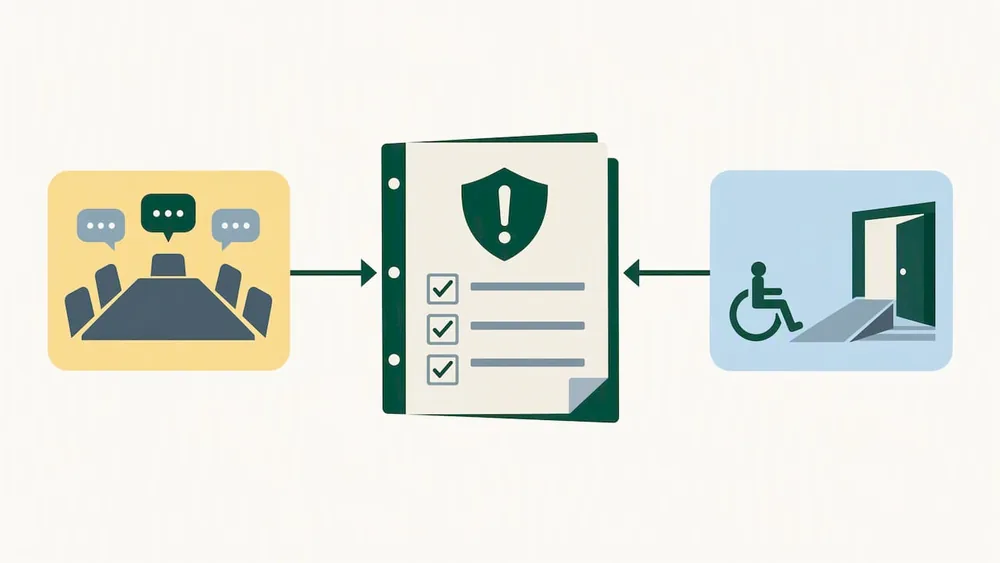
Emergency plans, permits and medical requirements vary by province and municipality, so treat this section as general guidance, not legal advice, and confirm the specifics with your local emergency services.
Technology and tools: what to centralize
Scattered spreadsheets and group chats are where logistics plans quietly fail. Centralizing a few core functions removes most of the manual reconciliation work that eats up the final week before an event.
- Registration, check-in and any badge printing should draw on one attendee list, not three copies of it.
- An agenda manager and interactive site map give staff live visibility into what's happening where.
- Staff scheduling and reporting work better on a shared dashboard than in individual trackers.
- Plan for offline operation with spare devices and a manual check-in backup.
The site map earns its keep when it carries operational detail, not just the attendee view. In Eventist, for instance, operational markers such as cable runs, barricades and staging areas can be hidden from the public map while staff still see them, and crews can mark each one done from the live map as setup progresses.
Closeout: teardown, reconciliation and lessons learned
Closeout starts before the last truck leaves, and the details are freshest in the first few days.
- Walk the site with each vendor for a sign-off and acceptance checklist before they leave.
- Reconcile final attendance numbers and file any incident reports while details are fresh.
- Prepare a statement of actual expenditures and outstanding bills; FEMA's manual makes it part of the after-action report.
- Hold a debrief within a week and assign an owner to each action item that comes out of it.
- Feed real numbers (actual costs, timeline slippage, staffing needs) into the next event's budget and schedule.
FEMA's advice on the post-event meeting is worth borrowing for any event: the meeting "is intended to be a positive learning experience for all agencies, not a session to assign blame for problems that occurred during the event." It also suggests discussing problems in generic terms rather than singling out one agency, which keeps vendors and staff talking openly.
Frequently Asked Questions
What is event logistics planning?
Event logistics planning is the work of organizing everything an event physically needs to run: budget, timeline, venue and floorplan, staff and volunteers, vendors and deliveries, check-in, and the risk and emergency plan. It's the operational side of event planning, focused on who does what, where, when and with which resources.
How do I create a logistics plan for an event?
Start by defining your objectives and scale, then build budget buckets and a milestone timeline with named owners, and lock your venue before onboarding vendors. Layer in a risk and emergency plan built on an ICS structure, confirm check-in and peak staffing, and schedule the closeout and debrief before event day.
What are the 5 C's of event planning?
The 5 C's are concept, coordination, control, culmination and closeout: the idea and purpose of the event, organizing resources and suppliers, keeping work on time and on budget, the event itself, and the post-event review. It's a common teaching model rather than a formal standard, so sources draw the boundaries between phases a little differently.
What are the 5 P's of event planning?
Definitions vary. A common version is people, place, product, price and promotion: who the event serves and who runs it, where it happens, what attendees get, what it costs and how it's marketed. Other versions swap in purpose or program. All of them overlap heavily with the logistics areas in this guide.
What are the 7 stages of event planning?
There's no single official list. The seven-step order at the top of this guide is one practical version: define objectives and scale, set the budget and contingency, build a timeline with owners, lock the venue and floorplan, onboard vendors, run a tabletop exercise, and finalize emergency contacts and chain of command. The event itself and the closeout follow.
How much does event management software cost?
Pricing depends on the platform and event type: some charge a percentage plus a fixed fee per ticket, others a subscription or a custom quote. Eventist charges a flat $0.75 USD per paid ticket for event ticketing, $3.50 USD for festivals and conferences and $7 USD for competitions; free tickets and registrations run on monthly plans from $100 CAD, and card processing is paid to Stripe or Square at their rate. The pricing page has the details.
Sources
- IS-15: Special Events Contingency Planning, Job Aids Manual (FEMA, updated 2010)
- EMS Mass Gatherings, StatPearls (NCBI Bookshelf)
- Integrating Access and Functional Needs Within Large Venue Safety and Security Operations (Cal OES)
- Event planning tips: Logistics and operations (MIT Institute Events)
If you're about to sign a venue, the 20 questions to ask before you sign an event venue contract pair well with this checklist, and the guide to hiring event security covers how many guards to book and how to brief them.
Tags
Ready to simplify your events?
Join hundreds of organizers, studios, and festival directors who trust Eventist to run their events.