Reserved Seating vs General Admission: How to Choose
General admission (GA) sells entry to an area, and guests pick their own spot on arrival. Reserved seating sells a specific seat, row or table, and the guest knows exactly where they will be before they arrive. GA suits standing shows, festivals and anything built around movement. Reserved seating suits theatres, seated concerts, galas and conferences, where comfort, sightlines and certainty matter more than flexibility. Many events use both, and that mix is often the strongest layout.
This guide is written for organizers, and it also answers the question fans ask when they are choosing tickets. It covers what each model means, what it does to revenue and operations, when to use GA, and how to plan a hybrid layout.
TL;DR
- GA maximizes flexibility and capacity, and it is simpler to set up. Reserved seating gives guests certainty and gives you pricing tiers by location.
- GA tickets are usually priced lower. Reserved seats often cost more because the location is guaranteed, so seat maps can lift revenue per head when the room has clearly better and worse spots.
- Use GA for standing floors, festival grounds and mingling events. Use reserved seating for seated shows, galas and anything with a long program.
- A hybrid layout, such as a GA pit with reserved seats behind it, lets you sell at several price points in one room.
- If you sell assigned seats, plan accessible and companion seating from the start. In the United States the ADA sets specific ticketing rules, and Canadian requirements vary by jurisdiction.
What each model actually means
General admission
A GA ticket gets the holder into the venue or a defined zone. There is no assigned seat. Guests choose a place on a first-come basis, so those who arrive early get the best positions. At a standing show this is the crowd at the barrier. At a seated event with GA, it is the scramble for good chairs. That is the worry in one fan thread: does a GA ticket mean a seat is handed out or a rush for seating. The honest answer depends on the venue, so your event page should say it plainly.
A GA label can also mean "standing room only". A venue listing for a show in San Diego, for example, describes its general admission as standing room only. If your GA area has some seating, or none, say so in the ticket description.
Reserved seating
Reserved seating assigns each ticket to a specific seat, or to a table or box. Guests pick from a seat map at checkout or are assigned by the organizer. The ticket then carries the section, row and seat number, which is also what staff members scan and verify at the door.
There are three common variants:
- Fully reserved: every seat is numbered, as in a theatre or a seated concert hall.
- Reserved tables: guests buy a table or a seat at one, common at galas, fundraisers and dinner shows.
- Reserved sections with open seating inside: the guest buys the section and sits anywhere within it.
Side-by-side comparison
| Factor | General admission | Reserved seating |
|---|---|---|
| Guest knows their spot | No | Yes |
| Typical price | Usually lower | Often higher, tiered by location |
| Capacity | Often higher, since standing room packs tighter | Fixed by the number of seats |
| Setup effort | Low: one ticket type and a cap | Higher: you build and price a seat map |
| Door experience | Queues form early for good positions | Guests can arrive closer to showtime |
| Pricing flexibility | Few tiers, usually early bird and day-of | Many tiers by section, row or table |
| Best for | Standing shows, festivals, club nights | Theatres, galas, conferences, seated concerts |
What it does to price and revenue
GA is generally the lower-priced option. One ticketing guide notes that GA tickets are often less expensive than reserved seating and usually easier to get for popular events.
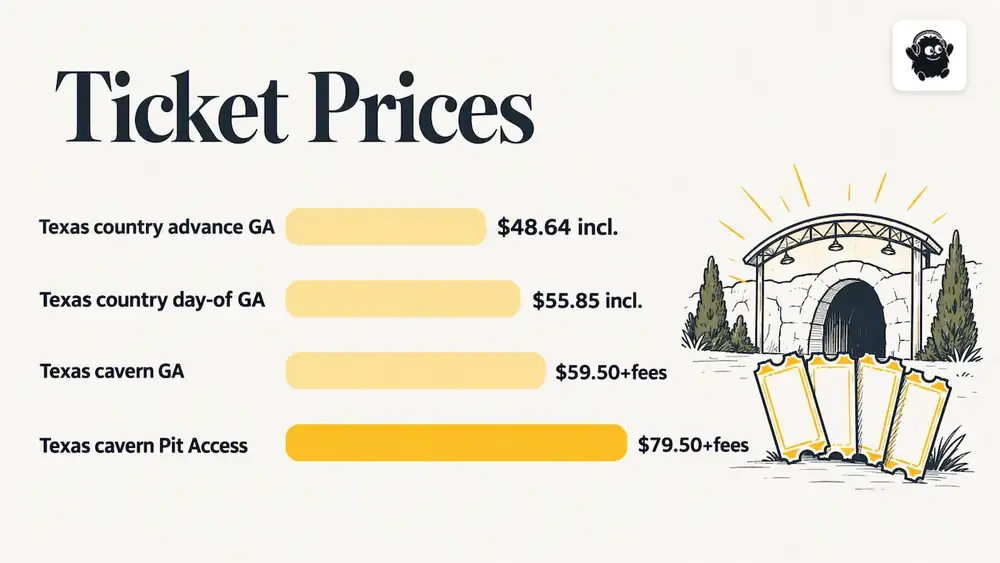
Published venue pricing shows the pattern. A Texas country venue lists advance GA at $48.64 and day-of-show GA at $55.85, with fees included, which is a reminder that GA itself can use tiers by purchase date. A Texas cavern venue lists GA at $59.50 and a closer Pit Access tier at $79.50, plus tax and fees. These are US prices for specific shows, so treat them as examples of structure, not benchmarks for your own pricing.
The lesson is that location is a product. In a reserved room, the front centre of a hall is worth more than a side balcony, and a seat map lets you price that difference. In a pure GA room you can only price the access tier (early bird, standard, day-of, VIP add-ons).
A worked example
Take a 600-seat room with a stage.
- Reserved layout: 150 premium seats at $85, 250 mid-tier seats at $65 and 200 rear seats at $45. Sold out, that is 12,750 + 16,250 + 9,000 = $38,000.
- Single GA price at $60 with a 600 cap, sold out: $36,000.
The tiered layout earns $2,000 more at full capacity in this example, though the numbers are invented for illustration. Reality depends on whether guests will pay for the premium seats. If most buyers want the cheapest option, the tiers add little, and GA may sell out faster with less setup.
Capacity and room use
A standing GA floor can hold more people per square metre than a seated layout, because seats need aisles, legroom and sightlines. Your venue's fire and occupancy limits set the true maximum, and the local authority and venue operator decide those figures. Treat this as general guidance, not legal advice, and confirm the numbers with your venue and local fire officials before you sell.
Reserved layouts have a hidden cost: seats that cannot be sold. Obstructed views, sound or lighting positions and accessible spaces all reduce the count. Mark them on the map before you set a ticket total, not after.
When to use GA
If you are asking when GA is the right call, these are the situations where it usually wins:
1. Standing shows and club nights. The crowd is part of the product, and a seat would get in the way.
2. Festivals and multi-stage events. Guests move between stages, so a fixed seat for the whole day makes no sense. A GA day pass with optional VIP or reserved viewing areas is the common structure.
3. Short, mingling events. Trade show floors, open houses, markets and tastings do not need a seat.
4. Events where you want fast, simple sales. One ticket type needs no map, no seat holds and fewer support questions.
5. Uncertain demand. If you do not know whether you will sell 200 or 600, GA lets you raise or lower the cap without redrawing a room.
GA is a weaker choice when the event is long, when guests are bringing older relatives or young children, or when a few spots are clearly better than the rest. In those cases, the first-come scramble creates arrival stress and complaints.
When reserved seating is worth it
- Seated concerts, theatre, comedy and spoken-word shows. Guests expect a seat and a sightline.
- Galas, fundraisers and awards dinners. Table sales are the model, and hosts want to seat groups together.
- Conference keynotes and ticketed sessions. Assigned seats avoid crowding at popular sessions.
- Events with a strong premium audience. Corporate buyers and couples will pay for guaranteed good seats.
- Venues with a season or subscription base. Repeat buyers want the same seats each time, which is a reason to look at season ticket management software for venues.
For fans choosing between the two, one fan discussion captures the trade-off well: GA can feel more involved and in the middle of the show, while a well-placed seat can give a better view and more comfort. For concerts, the best seating is the one that matches how the guest wants to experience the show. Some want to be at the barrier, and others want a clear view without standing for four hours.
The hybrid layout
Most mid-sized venues and many festivals end up with a mix:
- A GA floor or pit at a premium price for guests who want to be close.
- Reserved seating in the tiers or balcony for guests who want to sit.
- VIP tables or boxes sold as a unit.
- Accessible and companion seating placed in several areas, not only at the back.
The hybrid model lets you sell to different fans in one night. Keep each zone's rules clear on the ticket: whether the pit is standing only, whether re-entry is allowed and where each ticket type enters.
Presales and release stages
The two models behave differently across release stages. North American on-sales often run artist or venue presales, sometimes needing registration or a code, before a public general onsale. Presales reward loyal fans and let you gauge demand before you open the remaining tickets.
With reserved seating, hold back sections for each stage and release them on a schedule. With GA, you set the quantity per stage instead. If you are planning stages for a festival, the guide to festival ticketing tools for presales goes deeper.
Accessible seating and companion seats
If you sell assigned seats, accessible seating needs to be part of the plan from the first draft of the map. In the United States, the ADA guidance says venues must sell tickets for accessible seats under the same conditions, hours and methods as other tickets. That includes presales, promotions and general sales, and the price must not be higher than other tickets in the same section. The underlying rule is 28 CFR § 35.138, which defines accessible seating as wheelchair spaces and companion seats, among other things.
Good practice that follows from this:
- Spread accessible spaces across price levels and locations.
- Place companion seats next to wheelchair spaces, so groups are not split up.
- Describe the features of each accessible location clearly, so guests can judge whether it meets their needs.
- Do not make guests email or phone a separate number to request accessible tickets when others buy online.
This is general guidance, not legal advice. These rules are US federal rules. If you run events in Canada, requirements depend on your province or territory and on your venue, so check with your venue operator and a qualified advisor. A seat map tool that lets you tag accessible and companion seats makes all of this much easier to manage.
Choosing in six questions
1. Is the guest going to stand, or sit for more than an hour? Standing leans GA. A long seated program leans reserved.
2. Are some spots clearly better? If yes, a seat map lets you charge for them.
3. Is your demand certain? If not, GA is easier to adjust.
4. How much setup time and support capacity do you have? Reserved events need a built map, holds and more guest questions about seats. Planning tools help, and a comparison of project management tools for event planners can help you organize that work.
5. Who is buying? Groups, corporate buyers and older guests value certainty. Younger standing crowds value access.
6. What does your venue allow? Fixed seating, flat floors and fire limits can decide this for you.
How the fee model affects the choice
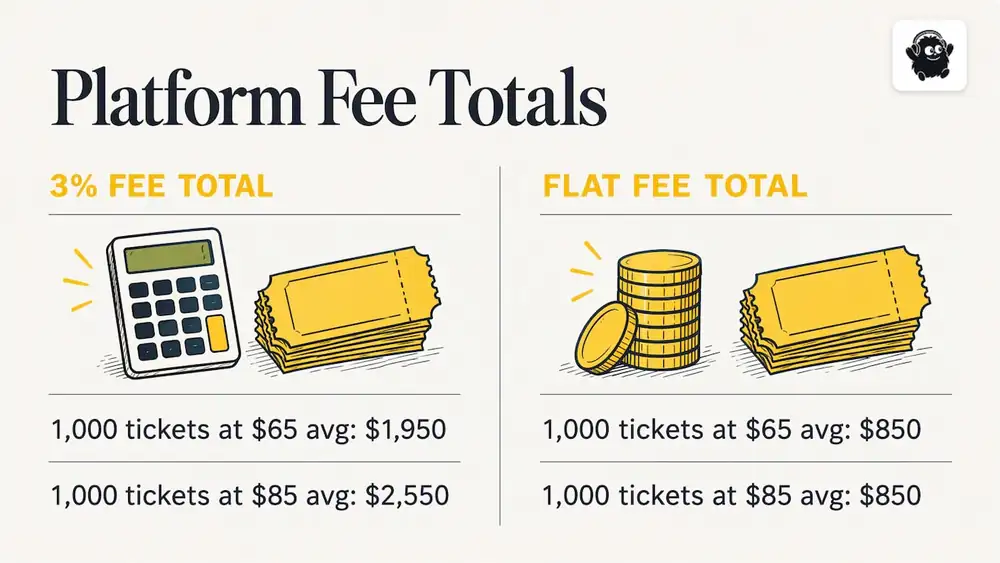
The fee structure of your ticketing platform matters here, because a reserved layout with higher-priced seats raises your average ticket price. Under percentage pricing, the platform's cut grows with every premium seat you add. Under a flat per-ticket fee, it does not.
Here is the arithmetic, using a hypothetical 3% platform fee for illustration (not a quote from any named provider). On 1,000 tickets at an average of $65 each, a 3% fee comes to $1.95 per ticket, or $1,950. A flat fee of $0.85 per paid ticket comes to $850 on the same 1,000 tickets. If your average price rises to $85 through premium seating, the 3% fee rises to $2,550, while the flat fee stays at $850. That is why a flat fee is usually cheaper as your prices climb, though not in every case: at very low ticket prices, a small percentage can come out lower. Card processing fees are separate in both cases and are paid to the payment processor at its own rate.
Our perspective
We see the GA vs reserved decision as a question about the whole event, not only the ticket. A seat map changes your pricing, your door flow, your staffing and your guest messaging at once. The organizers who get it right usually decide the layout before they decide the ticket price, and they test the check-in flow for each ticket type before doors open.
In our experience of how organizers use the platform, the hybrid model is where the tools matter most: a standing area with a cap, reserved sections behind it, tables sold as units, and accessible and companion seats tagged on the same map. That is why we built seat maps, QR check-in from any phone and door sales into one system. The map you sell from is then the same data your staff members scan at the gate.
Our advice: if you are unsure, start with the layout your room naturally supports, price the best spots honestly, and give guests a clear description of what each ticket includes.
Setting up reserved seating with Eventist
If you are planning a seated or hybrid event, Eventist supports general admission and reserved seating with seat maps, plus QR check-in and a built-in point of sale for door sales. As of October 2026, the pricing page lists Canadian organizers at $0.85 CAD per paid ticket for event ticketing and $4.99 CAD per paid ticket for festivals and conferences. Venues are priced differently, at 0.5% to 1.9% of what they charge on everything they sell, single tickets included, so check the venue page for details. Free tickets and registrations run on monthly plans starting from $100 CAD. Card processing fees go to Stripe or Square at their own rate. For a comparison of platforms that handle seating, see our guide to ticketing platforms with reserved seating.
Frequently Asked Questions
Is general admission cheaper than reserved seating?
Usually, yes. GA tickets tend to be priced lower because the guest is not buying a guaranteed spot, while reserved seats are often priced by location. There are exceptions: a close-up GA pit can cost more than a rear reserved seat, as the Texas venue pricing above shows.
Does general admission mean standing?
Not always. At many concerts it does, and the listing will say "standing room only". At other events, GA means open seating, where you choose any free seat. Check the event page or ask the venue before you buy.
Can an event use both reserved seating and general admission?
Yes, and many do. A common layout is a GA floor in front of the stage with reserved seats in the tiers behind it. Each zone gets its own ticket type, price and entry instructions.
Do I need to offer accessible seats if I sell reserved tickets?
In the United States, the ADA sets ticketing rules for accessible seating, including the same sales methods and no higher price as other seats in the section. In Canada, requirements depend on your province and venue. This is general guidance, not legal advice, so confirm with your venue and a qualified advisor.
How do I decide between GA and reserved for a festival?
Most festivals use GA day passes because guests move between stages, then add reserved or VIP areas for premium viewing. Work out which spots are valuable enough to sell separately, and keep everything else open.
Sources
- ADA Requirements: Ticket Sales, ADA.gov
- 28 CFR § 35.138, Ticketing, Legal Information Institute
- Reserved Seating vs. General Admission Tickets, Softjourn
- Midland at Floore's Country Store
- Allen Stone and Ripe in The Caverns
- William Black at SOMA San Diego
- Ed Sheeran Loop Tour 2026, North America
- Trying to decide between GA or reserved seating, Reddit
- Does general admission mean rushed seating, Facebook group
Recommended
Tags
Ready to simplify your events?
Join hundreds of organizers, studios, and festival directors who trust Eventist to run their events.