Supplier Diversity in Event RFPs: Verifying the Claims
If you run events for a public body, a university, a hospital or a large company, supplier diversity has probably arrived in your procurement paperwork. Somewhere in the RFP template there is now a question asking whether the vendor is woman-owned, Indigenous-owned or otherwise diverse, and a box for them to tick.
The box is the easy part. The hard part is that a tick, and a line on a vendor's About page, are not evidence of anything. This guide covers what each category actually means in Canadian procurement, which bodies verify which claims, what the federal 5% Indigenous target obliges, and what to ask a vendor for when the answer has to hold up.
This article is general guidance for event and procurement teams, not legal or procurement advice. Check your own organization's policy and, for federal contracts, the governing directive.
TL;DR
- "Woman-founded" and "woman-owned" are different claims. The procurement definition is majority ownership plus control, not who started the company.
- The common Canadian test is at least 51% owned, managed and controlled by people in the relevant group.
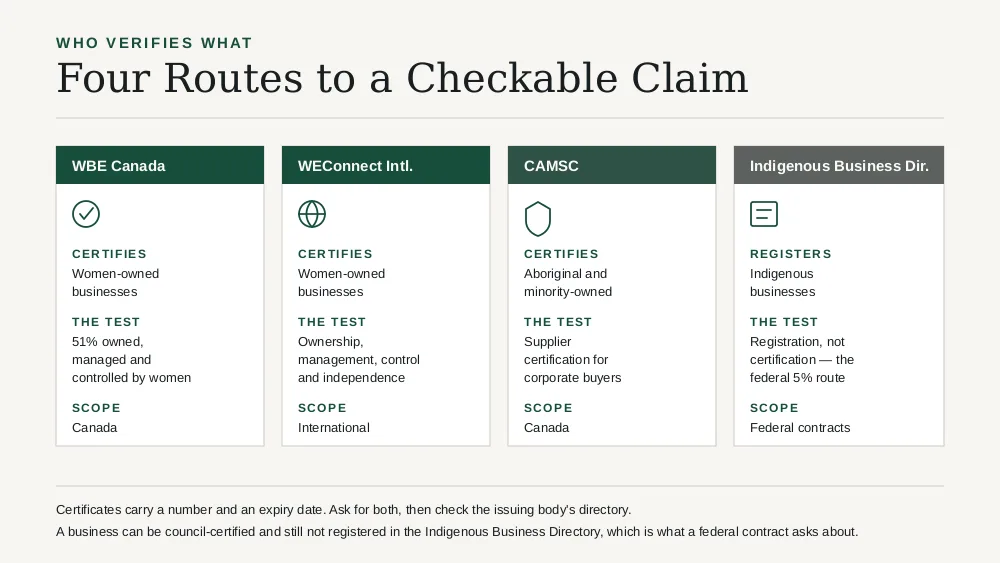
- Third-party certification is the strongest evidence. WBE Canada and WEConnect International certify women-owned businesses; CAMSC certifies Indigenous and minority-owned suppliers.
- Federal departments carry a mandatory minimum 5% Indigenous procurement target, with its own definition and directory, separate from any certification.
- For an uncertified vendor, a written ownership statement naming owners and shares is a reasonable substitute. A website claim is not.
What the categories mean
Supplier diversity programs usually recognise several distinct groups, and the definitions are not interchangeable.
Women-owned. The standard Canadian test, used by WBE Canada, is an independent, for-profit business that is at least 51% owned, managed and controlled by one or more women, legally established in Canada with its principal place of business in Canada, or majority owned and controlled by women who are Canadian citizens or permanent residents, with daily operations directed by one or more women.
Indigenous-owned. For the federal 5% target, Indigenous Services Canada defines an Indigenous business as one owned and operated by Elders, band or tribal councils, a business registered in the Government of Canada's Indigenous Business Directory, or a business registered on a modern treaty beneficiary business list. Note that this is a *registration* test, not a certification test.
Minority-owned. The Canadian Aboriginal and Minority Supplier Council certifies Aboriginal and minority-owned suppliers, operating the Canadian equivalent of the supplier councils large corporate buyers use elsewhere.
Other categories appear in individual programs, including veteran-owned, 2SLGBTQ+-owned, and disability-owned business certifications. Which ones your organization recognises is a policy decision, and it should be written down before the RFP goes out, not negotiated afterwards.
The difference that trips everyone up
A woman founded the company. A woman runs the company. Women own the majority of the company. These are three different statements, and most procurement programs only count the third.
This matters enormously in event software, because the best-known platforms were frequently co-founded by women and are now publicly traded or venture-backed. A woman CEO of a public company is woman-*led*, which matters for plenty of reasons, but it does not meet a 51% ownership test, because the shareholders own the company. Our guide to woman-owned ticketing software works through which platforms meet which definition.
The same distinction applies across every category. "Founded by", "led by" and "owned by" need to be read carefully, and a vendor who blurs them in a proposal is telling you something.
Certification, self-declaration, and the gap between them
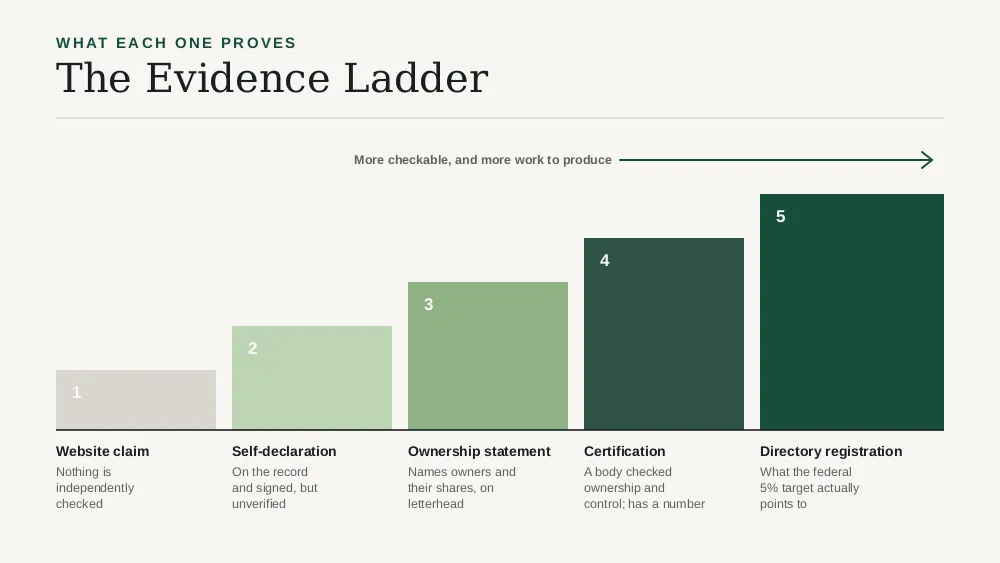
Think of vendor evidence as a ladder, because what you should accept depends on what the contract is worth and what your policy requires.
1. A claim on a website. No independent verification. Fine as a starting signal, worthless as evidence.
2. A self-declaration on the RFP form. The vendor asserts it, usually with a signature. Better, because it is on the record and misrepresentation has consequences, but nobody has checked it.
3. A written ownership statement. The vendor names the owners and their percentage shares, on letterhead, signed by an officer. This is the practical middle ground for small suppliers, and a reasonable thing to ask for.
4. Third-party certification. A certifying body has examined ownership, management, control and independence, and issues a certificate with a number and an expiry date. Ask for the number and check the certifying body's directory.
5. Government directory registration. For Indigenous businesses and federal contracts, registration in the Indigenous Business Directory or on a modern treaty beneficiary list is what the directive actually points to.
The certifying bodies
WBE Canada certifies Canadian women's business enterprises against the 51% ownership, management and control test, and maintains a directory that corporate and government buyers use.
WEConnect International certifies women-owned businesses internationally against four criteria: ownership, management, control and independence. Its WECommunity directory is visible to its member buyers, which is the point of it for a supplier selling across borders.
CAMSC, the Canadian Aboriginal and Minority Supplier Council, certifies Aboriginal and minority-owned suppliers for buyers running Canadian supplier-diversity programs.
The Indigenous Business Directory, run by the Government of Canada, is the registration route that the federal 5% target refers to. It is not a certification body in the same sense, and this difference catches people out: a business can be legitimately Indigenous-owned and certified by a council while not being registered in the IBD, which is what a federal contract will ask about.
The federal 5% target, and why it reaches event budgets
The Government of Canada requires that federal departments and agencies award a minimum of 5% of the total value of contracts to Indigenous businesses annually, with departments required to meet or exceed the target by the end of fiscal 2024–25. The Treasury Board's Directive on the Management of Procurement sets out the mandatory procedures in its Appendix E.
For an events team inside or adjacent to the federal system, this is not an abstraction. Conference registration, ticketing, AV, catering, printing and venue services all count toward contract value, so the question of whether a supplier is Indigenous-owned attaches to procurement decisions that used to be made purely on price and function. If you are responding to a federal RFP rather than issuing one, expect the question and expect your answer to be checked against the directory.
What to put in the RFP
Ask questions that produce checkable answers:
- Which category do you claim, and under whose definition? Naming the standard stops a vendor answering a different question.
- Are you certified, and by whom? Ask for the certifying body, the certificate number and the expiry date.
- If not certified, provide a signed ownership statement naming the owners and their percentage shares.
- Where is the business legally established and principally located? Several certifications turn on this, not only on who owns the shares.
- Is the claim current? Ownership changes. An investment round, an acquisition or a founder's exit can end a 51% position without anything on the website changing.
And decide in advance how you will weight the answer. A diversity criterion that is worth two points out of a hundred changes nothing and costs everyone time; one that is a mandatory gate needs to be stated as a gate before anyone writes a proposal.
Where this goes wrong
- Accepting the About page. The single most common failure. It is a marketing page, not a filing.
- Treating "certified" as self-evident. Certifications expire, usually annually. Ask for the date.
- Confusing the Indigenous Business Directory with certification, in either direction, on a federal contract.
- Asking the question and then not using the answer, which teaches vendors that the section is decoration.
- Not re-checking on renewal. A multi-year contract outlives a certificate and sometimes the ownership behind it.
Our perspective
Our honest view is that the verification burden mostly falls in the wrong place. Large suppliers have procurement teams who produce certificates on request; small suppliers, which is where most genuinely diverse-owned businesses actually are, often have not spent the money and the weeks on certification because no buyer had asked yet. A programme that accepts only third-party certification therefore filters toward larger firms, which is close to the opposite of the intent.
So the practical balance we would argue for is to require certification where the contract value justifies it, accept a signed ownership statement below that threshold, and be explicit in the RFP about which applies. That keeps the claim checkable without making the paperwork the qualifying criterion.
Where Eventist fits
For transparency, since this article is about verifying claims: Eventist was founded in May 2021 in Kitchener, Ontario by Ciara Azam, who runs the company. It is bootstrapped with no outside investors, which makes it founder-owned and woman-owned under the majority-ownership test, not only woman-founded. We are happy to provide a written ownership statement for a procurement file on request.
On the platform side, if your RFP response or your own event procurement needs the paper trail, Eventist keeps exhibitor and vendor records, signed contracts and attendee data in one exportable system, so the documentation behind an event is retrievable rather than reconstructed. The events platform page covers the general feature set and the pricing page shows the flat per-ticket fee.
Frequently Asked Questions
What does supplier diversity mean in a procurement context?
It is a buyer's practice of deliberately directing a share of spending to businesses owned by groups that have historically been under-represented among suppliers, most commonly women, Indigenous peoples, and visible minorities, with other categories recognised by individual programs. In Canada, the common test is that the group holds at least 51% ownership and also manages and controls the business, so it is a question about who owns and runs the company rather than who works there.
What is the difference between woman-owned and woman-led?
Woman-owned means women hold a majority of the company, usually at least 51%, and control its operations. Woman-led means a woman runs it, regardless of who owns the shares. A publicly traded company with a woman CEO is woman-led but not woman-owned, because its shareholders own it. Supplier-diversity programs almost always use the ownership definition, so the distinction decides whether a vendor qualifies at all.
How do I verify that a supplier is actually woman-owned?
Ask for a certification from WBE Canada, WEConnect International, or WBENC in the United States, and ask for the certificate number and expiry date so you can check it against the certifying body's directory. These bodies examine ownership, management, control and independence rather than taking the claim at face value. If the supplier is not certified, which is common among small businesses, ask for a signed ownership statement on letterhead naming the owners and their percentage shares.
What is the federal 5% Indigenous procurement target?
It is a requirement that federal departments and agencies award a minimum of 5% of the total value of their contracts to Indigenous businesses each year, with departments required to meet or exceed it by the end of fiscal 2024–25. For this purpose an Indigenous business is one owned and operated by Elders, band or tribal councils, one registered in the Government of Canada's Indigenous Business Directory, or one on a modern treaty beneficiary business list. The mandatory procedures sit in Appendix E of the Treasury Board Directive on the Management of Procurement.
Is a self-declaration ever enough?
It depends on contract value and your own policy, and it is reasonable to set a threshold. For a small contract, a signed declaration or a written ownership statement is proportionate, and insisting on certification mainly filters toward larger suppliers that can afford the process. For a significant contract, or any contract where the diversity criterion affects the award, ask for third-party certification or directory registration. Whichever you choose, say so in the RFP so vendors know what will be accepted.
How often should diverse supplier status be re-checked?
At every renewal, and on any contract running longer than a year. Certifications typically expire annually, and ownership itself can change through an investment round, an acquisition or a founder's departure without any public announcement. Treat the status as a dated fact rather than a permanent attribute, and record the date you verified it alongside the certificate number.
Sources
- WBE Certification for Canadian Women Owned Businesses, WBE Canada
- WEConnect International Certification
- Supplier Certification, Canadian Aboriginal and Minority Supplier Council
- Mandatory minimum 5% Indigenous procurement target, Indigenous Services Canada
- Directive on the Management of Procurement, Appendix E, Treasury Board of Canada Secretariat
Recommended
Tags
Ready to simplify your events?
Join hundreds of organizers, studios, and festival directors who trust Eventist to run their events.