Sched Alternatives for Event Organizers in 2026
The best Sched alternative depends on what you need beyond a published programme. Choose Whova if attendee networking is the priority. Choose EventMobi or Eventee for a mobile-first attendee experience. Choose Cvent, Bizzabo or Stova if you run an enterprise events portfolio and have the budget. Choose an all-in-one platform such as Eventist if you also sell tickets, manage seating, check people in and coordinate vendors and staff. This guide compares them on what organizers actually weigh: event type, ticketing and registration, pricing model and day-of operations.
TL;DR
- Sched is built around conference scheduling and session management. Most reasons to leave it come down to wanting ticketing, seat maps, booths or door sales in the same system.
- Cvent, Bizzabo and Stova are enterprise suites with quote-based or five- and six-figure annual pricing. Whova and EventMobi sit in the mid-market. Eventee is aimed at smaller corporate events.
- Eventist charges a flat fee per paid ticket, not a percentage, and covers scheduling, ticketing, check-in, maps and booths in one place. Fees on this page are as of November 2026.
- Match the tool to the event: a multi-day conference, a festival, a trade show and a comedy night need different things.
What Sched does well, and why organizers look elsewhere
Sched is a conference scheduling tool. It handles session management, attendee schedules and personalized agendas, and reviewers on Capterra describe it as affordable and cite savings on printed programs. Capterra lists a free version and trial, with the Launch plan starting at $600 per year on usage-based pricing, Boost at $1,500 per year and Ultra at $3,900 per year.
That focus is also the reason people search for alternatives. Typical triggers:
- You need to sell tickets, with tiers, promo codes and reserved seating, not only publish a schedule.
- You run exhibitors or vendors, and need booth maps and exhibitor contact in the same place as the programme.
- You need on-site operations: QR check-in, door sales and staff roles.
- You want attendee networking or a branded mobile app that goes further than a schedule.
- You run a festival or multi-stage event where schedules, maps and artist logistics are tied together.
None of these is a flaw in a scheduling tool. They are different jobs, and the right alternative depends on which one you are hiring software for.
How to compare Sched alternatives
Five criteria separate the options in practice:
1. Event type. Conferences, festivals, trade shows, venues and community events have different needs. A tool that suits a 300-person association meeting may be wrong for a three-stage festival.
2. Scope. Does it cover scheduling only, or also registration, ticketing, seating, check-in and exhibitors?
3. Pricing model. Annual licence, per-event fee, per-ticket percentage or flat per-ticket fee. These behave very differently as you grow.
4. Implementation effort. Some enterprise platforms take months to deploy. Others you can set up in an afternoon.
5. Support. Who helps you configure the event, and when?
The event management market in 2026 splits roughly into enterprise suites for large portfolios, marketing-led tools for product-focused teams and virtual-hybrid platforms for mixed formats, according to the Zendikt review of event management software. That split is a useful map for the shortlist below.
Sched alternatives at a glance
| Platform | Best for | Pricing model | Main trade-off |
|---|---|---|---|
| Whova | Conferences that want an attendee community and networking | Quote-only | Wider registration and exhibitor scope may duplicate tools you already run |
| EventMobi | Mobile-first engagement, registration and on-site operations | From $3,500 | Starting price is high for small events |
| Eventee | Smaller corporate events with social features | From $1,499 per event | Gamification may add little to formal meetings |
| Cvent | Large enterprise event portfolios | Quote-only, typically $30K to $1.5M+ per year | Months-long implementation |
| Bizzabo | Marketing-led enterprise event teams | Typically $40K to $300K+ per year | Opaque pricing |
| Stova (formerly Aventri) | Mid-market and enterprise meetings programs | Typically $25K to $400K per year | Enterprise scale and cost |
| Eventist | Festivals, conferences, trade shows, venues, concerts and ticketed events | Flat fee per paid ticket, monthly plans for free-ticket events | Not an enterprise suite built around quote-based contracts |
Figures for Cvent, Bizzabo and Stova are Zendikt's typical ranges for Canada, published in its Canadian event management software ranking. Eventee and EventMobi starting prices come from a comparison of Sched alternatives. Always confirm current pricing on each provider's own page.
The alternatives in detail
Whova
Whova focuses on attendee networking, per the Zendikt review, and lists quote-only pricing. It suits conferences where attendees meeting each other, discussing sessions and engaging with sponsors is a core outcome. If your event is a ticketed festival or a trade show with a floor plan, you will likely need to look at how it handles seating and booths before committing.
EventMobi
EventMobi is described as mobile-first. A Sched alternatives comparison places it as a provider that brings attendee engagement, registration and on-site operations together, with a starting price of $3,500. It fits organizers who want a branded attendee app and who run events large enough to justify that entry cost.
Eventee
Eventee leans on social activity, gamification and match-based networking for a mobile-first audience, with pricing from $1,499 per event according to the same comparison. It is a reasonable fit for internal conferences and customer days where an app is part of the experience.
Cvent
Cvent remains the installed-base market leader in event management, with implementation that Zendikt puts at three to six months for full deployment. Pricing is quote-only. Zendikt's Canadian ranking also flags per-event registration fees, separately priced apps or badging, implementation services of $25K to $200K and annual increases of 8 to 12%. It is built for organizations running many large events at once. If you are weighing it, our guides on Cvent alternatives and Eventist versus Cvent for conferences go deeper.
Bizzabo
Bizzabo is positioned for marketing-led enterprise event teams, with typical pricing of $40K to $300K+ a year, per Zendikt. It is seen as a modern enterprise option with a cleaner interface than the largest suites. See our roundup of Bizzabo alternatives if you are comparing at that level.
Stova (formerly Aventri)
Aventri merged with MeetingPlay and Eventcore in 2022 to form Stova, and the Aventri brand is no longer marketed separately, according to an overview of Cvent competitors. Stova covers event lifecycle management, including registration, mobile event apps and venue sourcing for mid-market and enterprise meetings programs. If you found Aventri in an older "best of" list, Stova is the current name.
Eventist
Eventist is a Canadian platform that sells tickets and also helps organizers run the event. For scheduling, it offers multi-stage and multi-track schedules with live maps and speaker and artist dashboards. Around that sit general admission and reserved seating with seat maps, registration, QR check-in from any phone, a built-in point of sale for door sales, vendor and exhibitor booths, and staff roles with a run of show. Marketing tools include abandoned-cart recovery emails, SMS reminders and influencer referral links. Organizers also get setup help from a Canadian team.
That breadth makes it a fit for festivals, conferences, trade shows, venues, concerts and everyday ticketed events such as workshops, comedy nights and fundraisers.
Which alternative fits which event
| Your event | What to prioritize | Shortlist |
|---|---|---|
| Association or academic conference, a few hundred people | Agenda, speaker management, attendee app | Sched, EventMobi, Eventee, Whova |
| Large corporate programme across many events | Governance, integrations, enterprise support | Cvent, Bizzabo, Stova |
| Multi-stage festival | Multi-stage schedule, live map, artist dashboards, ticketing | Eventist |
| Trade show or expo | Booth maps, exhibitor management, registration | Eventist, Cvent |
| Venue or concert with reserved seats | Seat maps, door sales, check-in | Eventist |
| Workshops, comedy nights, fundraisers | Fast setup, low per-ticket cost, simple check-in | Eventist |
If your event is a conference that needs to sell tickets and has a floor plan with sponsors, the question is whether you want one system or a scheduling tool plus separate ticketing. Running one system means fewer exports between tools and a single attendee list.
What alternatives really cost
Pricing models are where the alternatives diverge most:
- Annual licences (Sched, and the enterprise suites): predictable once signed, but you pay whether or not you run events that year. Enterprise suites often add implementation fees and annual increases.
- Per-event pricing (Eventee, some mid-market tools): fits organizers with one or two events a year.
- Percentage per ticket: cheap on low-priced tickets, but cost rises with ticket price.
- Flat fee per paid ticket: cost is the same whether a ticket sells for $20 or $200, which makes budgeting simple.
If you are comparing subscription costs, add-on fees and pricing models across planning tools, this overview of project management tools for event planners is a useful companion for the planning side of the budget.
Eventist fees for Canadian organizers
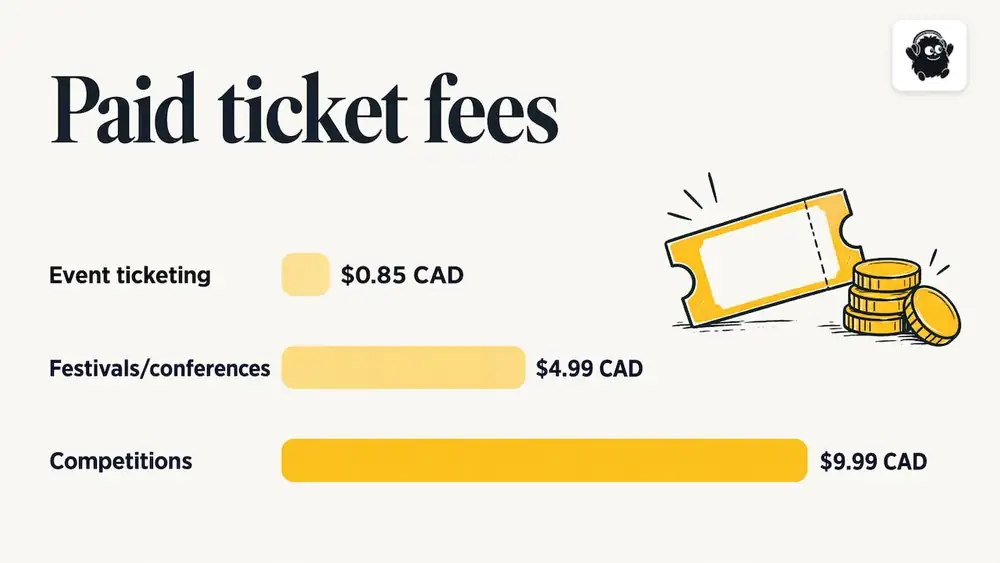
As of November 2026, the Eventist pricing page lists these per paid ticket for Canadian organizers:
| Event type | Fee per paid ticket |
|---|---|
| Event ticketing | $0.85 CAD |
| Festivals and conferences | $4.99 CAD |
| Competitions | $9.99 CAD |
Tickets and registrations that are not paid run on monthly plans starting from $100 CAD per month, with Growth at $500 CAD and Enterprise at $2,250 CAD. For paid ticketing there is no subscription. Venues are different: they pay 0.5% to 1.9% of what they charge on everything they sell, single tickets included, so there is no flat per-ticket fee for venues.
Card processing fees are separate. They are paid to Stripe or Square at their own rate.
The arithmetic: why a flat fee is usually cheaper
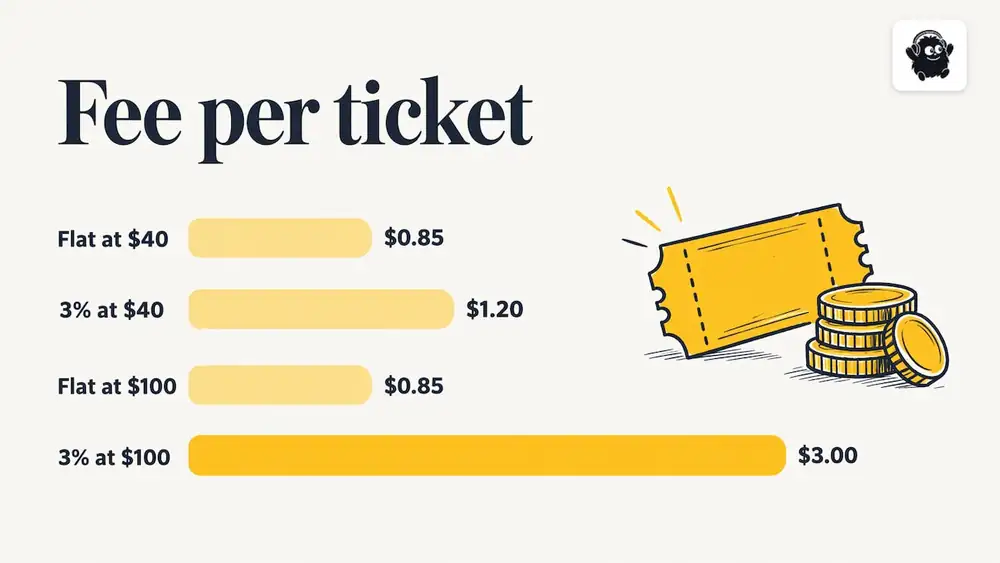
Take an everyday ticketed event, such as a comedy night with 400 paid tickets at $40 each. The platform fee on a flat $0.85 CAD per ticket is 400 × $0.85 = $340.
Now compare a hypothetical platform that charges a 3% fee on the ticket price (an illustrative rate, not a named provider). That is $1.20 per ticket, so 400 × $1.20 = $480. The flat fee comes out $140 lower.
The gap widens with ticket price. At $100 a ticket, the same 3% is $3.00, against a flat $0.85. A percentage model only comes out cheaper on tickets priced under about $28 at that rate ($0.85 ÷ 0.03). That is why we say a flat fee is usually cheaper, not always. Run your own average ticket price through the same sum, and include any service fee the other platform charges your attendees.
Questions to ask before you switch
Switching mid-cycle costs time, so check these first:
- Can it sell and seat? If you need reserved seating, ask whether the seat map is built into the ticketing flow.
- Can it run the door? QR check-in on staff phones and door sales through a point of sale matter on the day.
- Who sets it up? Ask what implementation help is included and what it costs. For reference, Eventist lists done-for-you setup at $500 USD per day per stage and team training at $500 USD.
- What happens to renewals? Annual increases of 6 to 12% are flagged for the largest suites, per Zendikt.
- How do you pay? Check payout timing and which processor handles cards.
If you also need a broader view of ticketing, our event ticketing platform comparison and the Eventbrite alternatives guide cover the ticketing side in detail.
Our perspective
Scheduling is only one part of running an event. A programme that looks perfect on screen still has to meet a ticket count, a seat map, a door line, a vendor load-in and a team of staff members who need to know where to be at 6 a.m.
That is why we built Eventist as one system. A multi-track schedule, a live map, speaker and artist dashboards, booth management, QR check-in, door sales and staff roles share the same attendee and ticket data, so changes made in one place are not re-keyed somewhere else.
We also think pricing should be easy to predict. A flat fee per paid ticket means you can work out platform cost before you set your ticket price, and the arithmetic stays the same as your prices change. For many everyday events this is usually cheaper than a percentage, and we show the sum so you can check it against your own numbers.
Canadian organizers also get hands-on help from a Canadian team, which matters most the first time you configure a festival or conference.
— Ciara
Run the whole event, not just the schedule
If you are replacing a scheduling tool and also need ticketing, seat maps, check-in and booths, Eventist's pricing page lists every fee and plan, and the services page lists setup and support options. Venues can start with the venue page.

For organizers who sell paid tickets, the flat-fee ticketing page explains how the fee works for everyday events.
Frequently Asked Questions
What is the best alternative to Sched for a large conference?
For large enterprise programmes, Cvent, Bizzabo and Stova are the usual names, with typical annual pricing from the tens of thousands of dollars upward. For a conference that also needs ticketing, a floor plan and on-site check-in in one system, Eventist is worth shortlisting. Match the tool to your budget and how long you can spend on implementation.
Is there a cheaper Sched alternative for small events?
Sched's own entry plan is listed at $600 per year on Capterra, so the cheapest route depends on what you need besides scheduling. Eventee starts at $1,499 per event. If you sell paid tickets, Eventist charges $0.85 CAD per paid ticket for event ticketing, which is usually cheaper than a percentage fee on typical ticket prices.
Which Sched alternatives handle reserved seating and booths?
Enterprise suites such as Cvent cover exhibitors and registration at scale. Eventist includes seat maps for general admission and reserved seating, plus vendor and exhibitor booths. Ask any vendor to show the seat map or booth builder working with your own layout.
Is Aventri still available?
Aventri merged with MeetingPlay and Eventcore in 2022 to form Stova, and the Aventri brand is no longer marketed separately. Existing customers can find updated documentation under the Stova name.
Sources
- Sched Software Pricing, Alternatives & More 2026 (Capterra)
- Event Management Software: 10 platforms ranked (Zendikt)
- Top 10 Event Management Software in Canada for 2026 (Zendikt)
- Cvent Competitors 2026: 8 Honest Picks
- 7 Best Sched Alternatives for Small Corporate Event Teams
Recommended
Tags
Ready to simplify your events?
Join hundreds of organizers, studios, and festival directors who trust Eventist to run their events.