Immersive Event Experiences: How to Design Them
An event becomes immersive when attendees stop watching and start taking part, and when what they see, hear, touch and do all point to the same world. You don't need a large budget for that. You need a clear idea of the experience, a layout that lets people move through it, and a way to check afterwards that it worked. This guide covers the definition, the design choices, gamification, accessibility, measurement and the operations that keep it running.
TL;DR
- Research on immersive events points to three ingredients that need to be present together: interaction, sensory experience and localisation (a sense of place).
- Start with one attendee journey, then add touchpoints (a game, a build, a scan, a scent) that serve it, rather than stacking technology.
- Gamification works best when missions are tied to the event's own content, such as booth visits or session attendance, and each one can be measured.
- Plan accessibility, safety and staffing at the start, and set measurable goals before you build anything.
- Immersive formats still run on basics: ticketing, seat or booth maps, check-in and schedules that hold together on the day.
What makes an event immersive
A 2020 study by Sobitan and Vlachos proposes that an immersive event arises when interaction, sensory experience and localisation are present at the same time in one time-space. Their survey of 201 people who had attended an immersive event in the past year also found that novelty and entertainment weigh heavily on why people attend.
That gives organizers a practical test with three questions:
1. Interaction: can attendees change something, solve something or contribute something?
2. Sensory experience: does more than one sense get engaged, through sound, light, touch, scent or taste?
3. Localisation: does the space feel like a specific place, with a theme or story, rather than a generic hall?
The Immersive Experience Institute describes the goal as creating the illusion of being there, and adds that how a medium is used matters more than which medium it is. A VR headset in a plain corner is not immersive. A simple physical set with a clear story can be.
This is also why the term covers so many formats: a festival arena, a trade show booth, a conference lobby, a gala dinner or a gallery night. The format changes, but the test stays the same.
Examples from festivals, conferences and trade shows
Looking at what has worked at scale shows which design moves transfer to smaller events.
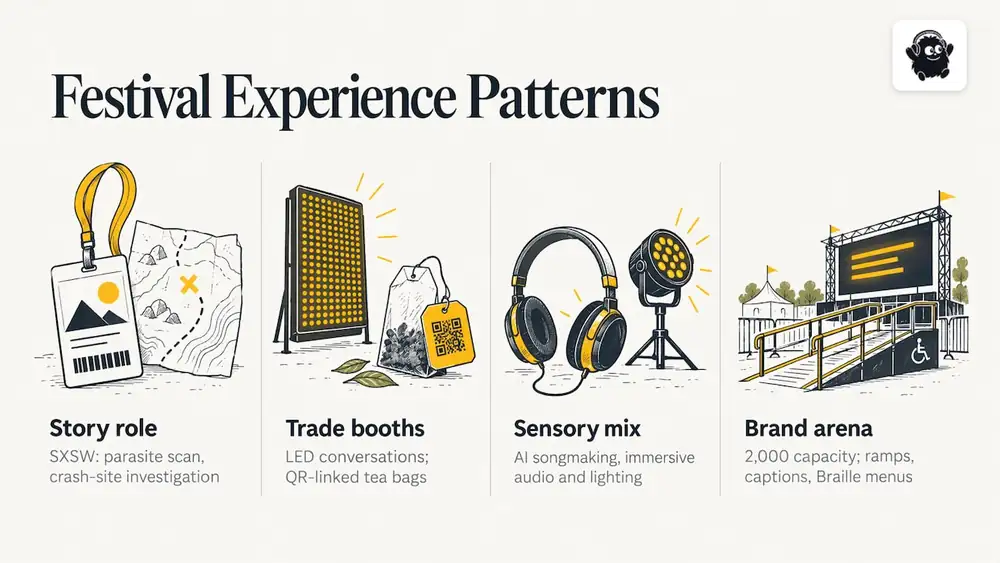
Story-driven activations. At SXSW 2025, FX's "Alien: Earth" activation scanned attendees for fictional parasites, issued credentials and sent them through a crash-site investigation. A television promotion became a narrative visitors took part in. The lesson: give people a role and a reason to move through the space.
Hands-on trade show booths. At CES 2023, Reddit's "Future Tellers" installation displayed real Reddit conversations on a large LED display, while a tea bar linked messages on tea bags to their source threads through QR codes. Canon's booth in the same report recreated a cabin from a film in a fabricated forest and let visitors use VR to enter the story. A physical object plus a scan is a low-cost pattern any exhibitor can copy.
Sensory variety. At IMEX America 2025, Encore built a train-themed experience with AI-assisted song co-creation, immersive audio and lighting, while other exhibitors used scent, LEGO-based problem solving and retro 3D viewfinders. Not one of these needed a huge screen.
Flexible zones. For SXSW 2026, organizers created three Clubhouses, for Film & TV, Music and Innovation, combining programming, collaboration spaces, live music and partner activations. Themed zones gave attendees a place that felt like it belonged to their interest.
Festival brand arenas. At Electric Picnic, Smirnoff built a 2,000-capacity arena with live DJs, immersive lighting, guests joining on stage, live art, upcycling workshops and a roaming circus. The same activation included lifts, ramps, lowered counters, captions, sign-language interpretation and Braille menus. Accessibility was part of the design, not an afterthought.
Designing the experience step by step
Start with one attendee journey
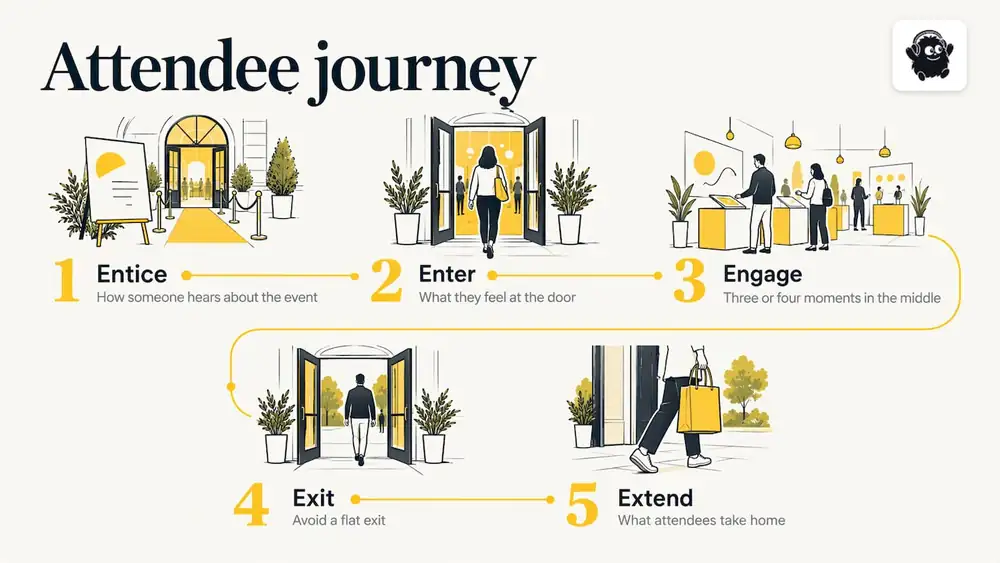
Write the journey in a few lines: how someone hears about the event, what they feel at the door, three or four moments in the middle, and what they take home. The Association for Talent Development describes a 5Es framework of Entice, Enter, Engage, Exit and Extend, which fits this structure well. Immersion often fails at the edges: a confusing entry queue breaks the spell before it starts, and a flat exit wastes the emotion you built.
Pick a theme that can be built in three dimensions
A theme that only lives on signage is decoration. A theme that changes the route, the lighting, the sound, the staff members' roles and the food is localisation. Choose something your audience already cares about: the genre of a music festival, the industry of a conference, the product story of a brand.
Let attendees shape their own path
PCMA's 2025 guidance on engaging every attendee recommends letting attendees customize their experience through flexible content and formats, building connections between guests and using interactive polling or emoji stickers to read emotional response. It also notes that Marriott International used tactile tools such as building blocks and slime to create inclusive sensory experiences. Choice is a form of interaction: parallel tracks, optional side rooms and self-guided routes all give it.
Use technology to carry the story
VR, AR, projection, audio and QR triggers are tools, not the experience. A useful rule is one technology per moment, each with a clear purpose. If you want to capture what attendees do with it, event engagement tracking methods show how scans and responses can be tied back to your goals. And if the technology serves a message, storytelling to boost brand engagement is a good frame for deciding what the narrative should be before you pick the hardware.
Plan the physical flow
Immersive spaces fail when people bunch up. Draw the route, mark pinch points, and decide where attendees choose between options. For larger events, a clear digital map helps attendees find zones on their own; our guide to interactive venue maps covers the types and what to look for.
Scaling the idea: three budgets
| Event type | Immersive move | What it needs |
|---|---|---|
| Everyday ticketed event (workshop, comedy night, community show) | Themed entry, a hands-on station, a shared moment such as a vote or live poll | A small team, simple props, clear signage |
| Trade show or expo | A booth with a physical object, a scan or QR trigger, and a game or demo | Booth design, lead capture, staff trained to guide visitors |
| Festival or conference | Themed zones, multi-stage programming, a brand arena or clubhouse | Production crew, stage and zone schedules, accessibility planning |
In each case, the first step is the same: decide what attendees should do, feel and remember, then work backwards.
Gamification at events
Gamification adds goals, progress and rewards to behaviour you already want: visiting booths, attending sessions, meeting sponsors or sharing content. A 2024 peer-reviewed study in the journal Sustainability found that guiding visitors through missions in a metaverse exhibition improved their understanding of the offline exhibition's narratives, raised engagement with its themes, stimulated interest and promoted attendance. The setting was digital, but the principle applies on the floor: missions work when they lead people toward the content.
Practical formats:
- Passport or stamp trail: attendees collect scans at booths or stages. It sends traffic to quieter exhibitors.
- Team challenges: tables or groups compete across a conference day, which supports connection between guests.
- Scavenger hunts: clues tied to the venue's story or map, ideal for festivals.
- Live polls and votes: a lightweight way to make a keynote or a comedy night participatory.
- Unlockable rewards: a talk, a tasting or a meeting that opens after a set of missions.
Keep the rules short enough to explain in one sentence, make rewards relevant to the event, and decide before launch what each mission is meant to change. A badge scan only matters if you know which behaviour it stands in for.
Accessibility and safety
Immersion should never exclude people. Australia's Disability Gateway recommends that organizers choose an accessible venue and route, provide safety information in accessible formats, prepare evacuation plans for attendees with disabilities, train staff and consider a low-sensory space. That is Australian government guidance, but the practices are widely applicable. Build them in at the layout stage, because retrofitting ramps and quiet rooms is harder than planning them.
If your experience uses headsets, Meta's accessibility guidance for immersive design suggests involving people with disabilities from research through testing, allowing independent navigation, supporting seated use and alternate controls, and testing screen readers, text scaling and high contrast.
A few practical points:
- Flashing lights, loud audio, scent and dark rooms can overwhelm some attendees. Post what to expect at the entry and online ahead of time.
- Offer a quiet space and a route that avoids the most intense zones.
- Brief staff and volunteers so they can answer accessibility questions on the spot.
- Check capacity limits per zone and keep exits clear of props and set pieces.
This is general guidance, not legal advice. For permits, security, AV, insurance, contracts and tax, confirm requirements with your municipality, your insurer and a qualified professional before you build.
Measuring whether it worked
Decide what success looks like before you build. A guide to gamification in engagement suggests defining measurable objectives first, then tracking interaction time, drop-off rates, post-event visits to related content, badge scans and direct feedback. For events, that translates into a short list:
1. Participation rate: what share of attendees took part in the activity?
2. Time spent: how long did they stay at a station or zone?
3. Drop-off: where did people leave a mission trail or queue?
4. Follow-up behaviour: website visits, sign-ups or purchases after the event.
5. Direct feedback: quick polls or a one-question survey on the way out.
Connect these to ticketing and check-in numbers so you can compare the people who came with the people who engaged. Our piece on data analytics for event organizers goes deeper on which numbers matter.
Perspective
Immersive design gets the attention, but we see where it succeeds or fails: in the basics around it. A themed zone is only immersive if attendees can find it, get in on time and move through it without a bottleneck.
That is why we build Eventist as one system for the whole event. Ticketing with seat maps, QR check-in and door sales, multi-stage and multi-track schedules, live maps, vendor and exhibitor booths and staff roles all sit in one place, so the team can spend its attention on the experience rather than on stitching tools together.
Our advice to organizers is to design the journey first, then make sure every touchpoint on it can be scheduled, staffed and measured. That is the point where a big idea turns into an event that runs well.
— Ciara
Running immersive events with the right operations
The more zones, stages and activations you add, the more the operations matter. A few places where tooling helps:
- Scheduling across stages and tracks. Eventist offers multi-stage and multi-track scheduling and a run of show for staff, so parallel activations don't collide.
- Maps for navigation. Live maps and seat map builders help attendees find zones, and help you manage booths for exhibitors. See our page on trade show management and booth sales.
- Entry and door sales. QR check-in from any phone and a built-in point of sale for door sales keep the first impression smooth.
- Staff and vendors. Staff roles and vendor dashboards keep everyone clear on where they should be.
For further reading, see our look at 2026 event management trends.
Pricing for immersive events on Eventist
Eventist is a Canadian platform, and pricing is a flat fee per paid ticket rather than a percentage. The figures below come from our pricing page and are as of November 2026.
| Event type | Canadian organizers, per paid ticket |
|---|---|
| Event ticketing | $0.85 CAD |
| Festivals and conferences | $4.99 CAD |
| Competitions | $9.99 CAD |
Events that run on free tickets or registrations use monthly plans starting from $100 CAD. Card processing fees are paid to Stripe or Square at their own rate. Venues pay 0.5% to 1.9% of what they charge on everything they sell, single tickets included. For organizers in the US, the per-ticket fees are $0.75 USD, $3.50 USD and $7 USD for the same three categories.
We say Eventist is usually cheaper than percentage pricing, and the arithmetic is simple. Take a hypothetical 5% fee on a $50 ticket: that is $2.50 per ticket, against a flat $0.85 CAD. On 1,000 paid tickets, that is $2,500 against $850, a difference of $1,650. The gap narrows as tickets get cheaper. On a $10 ticket the same 5% is $0.50, which is less than $0.85, so check your own average ticket price against any fee you are comparing. The 5% is an illustration, not a quote from any provider.
Organizers who want hands-on help can also look at our event services, where setup help and training are listed with their prices. To see how it fits your event, start with the pricing page.
Frequently Asked Questions
What is an immersive event experience?
It is an event where attendees take part in the environment instead of observing it. Research describes it as the combination of interaction, sensory experience and a strong sense of place. The medium matters less than how it is used.
Do I need VR or expensive technology to make an event immersive?
No. Many successful examples rely on physical sets, scent, sound, themed zones and simple QR triggers. Technology helps when it serves the story, but a well-designed route and a hands-on activity can deliver the same effect at a smaller scale.
How do I add gamification to a conference or trade show?
Pick one behaviour you want to encourage, such as visiting exhibitors or attending sessions, and build a simple mission around it, for example a passport with scans at each stop. Offer a reward that relates to the event and track completion so you can measure the effect.
How do I keep an immersive event accessible?
Plan it from the start. Choose an accessible venue and route, share information about lights, noise and scents ahead of time, provide a low-sensory space, prepare evacuation plans and train staff. Where you use headsets, support seated use and alternate controls.
Sources
- Immersive event experience and attendee motivation (Sobitan and Vlachos, 2020)
- Definitions, The Immersive Experience Institute
- Experiential Marketing for Events: 21+ Examples, Skift Meetings
- 13 Interactive Trade Show Booths, TSNN
- IMEX America 2025: Five Takeaways for Trade Show Marketers, Event Marketer
- How SXSW Reinvented Itself for 2026, BizBash
- Smirnoff Summer Collective, The Drum
- Five Secrets for Designing an Event That Will Engage Every Attendee, PCMA
- Transform Your Events Into Effective Experiences, ATD
- Implementation of a Gamification-Based Metaverse, Sustainability (MDPI)
- Plan accessible in-person activities, Disability Gateway
- Accessibility design, Meta Horizon
- Build Meaningful HCP Engagement Through Gamification, Real Chemistry
Recommended
Tags
Ready to simplify your events?
Join hundreds of organizers, studios, and festival directors who trust Eventist to run their events.