Workshop Registration: Capacity, Forms and the No-Show Problem
Steps at a glance
- Set the capacity from how the session runs. Count the equipment, the table space and how many people one instructor can watch, not the fire limit of the room.
- Open an automatic waitlist. Publish a waitlist rather than a sold-out page, and offer each freed place to the next person with a deadline.
- Ask only the questions you act on. Name, email, level if it matters, and anything you buy or prepare per person, with per-person questions asked per person.
- Decide the price, the deposit and the cutoff. Take a deposit when you buy materials, set a registration cutoff with a reason, and publish the cancellation terms next to the price.
- Confirm, then remind twice. Send the details immediately, a reminder a week out and a short one the day before, with an easy way to say they cannot come.
- Run the door and follow up. Check people in against one list, give the instructor the notes that matter, then ask two questions and offer the next date.
Workshop registration is not ticket selling with a different word on the button. A workshop has a hard capacity, a prerequisite someone will ignore, materials you have to buy in advance, and an instructor who needs a list of names the night before. Sell it like a concert and you get a full room of people who booked the wrong level, half of whom do not turn up.
This guide covers how to set up registration for a one-off or short-series workshop: capacity and waitlists, what to ask on the form, deposits and cancellation terms, the reminders that decide your no-show rate, and what the instructor needs in their hand on the day.
Key takeaways
- Capacity is a teaching limit, not a fire limit. Set it where the workshop still works and let the waitlist carry the rest.
- Ask for what changes how you run the session, and nothing else. Every extra question costs you registrations.
- A deposit converts interest into commitment. For materials-heavy workshops it is the difference between a budget and a guess.
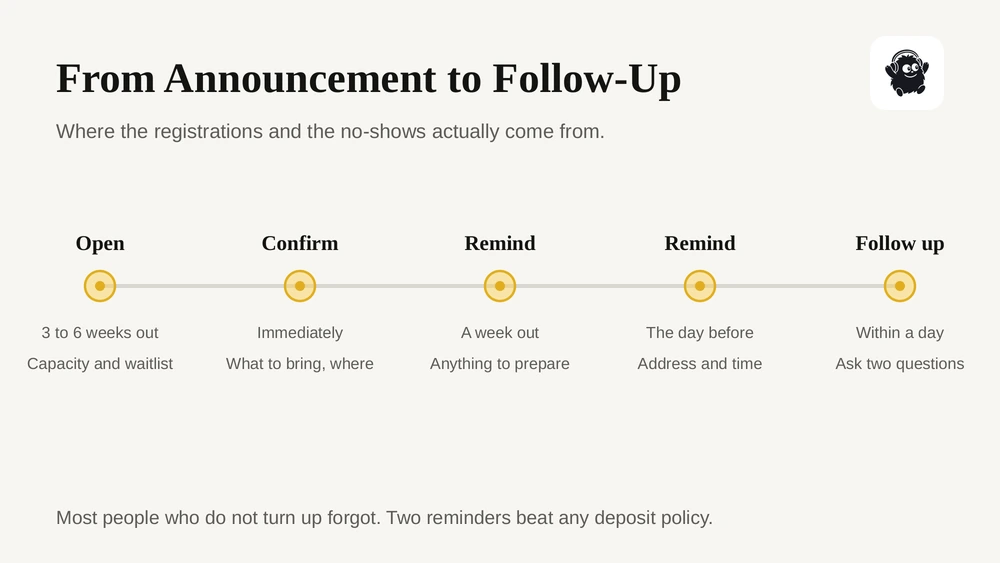
- Most no-shows are forgetting, not deciding. Two reminders are worth more than any deposit policy.
- Write the cancellation terms before you open registration, not when the first person asks.
Workshop registration is different
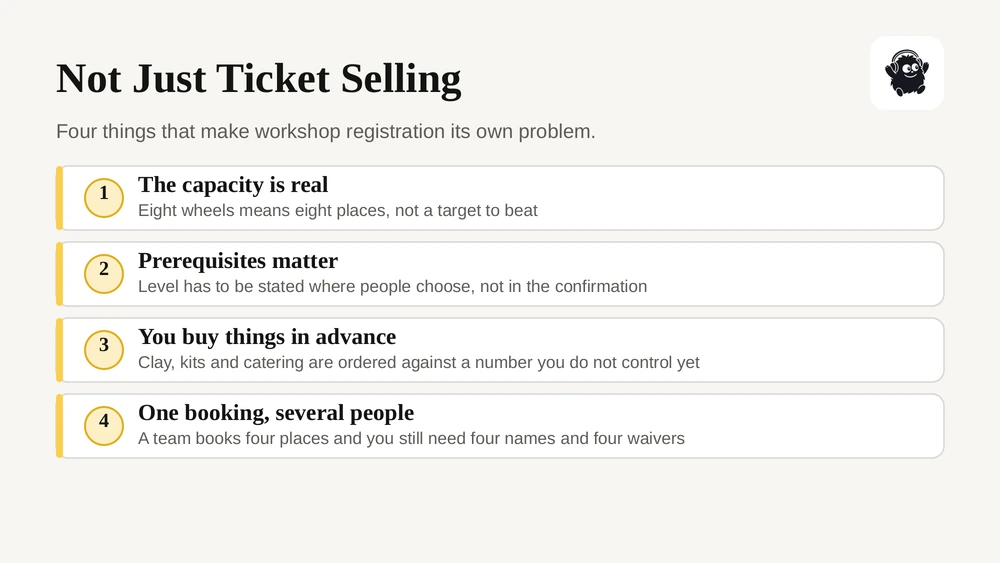
Four things make it its own problem.
The capacity is real. A pottery wheel class holds eight because there are eight wheels. A clinic holds twenty because beyond that nobody gets feedback. Overselling is not a revenue win; it is a refund and a bad review.
Prerequisites matter. Intermediate means something to you and nothing to the person booking. If level is a requirement, it has to be stated where they choose, not buried in a confirmation email.
You buy things in advance. Clay, ingredients, kits, print, catering. Your order is placed against a number you do not control yet, which is what the deposit and the cutoff are for.
One registration can be several people. A team books four places under one payment, and you still need four names, four dietary notes and four waivers. Our guide to group registration forms covers how one submission becomes separate attendee records.
Set the capacity, then the waitlist
Decide the number from how the session actually runs: equipment, table space, how many people one instructor can watch, how many the room holds with the layout you need.
Then publish a waitlist rather than a sold-out page. A waitlist is worth having for three reasons: it fills the places that cancellations create, it tells you whether to run a second date, and it gives you a list of warm people to tell when you do.
- Make the waitlist automatic. When a place opens, the next person gets an offer with a time limit. Manual waitlists die in an inbox.
- Give the offer a deadline. A few hours for a workshop next week, a couple of days for one next month.
- Count the waitlist before you add a date. Twelve people waiting for an eight-place class is a second session, not a bigger room.
The form: ask less than you want to
Every question is a chance to abandon the booking. The test for keeping one: does the answer change what you do?
Worth asking
- Name and email, and a phone number only if you would actually use it on the day.
- Experience level, when the workshop has one, as a choice rather than a free-text box.
- Anything you must buy or prepare per person: size, dietary needs, kit choice, machine preference.
- Accessibility needs, with a plain "anything we should know to make this work for you".
- The waiver, signed at checkout, when the activity needs one.
Not worth asking
- How they heard about you, unless someone reads the answers.
- A mailing address, unless something is being posted.
- Anything you could look up, such as a company name you already have on the invoice.
- Demographics you have no plan for.
Ask the per-person questions per person. A single answer on an order that covers four people tells you one person's shoe size and nothing about the other three.
Price, deposits and the cutoff
One price is a feature. Early-bird pricing works on big events because the decision is far away. On a workshop three weeks out, two prices mostly confuse. Use tiers when the series is long enough to deserve them.
Take a deposit when you buy materials. A deposit that becomes the full fee later converts interest into commitment and lets you order against something real. Payment plans are for multi-week courses, not for a Saturday afternoon. Our guide to payment plans and instalments covers how they are usually structured.
Set a registration cutoff and say why. "Registration closes the Tuesday before, because that is when we order the clay" is a reason people accept. An arbitrary cutoff is one they argue with.
Decide the cancellation terms up front. Full refund to a date, partial after, transfer to another date always. Write it next to the price. Our event refund policy guide covers how to word one that holds up.
Let people transfer rather than refund. A transfer keeps the money and the place filled, and it is what most people actually want.
Reminders: where the no-shows go
Most people who do not turn up did not change their mind. They booked six weeks ago and the date left their head.
- Confirmation immediately, with the date, time, address, what to bring, what to wear, parking and the cancellation terms. This email will be read more than your website.
- A reminder a week out, with anything they need to prepare.
- A reminder the day before, short, with the address and the start time.
- Make the address unmissable. The studio behind the building with the green door is where your no-shows come from.
- Ask people to tell you if they cannot make it. Give them a link. A cancellation two days out is a place you can fill.
Our guide to reducing no-shows covers the pattern in more detail; it was written for classes and applies to any session with a fixed capacity.
On the day
- One list, printed and on a phone. Names, levels, notes, and whether they have paid.
- Check people in as they arrive, by scanning or ticking, so you know who is missing before you start rather than after.
- Give the instructor the notes that matter: levels, injuries, dietary needs, the person who asked a question in advance.
- Keep two places back if the layout allows, for the person whose email went to spam.
- Have the waiver ready for walk-ins in whatever form you use, because one person will not have signed.
Our check-in operations playbook covers how to run a door that does not hold people up.
After the session
- Ask two questions, not ten. What was most useful, and what would you change. People answer two.
- Tell them what is next while they are still pleased. The best moment to sell the next workshop is the hour after this one.
- Record what actually happened. Registered, attended, waitlisted, refunded. Three sessions of that data tells you your real capacity and your real no-show rate.
- Keep the list, with consent. A workshop audience is small, specific and worth more than a general mailing list.
Where Eventist fits
Eventist treats a workshop as what it is: a session with a cap, a form and a list.
Capacity is set per ticket type, with an automatic waitlist that offers the place to the next person when someone cancels. Questions can be asked once on the order, like a company name, or per attendee, like a level or a dietary need, so a registration that covers four people produces four answers rather than one. Waivers are signed electronically at checkout, before anyone arrives.
Deposits and instalments are built in where the workshop needs them, confirmation and reminder emails go out automatically, and transfers let someone move to another date without a refund. On the day, every registration carries a QR code that any phone can scan, and the list of who has arrived updates as you go.
Pricing is a flat fee per paid registration rather than a percentage, so a $250 workshop costs the same to run as a $40 one, and free sessions are free.

You can see how it is set up on our events page, or compare the numbers on pricing.
Frequently Asked Questions
What is workshop registration?
Workshop registration is the process of collecting and managing sign-ups for a session with a fixed capacity: taking the booking and the payment, asking the questions you need to run the session, confirming the place, reminding the person before the date, and checking them in when they arrive. It differs from general ticketing mainly in the capacity, the prerequisites and the per-person information you need in advance.
How do I set up a workshop registration form?
Start from what you must know to run the session: name, email, experience level if it matters, and anything you buy or prepare per person. Ask per-person questions per person rather than once per order. Add the waiver if the activity needs one, state the cancellation terms next to the price, and stop there. Every extra field reduces completed registrations.
Should workshops have a waitlist?
Yes, for anything that sells out. A waitlist fills the places that cancellations create, tells you whether demand justifies a second date, and gives you a warm list to announce it to. Make it automatic, so the next person gets a time-limited offer when a place opens, rather than a note in an inbox someone has to remember.
Should I take a deposit for a workshop?
Take a deposit when you buy materials or commit to catering per head, because it lets you order against a real number and it converts interest into commitment. For a short session with no per-person cost, full payment at registration is simpler. Either way, publish the cancellation terms before registration opens.
How do I reduce no-shows at a workshop?
Send a confirmation immediately and reminders a week out and the day before, make the address and start time impossible to miss, allow free transfers to another date, and give people an easy way to tell you they cannot come. Most no-shows forgot rather than decided, which is why reminders outperform strict policies.
How far in advance should workshop registration open?
Three to six weeks is enough for most one-off workshops, and longer mostly adds forgetting. Open earlier only when people must travel or book time off, and when you do, add a reminder in the middle of the gap so the booking does not fall out of mind.
Sources
- Accessibility requirements for businesses, Government of Ontario
- Canada's Anti-Spam Legislation: consent and commercial electronic messages
- Competition Bureau Canada: drip pricing
Recommended
Tags
Ready to simplify your events?
Join hundreds of organizers, studios, and festival directors who trust Eventist to run their events.