Expo Planning Checklist: Twelve Months to the Doors Opening
Steps at a glance
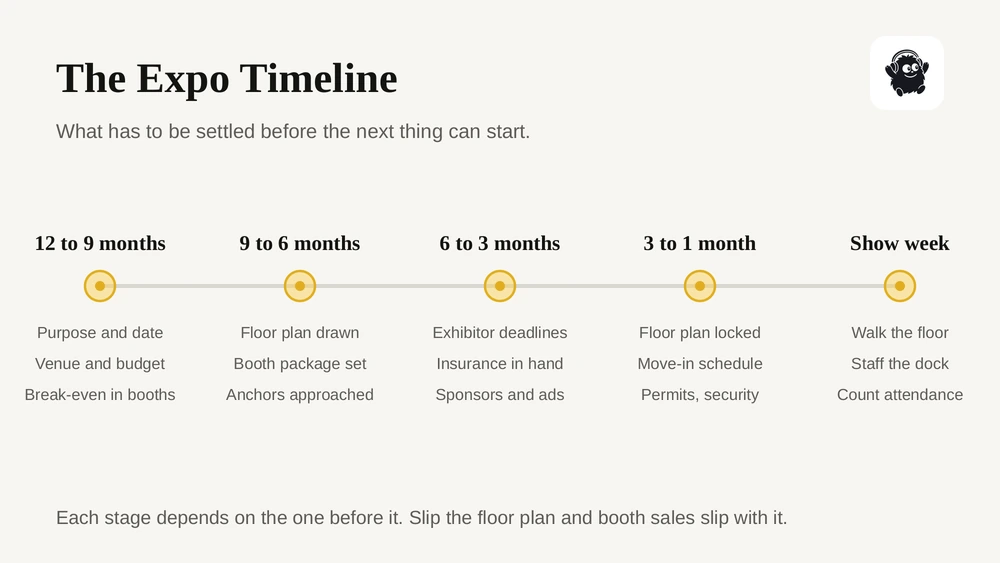
- Decide the show and book the room. Settle what the show is for, pick the date against your sector calendar, and read what the venue rental actually includes.
- Find your break-even in booths. Divide total costs by the average booth price, so you know how many exhibitors the show needs before anything else starts.
- Draw the floor plan and price the package. Publish a plan exhibitors can point at, price by position rather than area alone, and state exactly what the booth includes.
- Build the exhibitor deadline chain. Contract, deposit, insurance certificate, electrical and furniture orders and a load-in slot, each with a date and a chaser.
- Lock the plan and schedule the move-in. Freeze the floor plan, confirm venue services, and write move-in by booth so twelve trucks do not arrive at once.
- Run the show and count the door. Staff the dock, keep a visible problem desk, scan entries for an attendance number you can defend, and sell next year on the floor.
An expo lives or dies on decisions made months before the doors open: how big a room you signed for, what a booth costs, and whether exhibitors can see a floor plan early enough to care which square they are standing on. The checklist below is the order most organizers work in, from about twelve months out to the week after the show.
It is written for consumer shows, industry expos and trade shows of roughly 30 to 300 exhibitors, run by a team rather than a national association. It is general guidance, not legal advice: permits, fire code and liquor rules differ by city and province, so confirm yours with the venue and your municipality.
Key takeaways
- The floor plan is the product. Exhibitors buy a specific square, so publish it early and keep it accurate.
- Sell the room you have, not the one you hope for. Signing a venue bigger than your exhibitor list is the most expensive mistake available.
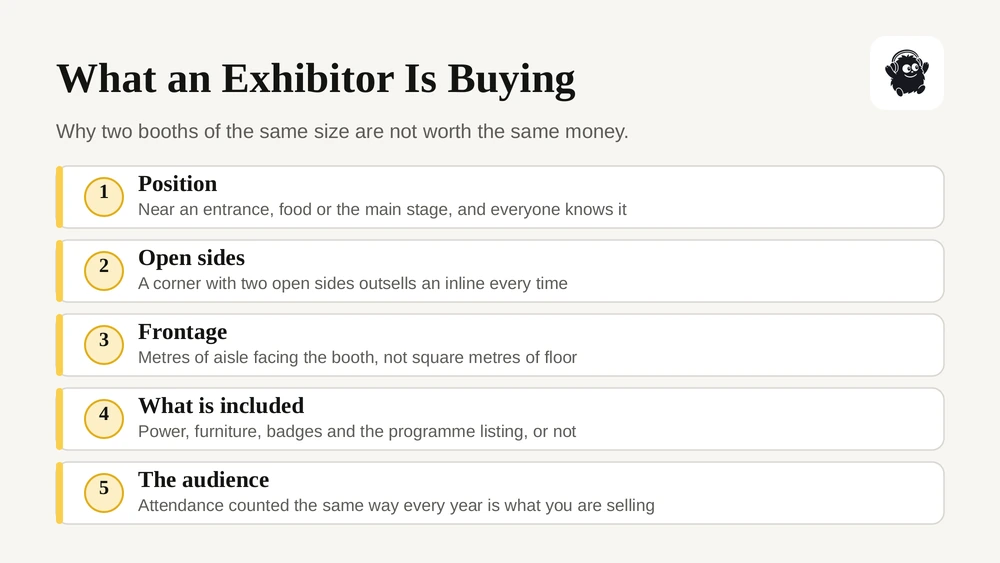
- Price booths on what the exhibitor gets, not on square footage alone: traffic, power, corner position and frontage all change the value.
- Exhibitor paperwork is a deadline chain, not a form. Insurance, electrical and load-in times each have a date, and chasing them is the job.
- Count attendance the same way every year, or you have nothing to sell next year's booths with.
Twelve to nine months out: the shape of the show
Decide what the show is for. Selling to consumers, generating leads between businesses, or both on different days. The answer changes the floor plan, the ticket price and who you can sell a booth to.
Pick the date against your sector's calendar, not just the venue's availability. A show two weeks after the big national one in your industry will struggle for exhibitors.
Book the venue, and read what the rental includes. Hall rental, move-in and move-out days, drayage, union labour rules if they apply, what the venue charges for power, internet, cleaning and waste. The rental number is rarely the venue number.
Set a budget with a break-even in booths. Total costs divided by the average booth price tells you how many exhibitors you need before anything else happens. Our guide to trade show booth sales covers how that number drives everything else.
Confirm the licensed capacity and the fire code constraints before drawing anything. Aisle widths and exit routes are not negotiable later.
Nine to six months out: the floor plan and the price list
Draw the floor plan early. Exhibitors ask for a specific booth, and the first ones to commit expect the best position. A plan you cannot show is a sale you cannot close.
Decide the booth sizes you will actually sell. A standard inline booth, a corner, a double, and possibly an island for the two or three big spenders. More options sell worse, not better.
Price on value, not area. A corner booth with two open sides is worth more than an inline of the same size. Position near entrances, food and main stages carries a premium, and everyone knows it.
Write the booth package. State exactly what is included: the space, pipe and drape or shell scheme, a table and chairs or not, power or not, the listing in the programme, how many exhibitor badges, and what costs extra. The most common exhibitor complaint is discovering that power was extra.
Open sales with an early rate and a deadline. Early-bird booth pricing works because exhibitors budget in advance.
Decide your anchor exhibitors and approach them first. A plan with four recognised names on it sells the rest of the room.
Six to three months out: exhibitors, sponsors and marketing
Build the exhibitor deadline chain and publish it. Contract and deposit, certificate of insurance, electrical order, furniture order, booth design if you approve them, shipping and load-in slot. Each one has a date, and each date has a chaser.
Require proof of insurance. Most venues require every exhibitor to carry commercial general liability naming the venue and the organizer as additional insureds. Collect the certificates rather than taking a promise. Our event insurance guide for Canada covers what is usually required.
Sell sponsorship as placement, not logos. Entrance arches, aisle signs, the floor plan on the programme, the seminar stage, the bags. Exhibitors who already bought a booth are your warmest sponsors.
Decide whether the public pays. A ticketed consumer show earns revenue and a better count; a free trade day earns reach. Many shows do both, on different days.
Start marketing to attendees now, and give exhibitors the assets to do the same. Most of your audience will come from the exhibitors' own lists, so make sharing easy: a link each, a graphic each, a deadline.
Book the seminars or demo stage. Programming draws attendance, and attendance is what exhibitors buy.
Three months to one month out: operations
Lock the floor plan. After this point a change moves someone who already paid for that square.
Confirm services with the venue: power drops, internet, rigging, cleaning, waste, forklifts and the loading dock schedule.
Write the move-in schedule by booth, not by hour. Islands and heavy builds first, inline booths after, and a slot per exhibitor so twelve trucks do not arrive at once.
Plan security, first aid and the quiet hours. Overnight security for a hall full of stock is not optional. Our event security guide covers the ratios people actually use.
Sort permits and the alcohol question. Depending on your city and the venue: occupancy sign-off, food service permits for vendors, and a special occasion permit if alcohol is served. Our event permits guide is a starting point, but confirm locally.
Send the exhibitor manual with load-in times, dock access, what the venue forbids, badge collection, teardown rules and contact numbers. One document, one version, dated.
Prepare badges and check-in. Decide whether attendees print at home, scan a code, or collect a badge on site, and test it before the morning it matters. Our guide to event badge printing covers the hardware side.
The week of the show
- Walk the floor with the venue the day before move-in: aisles measured, exits clear, power where the plan says it is.
- Staff the dock. One person with the move-in schedule and a radio saves hours.
- Have a problem desk, staffed, visible, with the plan, the manual and a roll of gaffer tape.
- Brief everyone on the same schedule: doors, seminars, exhibitor-only hours, teardown, and when the forklifts return.
- Count attendance properly. Scanned entries, not a clicker. Next year's booth price is argued from this number.
- Walk the floor every few hours and talk to exhibitors. Quiet corners are a problem you can still fix with signage or a seminar placement.
After the show
- Settle with the venue and your contractors within the week, while the details are still fresh.
- Send exhibitors their numbers: attendance, scans at their booth if you captured them, and anything you can show about traffic.
- Ask two questions, not a survey: would you exhibit again, and what would you change.
- Open next year's sales while they are still on the floor. Renewal rates are highest in the last two hours of a show that went well.
- Record what you changed and why. Floor plan, deadlines, prices. The second year of a show is built from the first year's notes.
Where Eventist fits
Eventist runs the exhibitor side and the attendee side of an expo on the same event.
Exhibitors buy booths through the same checkout attendees use, so a booth is a product with a price, a limit and its own form. The questions you need from an exhibitor, from the company name on the listing to the power requirement, are asked at purchase rather than chased afterwards, and contracts can be signed electronically from the exhibitor's own dashboard.
The interactive site map holds the floor plan, with markers that can be linked to tasks and hidden from the public while you work on them, so the plan the team uses and the plan the public sees are the same document. Attendee tickets carry a QR code that any phone can scan, which is what turns attendance into a number you can defend.

Our guide to expo management software compares the platforms, and trade show management software covers the larger B2B case. The numbers are on pricing.
Frequently Asked Questions
How far in advance should you plan an expo?
Twelve months is the usual runway for a show with 30 or more exhibitors, because the venue, the date and the floor plan all have to be settled before booth sales open, and exhibitors budget a season ahead. A second-year show can run on nine months once the date is established. Less than six months mostly costs you exhibitors rather than attendees.
What goes in an exhibitor manual?
Load-in and load-out times with a slot per booth, dock access and parking, what the venue forbids, the booth package and what costs extra, power and internet ordering with deadlines, insurance requirements, badge collection, teardown rules, the show schedule and emergency contacts. It should be one dated document, not a chain of emails.
How do you price expo booths?
Start from your break-even: total costs divided by the number of booths you can realistically sell. Then price by position rather than area alone, because a corner with two open sides and a spot near the entrance are worth more than the same square footage in a back aisle. Publish an early rate with a deadline, and state exactly what the package includes.
What insurance do exhibitors need at an expo?
Most venues require each exhibitor to carry commercial general liability, commonly a few million dollars, naming the venue and the organizer as additional insureds, with the certificate provided before move-in. Your own event policy does not cover an exhibitor's activity in their booth. Requirements vary by venue and province, so confirm the wording with your venue and broker.
How do you measure whether an expo worked?
Attendance counted the same way every year, exhibitor renewal rate, booth revenue against break-even, and what exhibitors say about lead quality. Renewal rate is the honest one: exhibitors who rebook on the floor are telling you the show worked, whatever the attendance number says.
What is the difference between an expo and a trade show?
In practice, an expo is usually open to the public and sells to consumers, while a trade show is restricted to the industry and sells to buyers. The planning is similar; the differences are ticketing, badge checks at the door, and what exhibitors expect from the audience. Plenty of shows run both, on separate days.
Sources
- Accessibility rules for businesses and non-profits, Government of Ontario
- Ontario Fire Code, O. Reg. 213/07
- Competition Bureau Canada: drip pricing
Recommended
Tags
Ready to simplify your events?
Join hundreds of organizers, studios, and festival directors who trust Eventist to run their events.