Concert Promoter Checklist: From the Date to the Settlement
Steps at a glance
- Lock the date and the room. Get the date, room, load-in and curfew times and what the rental includes in a signed contract, and confirm the licensed capacity in writing.
- Sign the artist and resolve the rider. Agree the guarantee or door split in writing, read the rider, and settle who pays for sound, backline, the opener, travel and hospitality.
- Build the budget and find break-even. List every cost, then divide by what you keep per ticket after fees to get break-even in tickets, and judge the show on a realistic house rather than a sell-out.
- Sort insurance, permits and licensing. Commercial general liability naming the venue, any liquor or noise permits your city requires, and confirmation of who files music licensing.
- Set tiers and open the on-sale. Early bird, advance and door prices that switch automatically, an all-in advertised price, and a tracking link per channel before you announce.
- Promote in three pushes. Announce, on-sale and a final-week reminder, keeping marketing attention and budget for the last seven days where most tickets sell.
- Run show day from one schedule. Doors, set times and curfew on one sheet for the venue, artist, security and box office, with scanners tested and the guest list loaded before doors.
- Settle the same night. Gross box office, less taxes and ticketing fees, less agreed show costs, equals net. Apply the artist deal to net and get the settlement signed.
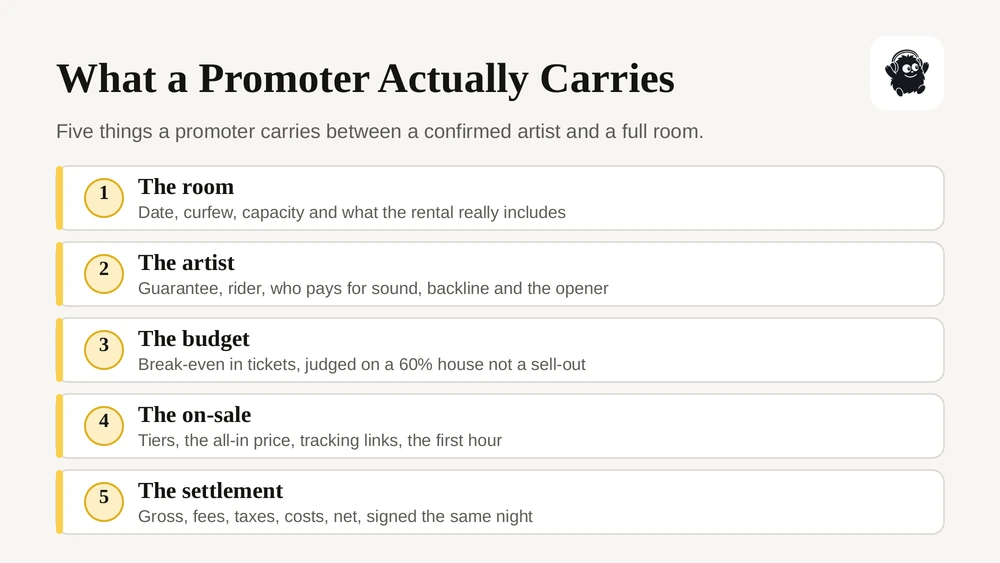
A concert promoter's job is to carry the risk between a confirmed artist and a full room. The checklist below is the order most independent promoters work in: lock the date and the room, sign the artist, build a budget that survives a half-full night, put tickets on sale, promote, run the show, and settle. Miss a step and it usually shows up as money, not chaos.
This is written for independent promoters putting on club, theatre and small-hall shows of roughly 100 to 2,000 people. It is a working checklist rather than a business course, and it is general guidance, not legal or financial advice: permits, licensing and insurance rules differ by city and province, so confirm yours locally.
Key takeaways
- Build the budget on a 60% house, not a sell-out. If the show only works full, you are gambling, not promoting.
- Lock the venue date before you announce anything. A hold is not a date.
- Your break-even in tickets is the single most useful number you have. Know it before the on-sale.
- Announce, on-sale and reminder are three separate pushes, not one.
- Settle the same night if you can. Memories and cash both get worse by morning.
Eight weeks out: the date and the room
Start with the building, because everything else depends on it.
Confirm the date in writing. A pencilled hold is not a booking. Get the date, the room, load-in and curfew times, and what the rental actually includes in a contract. Our guide to venue rentals and promoter settlement covers what to pin down and where the costs hide.
Know what you are renting. Flat fee, a percentage of the door, or a mix against a minimum? Does the venue take the bar, and do they expect a bar guarantee? Is sound and lighting included, with an engineer, or do you bring your own?
Check what else is on. Your city's listings for that night, and not just the same genre. A big game or a festival across town moves your audience.
Capacity and licensing. The licensed capacity is a legal number, not a suggestion. Confirm it in writing and build the budget on it.
Seven weeks out: the artist and the deal
Get the offer in writing. Guarantee, door deal or split, and which comes first. A common independent structure is a guarantee plus a percentage of net box office over a break-even figure.
Read the rider before you sign. Hospitality is usually cheap and sound is usually not. Backline, monitors, a specific console, extra crew and parking all land on your budget.
Settle who pays for what. Sound engineer, lighting, backline rental, accommodation, ground transport, catering, and the opener's fee. Write it down; this is where most disputes start.
Confirm support. A local opener who sells is worth more than a better-known one who does not. Agree their fee and their guest list.
Immigration and tax for touring acts. A non-resident artist performing in Canada may need a work permit or an exemption, and Canada withholds tax on amounts paid to non-residents for services rendered here unless a waiver is granted. Start that early; it is slow.
Six weeks out: the budget
This is the step most new promoters skip, and it is the one that decides whether the night is a business.
List every cost: artist guarantee, opener, venue rental, sound and lights, backline, security, box office staff, ticketing fees, licensing, insurance, marketing, posters and printing, hospitality, accommodation and travel.
Then calculate your break-even in tickets: total costs divided by what you actually keep per ticket, after fees. Not the face value — what lands in your account.
| Scenario | Tickets sold | What it means |
|---|---|---|
| Break-even | The number above | The night cost you nothing and made you nothing |
| Realistic | 55 to 65% of capacity | What most shows without a hit single actually do |
| Good | 80% | A genuinely successful independent show |
| Sell-out | 100% | Plan for it; never budget on it |
If the show only works at 90%, change something: a smaller room, a lower guarantee, a cheaper night, or a different artist. Our breakdown of all-in ticket pricing in Canada matters here, because the first price you advertise must include mandatory fees, which changes what you can charge.
Five weeks out: insurance, permits, security
Insurance. Most venues require commercial general liability naming them as an additional insured, commonly a few million dollars. Get the certificate before load-in day. Our event insurance guide for Canada covers what is usually required.
Permits and licences. Depending on your city and the room: a special occasion liquor permit if the venue does not hold its own licence, noise or late-hours approval, and occupancy sign-off. Our event permits guide is a starting point, but confirm locally.
Music licensing. In Canada, public performance of music generally requires a tariff payment to SOCAN, and reproduction rights may involve Re:Sound. Venues sometimes hold a blanket licence; many do not for ticketed concerts. Ask who is filing.
Security and medical. Agree the guard count with the venue, and who pays. Our event security guide covers the ratios people actually use.
Four weeks out: the on-sale
Set your tiers before you announce. Early bird, advance, door. Automatic switching on a date or a quantity, not someone changing a price at midnight. Our early bird ticketing guide covers how to structure them.
Decide the fee story. Absorb the fee into the face value, or show it; either way the first advertised price must be the all-in price.
Set up tracking links before, not after. A link per channel, and one per promoter or influencer if you use them, so you learn which actually sold. If you only learn this after the show, you have paid for a lesson you cannot use.
Expect the first hour. Even a modest on-sale concentrates demand. If you expect real volume, read why ticketing software fails during high-demand on-sales before you set the time.
Guest list policy now. Decide the size and who approves it. Guest lists quietly eat the margin of small shows.
Three weeks to show day: promotion
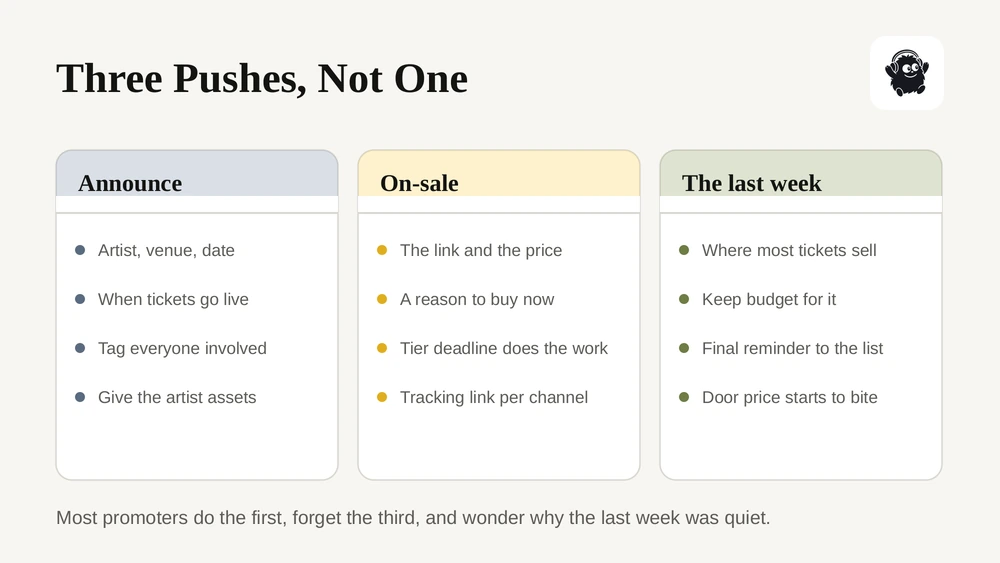
Announce, on-sale and reminder are three pushes. Most promoters do the first, forget the third, and wonder why the last week was quiet.
- Announce. Artist, venue, date, and when tickets go live. Tag everyone involved.
- On-sale. The link, the price, and a reason to buy now, which is usually the tier deadline.
- Local listings. Your city's events calendar, the venue's own listings, and community pages. Free, slow, and still works.
- The artist's own channels. Their audience outsells yours. Give them assets they can post without editing.
- Paid, narrowly. If you advertise, target the artist's own listeners and a tight radius. Broad reach is wasted on a 400-cap room.
- The last week. Most independent shows sell a large share of tickets in the final seven days, so budget attention and money for that week. Our guide to last-minute ticket sales covers the push.
Show day
- Doors, set times and curfew, in writing, given to the venue, the artist, security and the box office. One sheet, one version.
- Box office ready before doors. Scanners charged and tested, the guest list loaded, a float counted, and a way to sell at the door that lands in the same report as online sales. Our explainer on QR code check-in covers the scanning side.
- A door count you trust. Scanned tickets, not a clicker, because settlement depends on it.
- Someone owns the artist. Load-in, soundcheck, hospitality, set time, and settlement. If that is you, someone else owns the door.
- Walk the room before doors. Exits clear, nothing blocking a path, and the security team briefed on where they stand.
Settlement
Settle the same night, with the venue and the artist, while everyone is there and the numbers are fresh.
Bring: the box office report with gross, fees, taxes and net; comps and guest list used; the venue's cost sheet; receipts for anything you paid on the day; and the deal terms in writing.
Settle in this order: gross box office, minus taxes and ticketing fees, minus the agreed show costs, equals net. Then apply the artist deal to the net, not the gross, unless the contract says otherwise. Our guide to event revenue reconciliation covers where ticketing reports and bank deposits drift apart.
Get the settlement signed. A photo of a signed sheet has resolved more disputes than any email thread.
After the show
- Pay everyone within the week. Your reputation with openers and crew is your booking power.
- Record the real numbers. Tickets by tier, by channel, by day. Next year's budget comes from this year's data.
- Email the attendees. With consent, a short thank-you and what is next. This list is the only asset that compounds between shows.
- Note what went wrong while you remember. Everyone thinks they will remember. Nobody does.
Where Eventist fits
Eventist is built for promoters who want the ticketing and the night in one place. Tiers switch automatically on a date or a quantity, so early bird closes itself; the first price shown is the all-in price; and influencer and promoter tracking links let you see which channel actually sold, per link, rather than guessing afterwards.
On the night, every ticket carries a QR code that any phone can scan, the built-in point of sale handles door sales so they land in the same report as online, and the guest list lives beside the scan rather than on a clipboard. Settlement reads off one report with gross, fees, taxes and net broken out.
Pricing is a flat fee per paid ticket rather than a percentage, which on a $45 ticket is the difference between keeping a dollar's worth of fee and several, and card processing runs through your own Stripe or Square account at the processor's published rate, so the money is yours as it settles rather than held until after the show.

You can see the detail on our concerts page, or compare the numbers on pricing.
Frequently Asked Questions
What does a concert promoter actually do?
A promoter carries the financial risk of a show. They book the venue and the artist, build the budget, pay the deposits, set ticket prices, run the marketing, cover the costs on the night, and settle with the artist and venue afterwards. If the show sells, the promoter keeps what is left after costs; if it does not, the promoter absorbs the loss.
How do you budget a concert as an independent promoter?
List every cost, including the artist guarantee, opener, venue, sound and lights, backline, security, staff, ticketing fees, licensing, insurance and marketing. Then divide the total by what you actually keep per ticket after fees to get your break-even in tickets. Judge the show against a realistic 55 to 65% house rather than a sell-out, and change the room, the night or the guarantee if it only works full.
What does a concert promoter need before show day?
A signed venue contract with load-in and curfew times, a signed artist agreement with the rider resolved, commercial general liability insurance naming the venue, any liquor or noise permits your city requires, music licensing confirmed with SOCAN or the venue, a security plan with agreed guard numbers, tickets on sale with tiers set, and a one-page schedule everyone has.
How does concert settlement work?
Start from gross box office, subtract taxes and ticketing fees, then subtract the agreed show costs to get net. Apply the artist's deal to the net rather than the gross unless the contract says otherwise. Settle the same night with the box office report, the venue cost sheet and receipts in hand, and get the settlement signed before anyone leaves.
When do most concert tickets sell?
For independent shows, a large share sells in the final week, with a smaller spike at announcement and on-sale. That pattern catches new promoters out, because a quiet third week feels like failure when it is normal. Plan three separate pushes, announce, on-sale and a final-week reminder, and keep marketing budget for the last seven days.
Sources
- SOCAN licensing for live events
- Withholding for amounts paid to non-residents for services in Canada, Canada Revenue Agency
- Deceptive marketing practices: cases and outcomes, Competition Bureau Canada
- Accessibility requirements, Government of Ontario
Recommended
Tags
Ready to simplify your events?
Join hundreds of organizers, studios, and festival directors who trust Eventist to run their events.