Group Ticket Sales: How to Set Up, Price and Promote Them
Group ticket sales mean selling several tickets to one buyer in a single order, usually at a lower price per seat or with added perks, once the buyer reaches a minimum group size. For organizers the work comes down to five decisions: the minimum, the discount or perk, the payment terms, how seats are held together, and how you reach the people who organize outings. This guide covers each one, with real examples from Canadian and US venues and a worked fee calculation.
TL;DR
- Most venues set the group minimum at 10 tickets. Larger performing arts venues often step up to 15 or 20.
- Discounts take three forms: a percentage off, a flat group rate, or perks such as reserved blocks and a welcome message.
- Collect a deposit at reservation, set a balance due date, and allow headcount changes until that date.
- Flat per-ticket pricing is usually cheaper than percentage pricing once tickets cost more than a certain amount. The arithmetic is below.
- Promote to teams, schools, clubs, community groups and workplaces, and give each buyer one person to deal with.
What a group ticket offer is and how it works
A group offer is a package for one buyer who brings many attendees. The buyer is usually a team lead, teacher, office manager or club organizer. They want one invoice, seats together and a price that makes the outing easy to approve.
For the organizer, the appeal is simple. A block of seats sells in one transaction, which reduces unsold inventory and replaces dozens of small orders with one to manage. That is why group rates are common on weeknights and slower dates, and less common on shows that sell out anyway.
Most offers have four parts:
1. A minimum group size. The number of tickets needed to qualify.
2. A benefit. A discount, a fixed group rate, a free ticket for the organizer, or an experience upgrade.
3. Payment terms. A deposit, a balance date and rules for changing the headcount.
4. A contact. A named person or inbox that handles questions and changes.
Minimum group sizes and prices venues use
Looking at published offers shows how much the details vary. Ten is the most common threshold, but the benefits differ widely.
| Venue | Minimum | What the group gets |
|---|---|---|
| Seattle Sea Bears (CEBL) | 10+ | Prices start at $29 per person, with a dedicated group sales representative from booking onward |
| Boch Center | 10+ | Group discount, tickets held with an emailed invoice, and the ticket count adjustable until the payment due date |
| Tilles Center | 10 to 49, then 50+ | 15% off for 10 to 49 tickets and 20% off for 50 or more, with ticketing fees waived up to $7 per ticket |
| Kennedy Center | 20+ (lower for some productions) | Discounts of up to 50%, reduced handling fees, priority seat access and a payment plan |
Two patterns stand out. First, the discount rises with group size at the Tilles Center, which gives buyers a reason to add a few more people. Second, the best offers go beyond price: the Kennedy Center lists priority access to seats, flexibility in adjusting ticket numbers and personalized service next to its discounts.
Perks matter in sports and live entertainment as well. Sporting Kansas City describes group incentives such as scoreboard shoutouts, post-match photo opportunities and access to pre-match warm-up viewing. In Canada, evenko invites companies to attend a concert with their team in its amphitheatres and promotes corporate offers through a newsletter.
None of these figures is a rule for your event. Treat them as a reference range, then price against your own costs and demand.
How to set your group price
Start with the seat, not the discount. Know the average price of the seats you want to move in a block, your variable cost per attendee, and how likely those seats are to sell at full price.
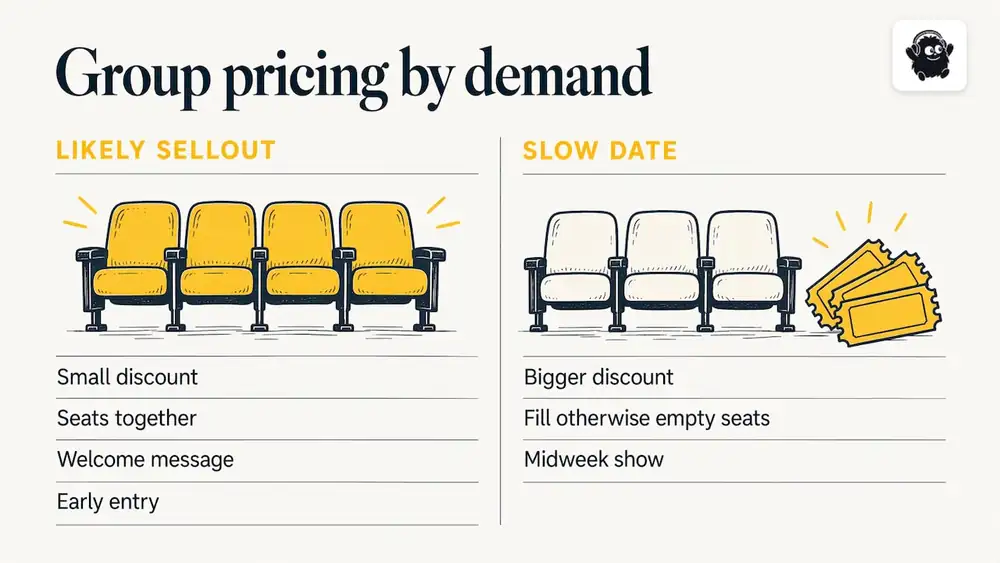
Choose the discount that fits the date
If a date sells out at full price, a deep group discount costs you money. Keep the discount small there, or offer perks instead: seats together, a welcome message, early entry. If a date is slow, such as a midweek show, a bigger discount fills seats that would otherwise be empty.
Use tiers to lift the order size
A tiered structure like the Tilles Center's (one rate for 10 to 49 tickets, a better one from 50) encourages a buyer with 40 people to find 10 more. A simple version for a mid-sized event:
- 10 to 24 tickets: 10% off
- 25 to 49 tickets: 15% off
- 50 or more: 20% off
These percentages are an illustration of the structure, not a recommendation of specific figures.
Add value that costs you little
When margins are tight, perks do the work of a discount. Options that cost little include:
- Reserved block seating so the group stays together
- A welcome on the screen, on stage or in the programme
- One complimentary ticket for every set number purchased, as the Tilles Center does with one for every 25
- Early entry or a dedicated group check-in line
- Waived or reduced service fees on the order
Price for the whole group
A flat group rate, like a single price for every ticket in the block, is easier to explain than a percentage. A buyer can multiply the rate by the headcount and put the total in a budget request. Fewer questions mean faster approvals.
Payment terms: deposits, balances and headcount changes
The biggest hurdle for a group buyer is committing money before everyone has confirmed. Venues handle this with clear, staged terms.
The Tilles Center asks for a minimum 10% non-refundable deposit at reservation, with the balance due two weeks before the performance. The Boch Center places tickets on hold, emails an invoice to the buyer, and lets the buyer change the number of tickets until the payment due date, typically four weeks before the performance.
A workable template:
1. Reserve. The buyer picks a date and seat block, and you hold it.
2. Deposit. A modest deposit confirms the booking. State clearly whether it is refundable.
3. Adjustment window. The buyer can raise or lower the headcount until a set date.
4. Balance due. Full payment is collected, and tickets are issued.
5. Final list. Attendee names or a single ticket bundle go to the group leader.
Put the refund and cancellation terms in writing on the group page and on the invoice. If you are drafting contract wording for large corporate or school groups, treat this as general guidance, not legal advice, and have your own adviser review the terms. The same applies to tax treatment of deposits and to insurance for the event.
Seating, tickets and check-in for groups
Groups buy a seat block because they want to sit together. If your ticketing tool only sells general admission, you cannot promise that. Reserved seating with a seat map lets you hold a block, price it as a group, and release unsold seats at a set date.
Check-in is where group sales either feel smooth or chaotic. Think about it at the planning stage:
- One ticket per person, or one bundle. Individual QR codes let each attendee scan in as they arrive. A bundle is simpler for the leader but slower at the gate.
- A dedicated lane or time. When 40 people arrive together, a separate lane keeps the main line moving.
- Late changes. Decide whether the leader can swap a name after the balance is paid, and tell them how.
- Door sales. Some groups add people on the day. A point of sale at the door lets your staff members take the extra payment and issue the ticket on the spot.
Eventist covers these pieces in one system for festivals, conferences, concerts and venues: reserved seating with seat maps, QR check-in from any phone, and a built-in point of sale for door sales. See the festival ticketing features comparison for how onsite tools stack up.
Promoting group tickets
Group buyers rarely find you by browsing. Someone has to think of the outing, and you can make that easier by going where those people already are.
Know who your buyers are
Group sales are not only for corporate outings. Buyers include school communities, alumni associations, birthday parties, social clubs, church groups, workplace groups, sports teams and informal friend networks. Write a group page that speaks to each, with a sentence about what the outing looks like for them.
Make the offer easy to find
- Give group sales their own page, linked from the event page and the footer.
- Show the minimum, the benefit and the contact on that page. Hiding the minimum behind a form loses buyers who just want to know whether their group qualifies.
- Use a single inquiry form that asks for date, group size and budget.
- Reply within one business day. A group leader often has several venues in a shortlist.
Reach organizations directly
Make a list of the local groups that might want an outing: schools, clubs, sports leagues, community associations, nonprofits and larger employers. Send each a short note with the date, the group rate and the contact. Offer the group leader a complimentary ticket or a perk for the organizer, since that person does the work of rounding up the group.
Some organizers also work with social-impact schemes. For example, Tickets for Good partners with event organizers in the UK to distribute free or discounted tickets to key worker groups, which helps fill seats while giving something back.
Let sellers track their own results
If a team captain, club or influencer sells to their own network, give them a referral link so you can see the orders they bring in and thank them properly. Tools for planning and tracking the campaign matter here too. A comparison of project management tools for event planners can help you set up outreach tasks and deadlines for the sales team.
Perspective: why group sales suit flat per-ticket pricing
We see group sales from the organizer's side of the screen, and one point comes up again and again: group orders are large, and large orders magnify whatever fee model sits underneath them.
A percentage fee grows with the order. A flat fee per paid ticket does not. When a group of 40 buys at a discounted price, a flat fee stays predictable, which makes the group rate easier to set because you know what each ticket costs you to sell.
We also believe group sales work best when the tool handles the whole job, not just the payment. A block of seats needs a seat map. A group arriving together needs fast QR check-in. A late add needs door sales. That is why we build ticketing and event operations as one system, with setup help from a Canadian team.
Our advice: set the minimum, write the terms down, and let the software carry the repetitive work so your staff members can spend their time on the group leader.
— Ciara
What to compare when choosing ticketing tools for group sales
When you compare platforms, look past the headline fee. These criteria matter most for group orders.
| Criterion | Why it matters for groups |
|---|---|
| Fee structure | Percentage fees rise with order value, flat fees stay fixed per ticket |
| Reserved seating and seat maps | Needed to hold and sell seats together |
| Hold and invoice options | Lets a buyer reserve now and pay later |
| Order changes | Headcount often shifts before the due date |
| Check-in | Individual QR codes and a fast door process |
| Door sales | Handles last-minute additions |
| Payment processing | Card fees are charged separately by the processor |
| Support | A person to help with setup and special requests |
Our own comparison of ticketing platforms beyond the fee goes through the same questions in more depth.
Worked example: flat fee versus percentage fee
These figures use Eventist's published Canadian event ticketing fee as of October 2026: $0.85 CAD per paid ticket. The percentage rate below is an assumed example, not a quote from any named platform, and card processing fees go to Stripe or Square at their own rate in both cases.
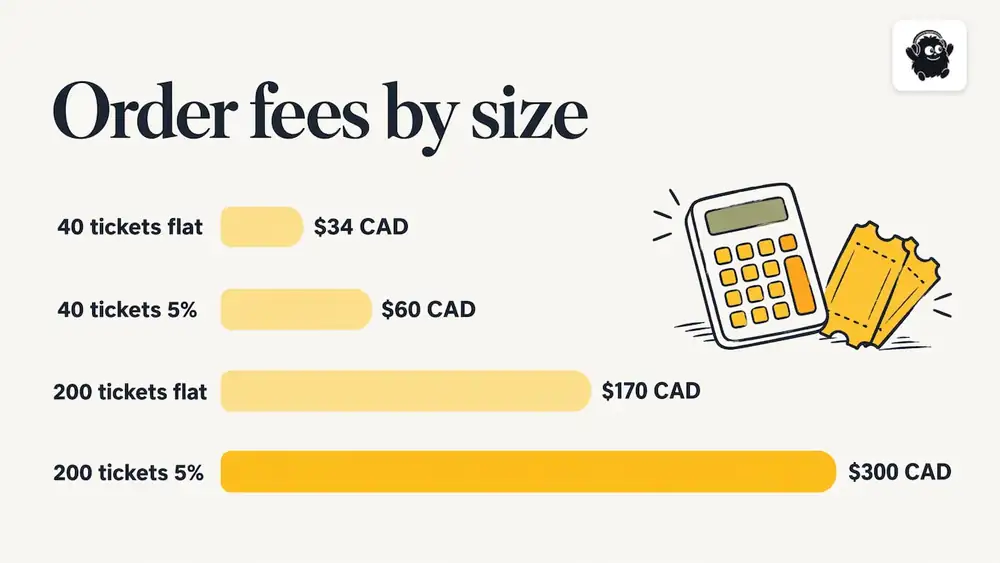
A group of 40 buys at a discounted price of $30 CAD per ticket, so the order is $1,200.
- Flat fee: 40 × $0.85 = $34.00
- Assumed 5% platform fee: 5% × $1,200 = $60.00
The flat fee is $26 lower on this order. Scale it to a 200-ticket block at the same price ($6,000):
- Flat fee: 200 × $0.85 = $170.00
- Assumed 5% platform fee: 5% × $6,000 = $300.00
The break-even price at an assumed 5% rate is $17 per ticket ($0.85 ÷ 0.05). Above that price, a flat fee is lower; below it, a percentage can be lower. That is why we say Eventist is usually cheaper, not always: it depends on your ticket price and the percentage you are comparing against. Run the same arithmetic with the real rates on any platform you are considering.
Festivals and conferences pay $4.99 CAD per paid ticket and competitions pay $9.99 CAD per paid ticket. US organizers pay $0.75 USD, $3.50 USD and $7 USD for the same three categories. Venues are priced differently: they pay 0.5% to 1.9% of what they charge on everything they sell, single tickets included. Full details are on the pricing page.
Free group events and registrations
Some group offers carry no ticket price at all, for example a community day for a school or a nonprofit open house. Free tickets and registrations run on monthly plans that start from $100 CAD per month, as of October 2026. Because a plan is a subscription, there is a monthly cost even when no money changes hands at the door. Only for paid ticketing is there no subscription.
Promo: group sales and the rest of the event in one place
If you sell reserved blocks, take door payments and check groups in at the gate, Eventist handles ticketing, seat maps, QR check-in from any phone and point of sale for door sales in one platform. Canadian organizers pay $0.85 CAD per paid ticket for event ticketing, as of October 2026, and a Canadian team helps with setup. See the ticketing page for how it works, or the pricing page for current fees.

If you want hands-on help before the event, the services page lists setup and training options.
A group sales checklist
1. Decide the minimum group size and test it against your typical weeknight crowd.
2. Choose a benefit: percentage off, flat group rate, or perks.
3. Set the deposit, balance date, refund terms and headcount change deadline.
4. Build a seat block on your seat map and hold it for groups.
5. Publish a group page with the minimum, offer and contact.
6. Prepare a short outreach list of schools, clubs, teams, community groups and workplaces.
7. Plan check-in: individual QR codes, a dedicated lane and a door point of sale.
8. Review results after each event: group size, lead time, no-shows and revenue per group.
Frequently Asked Questions
How many tickets make a group?
There is no standard number. Ten is the most common minimum in the published offers above, while larger performing arts venues such as the Kennedy Center start at 20 for most productions. Choose a number your typical buyers can reach easily, then adjust it after a few events.
Should I always discount group tickets?
No. Where a date sells out at full price, a deep discount costs you revenue, so offer perks like seats together or a welcome message instead. Discounts make the most sense on slower dates, where a block of seats replaces seats that would sit empty.
What happens if people drop out of the group?
That depends on your terms, so state them up front. A common approach is to let the buyer change the number of tickets until a payment due date, as the Boch Center does, and to make the deposit non-refundable, as the Tilles Center does.
Can I sell group tickets without reserved seating?
Yes, for general admission events a group rate or a promo code works. For groups that want to sit together, reserved seating with a seat map is the way to guarantee it.
Sources
- Group Tickets, Seattle Sea Bears (CEBL)
- Group Sales, Boch Center
- Group Sales, Tilles Center for the Performing Arts
- Group Sales, Kennedy Center
- Group Tickets, Sporting Kansas City
- Group Sales, evenko
- Become an Event Partner, Tickets for Good
Recommended
Tags
Ready to simplify your events?
Join hundreds of organizers, studios, and festival directors who trust Eventist to run their events.