How to Budget a Canadian Festival When Costs Keep Rising
Steps at a glance
- Rebuild the cost base from the ground up. Split every expense into fixed, variable, and platform and admin costs, then ask every major supplier and your municipality for an updated written quote.
- Add a contingency sized to your risk. An outdoor site exposed to weather needs a bigger cushion than a downtown venue, and processing fees, refunds and payout timing all change what you keep.
- Model at least three attendance levels. Budget for the crowd you might get rather than the one you hope for, and work out the break-even point those scenarios sit around.
- Set early-sales milestones against it. Once you know the break-even number, decide in advance what you will cut if the early sales miss the milestones.
- Use the ticket structure as the lever. Tiers and early-bird windows bring cash in sooner, payment plans widen reach, and add-ons raise revenue per attendee without raising the headline price.
- Budget grants, sponsors and other lines in. Treat grants, sponsorship, vendor booth fees, door sales and paid add-ons as part of the plan, and confirm each programme rule and deadline first.
Festival budgets rarely break because of one big mistake. They break because every line creeps up a little while the revenue plan stays the same. Across Canada, that squeeze is hard to ignore. Northern Lights Festival Boreal in Sudbury says its costs are up 40 per cent while grants have stayed flat, and industry officials warn that financial pressure is pushing events off the calendar.
This guide shows festival organizers how to build a festival budget that holds up under that pressure. It covers where cost increases hide, how to stress-test your revenue, and where to find money beyond ticket sales.
Why festival budgets are under pressure
The increases are showing up in several places at once. Calgary's GlobalFest moved to a new site for 2026, partly because of more than $100,000 in added costs at its previous city park. Organizers there also say electricity is no longer covered for events on city land.
Labour is tight too. HUB International's 2026 entertainment outlook report says demand for skilled workers continues to exceed supply. Many Canadian festivals also report fewer corporate sponsorships.
The takeaway is simple: last year's budget plus inflation is not a plan. Rebuild the budget from the ground up.
Start with a cost base you can defend
Split every expense into three groups:
- Fixed costs. Site, permits, insurance, staging, sound and artist guarantees. These stay the same whether 2,000 or 4,000 people show up.
- Variable costs. Security, washrooms, waste, bar and food supplies, and staffing that scales with the crowd.
- Platform and admin costs. Ticketing, card processing, scheduling and volunteer tools, and the staff hours spent moving data between them.
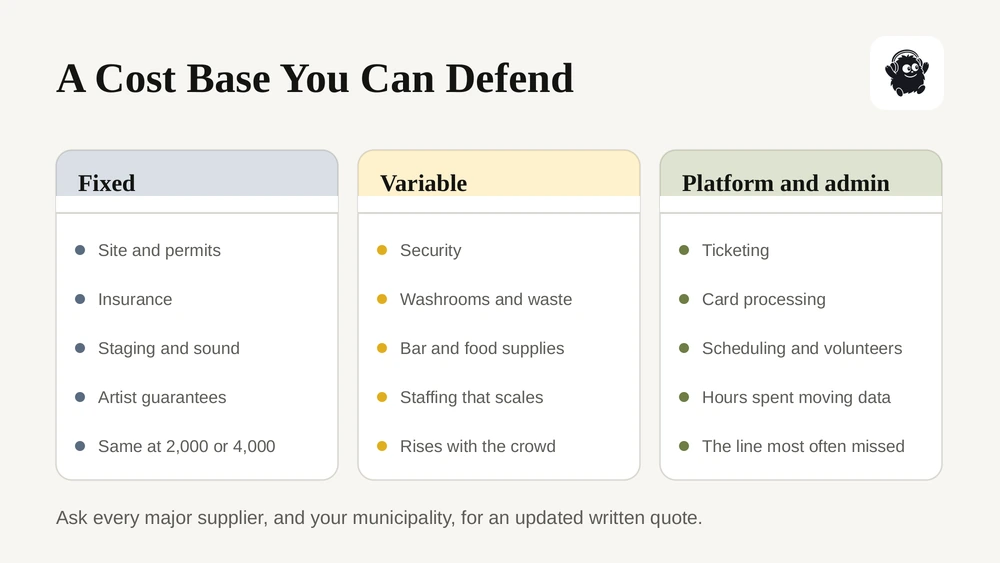
Then ask every major supplier for an updated written quote, including your municipality for power, permits and site fees. Costs that were stable two years ago may not be now.
Don't overlook the quiet costs. Processing fees, refunds and payout timing all change how much of each ticket dollar you keep, so it pays to reconcile ticket revenue and payouts monthly instead of after the event. Finally, add a contingency line sized to your risk. An outdoor site exposed to weather needs a bigger cushion than a downtown venue.
Stress-test revenue with three scenarios
Budget for the crowd you might get, not the crowd you hope for. Model at least three attendance levels. The example below is illustrative, in Canadian dollars: 4,000 weekend passes at $120, $300,000 in fixed costs and $20 per attendee in variable costs.
| Scenario | Attendance | Ticket revenue | Total costs | Result |
|---|---|---|---|---|
| Sell-out | 4,000 | $480,000 | $380,000 | +$100,000 |
| 75% of capacity | 3,000 | $360,000 | $360,000 | $0 |
| 60% of capacity | 2,400 | $288,000 | $348,000 | −$60,000 |
These numbers are invented and exclude sponsorship and processing fees. What matters is the break-even point. This festival must sell 75 per cent of capacity just to cover its costs. The formula is fixed costs divided by ticket price minus variable cost per attendee. Once you know your number, set early-sales milestones and decide in advance what you will cut if you miss them.
Price for the room you actually have
Ticket structure is your biggest lever. Tiers with early-bird windows bring cash in sooner, which helps when deposits are due months before gates open. Payment plans put a higher-priced pass within reach of budget-conscious buyers. Add-ons such as camping and parking raise revenue per attendee without raising the headline price. Our guide to multi-day festival passes covers how to structure them.
One rule shapes every pricing decision. In Canada, the first price a buyer sees must include mandatory fees, so plan around what you keep per ticket, not the sticker price. Our explainer on all-in ticket pricing shows how to comply.
Look beyond ticket sales
Grants and sponsorships matter more when costs rise, but both are competitive. The federal government has committed $46.5 million over three years, starting in 2026–27, to the Canada Arts Presentation Fund for professionally presented arts festivals. Ontario committed more than $20 million to nearly 400 festivals and events through Experience Ontario 2026. FACTOR also launched a $2-million program to help Canadian promoters and festivals book homegrown acts. Each program has eligibility rules and deadlines, so confirm them before you count on the money. Our guide to event grants and funding in Canada lists the programs worth tracking.
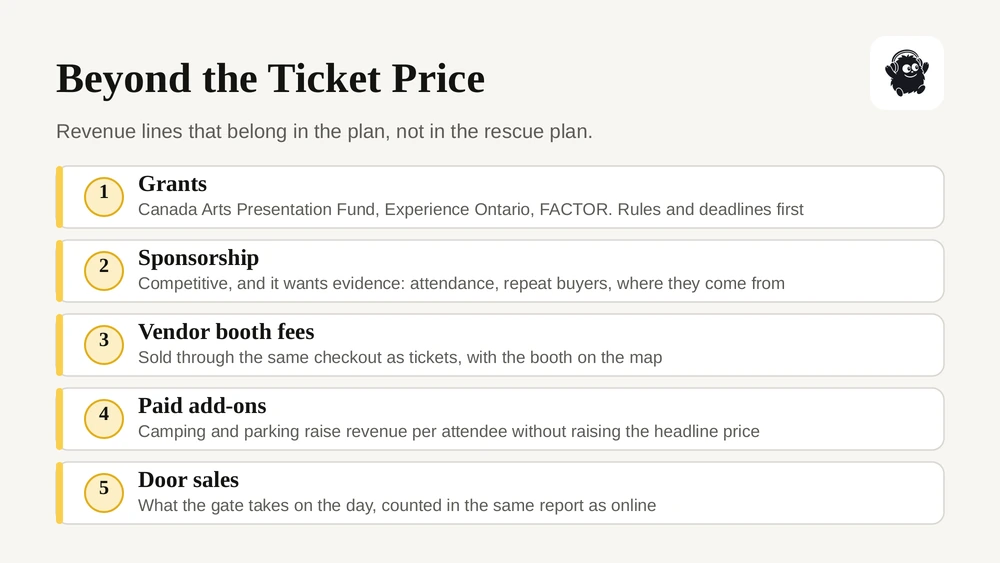
Funders and sponsors want evidence. Attendance figures, repeat buyers and where your audience comes from make a stronger case than a general pitch. That is one reason owning your attendee data matters. Other revenue lines worth budgeting for include vendor booth fees, door sales and paid add-ons.
Where Eventist fits
Eventist is a Canadian event management and ticketing platform that covers the whole festival, not just the checkout. Our festival management software combines passes, add-ons and payment plans with multi-stage scheduling, interactive maps, vendor booths sold through checkout, staff and volunteer roles, e-signed contracts and a built-in point of sale. Because these tools share one set of data, you may have fewer separate tools to pay for and fewer manual handoffs for your team.
Pricing is a flat fee per ticket, never a percentage, with no monthly subscription or setup fee on paid ticketing. Card processing runs through your own Stripe or Square account at the processor's published rate. You choose per event whether to absorb fees or pass them on.

Budget for the festival you can sustain
A realistic festival budget starts with a cost base you can defend. It tests revenue against lower attendance, and it treats grants, sponsors and add-ons as part of the plan, not as rescue funding. Build in decision points early, while you still have room to adjust.
Talk through your 2027 festival budget with us
If you want to see how your ticket tiers, vendors and crew could run in one place, Book a Call. We'll walk through your requirements and show you what the setup could look like.
Frequently Asked Questions
What are the biggest costs for a music festival?
Typically artist fees, production (stages, sound and lighting), site and permits, insurance, security, staffing, and washrooms and waste. Costs vary widely by size, site and municipality, so rely on written quotes rather than general averages.
How do I calculate break-even attendance for a festival?
Divide your fixed costs by the contribution per attendee, which is ticket price minus variable cost per attendee. In the example above, $300,000 divided by ($120 − $20) gives 3,000 attendees. Add processing fees and expected sponsorship to refine the figure.
How much contingency should a festival budget include?
No single figure fits every event. Size it to your risks: outdoor sites, weather exposure, a first-year event or a staffing-heavy weekend all justify a larger cushion. Review past overruns and set the line above them.
Are there grants for festivals in Canada?
Yes. Federal programs such as the Canada Arts Presentation Fund support professionally presented arts festivals, and provinces and organizations like FACTOR run their own programs. Each has its own eligibility criteria and deadlines, so check the funder's current rules before budgeting for the money.
Should I pass ticket fees on to buyers?
You can, but in Canada the first price shown must include mandatory fees. Decide whether to absorb or pass on fees, then set your displayed price accordingly. Eventist lets you choose per event whether to absorb its fee and processing or pass them on at checkout.
Tags
Ready to simplify your events?
Join hundreds of organizers, studios, and festival directors who trust Eventist to run their events.