Proximity Offers: Vendor Deals for People Nearby
Steps at a glance
- Set the allowance before the event. The host decides how many offers each vendor gets, and zero switches it off. Two or three for a weekend keeps attendees reading them.
- Choose the delivery that reaches people. An offer shown on the event map needs no app and no notification permission; keep SMS for things that matter to the individual.
- Write offers that are near, now and specific. A real thing at a real price, within walking distance, running out soon. Anything missing one of the three reads as spam.
- Match location on the device. Send the offers and the booth positions to every open map and let the phone decide if it is near, so no position is sent back.
- Keep the rules visible. The booth name on every offer, nothing blocking the things attendees need, and one plain sentence about how location is used.
- Brief vendors on price claims. A discount has to be from a price that was really charged. Tell them before the event rather than after a complaint.
A vendor with a quiet hour and 40 unsold portions has a problem that is solvable in about ninety seconds: tell the people who are already fifty metres away that the next twenty are half price. That is proximity marketing, and at an event it works better than anywhere else, because everyone is in the same field, at the same time, with the same phone already open on your map.
This guide covers how location-based offers actually work at events, what to send and when, the Canadian rules that apply to messages, the privacy design that keeps it defensible, and what to tell vendors so the whole thing does not turn into spam.
Key takeaways
- An offer is useful when it is near, now and specific. Remove any of those three and it is a push notification people turn off.
- Cap how many offers each vendor can send. The cap is not a limitation, it is what keeps the channel worth having.
- Timing beats discount size. Twenty per cent off at the moment the stage empties out beats half price at 3 pm.
- Match the location on the attendee's device where you can, so you learn that an offer was relevant without learning where anyone was.
- Nobody wants another app. If the offer only reaches people who installed something, it reaches almost nobody.
What proximity marketing is at an event
It is an offer delivered on the basis of where someone is. Outside events it is usually done with beacons in retail stores or geofences around a competitor's parking lot. At events it is simpler and more honest: the attendee is already using your map to find the toilets, and the vendor fifty metres away has something to sell in the next hour.
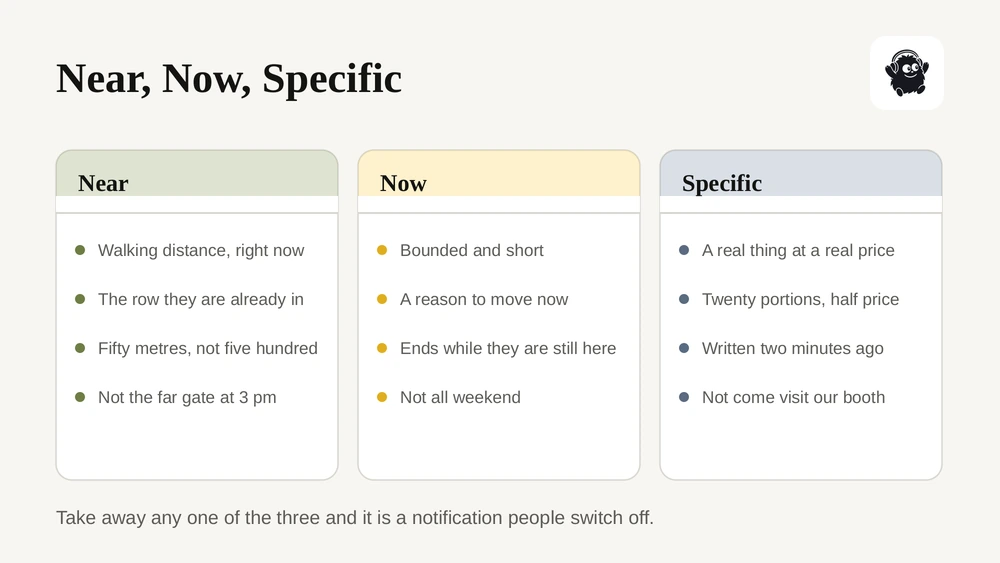
Three things have to be true for the offer to land as useful rather than as spam.
Near. Within walking distance of where they are, on a site they are already walking around. A deal at the far gate when someone is at the main stage is noise.
Now. Bounded in time, and short. "For the next hour" gives a reason to move. "All weekend" is a poster.
Specific. A real thing at a real price. "Come visit our booth" is not an offer.
How the delivery actually works
There are three mechanisms, and they are very different in what they demand from the attendee.
Push notifications from an app. Reaches people who installed the app and allowed notifications, which at most events is a small fraction of attendees. Can interrupt, which is both the appeal and the risk.
SMS. Reaches everyone, costs money per message, and is heavily regulated. Worth reserving for things that matter to the individual, like a queue place or a schedule change, rather than for marketing.
In-map offers. The offer is shown when the attendee next opens the event map. No install, no notification permission, no per-message cost. It cannot interrupt, which sounds like a weakness and mostly is not: people open an event map many times a day, and an offer waiting there is read in a moment when they are already deciding where to go next.
For events, the third one is usually the right default, with SMS reserved for the individual and operational.
What to send
| Situation | What works | What does not |
|---|---|---|
| Quiet hour | A time-boxed discount for the next 30 to 60 minutes | A general "visit us" |
| End of day stock | Clear-out pricing, stated plainly | Vague "specials" |
| Long queue elsewhere | "No wait at our booth right now" | Attacking the other vendor |
| New product or tasting | Free sample, limited quantity | A description of the brand |
| Weather turn | Something that fits the moment: hot drinks, shade, ponchos | Anything pre-written weeks ago |
A good offer is one sentence and reads like a person wrote it two minutes ago, because they did.
Rules of the channel
Cap the number per vendor. Three offers per vendor for a weekend festival is plenty. Without a cap, the few most aggressive vendors burn the channel for everyone, and attendees stop reading.
Make the host the one who sets the cap, and let them set it to zero. Some events do not want this at all, and that is a legitimate choice.
Keep offers off the attendee's critical path. Finding the medical tent must never be slower because an offer is in the way.
Say who it is from. The booth name, on the offer, on the map.
Let attendees ignore it without consequence. No interstitials, no "confirm you do not want this discount".
What Canadian law expects
General guidance rather than legal advice, and worth a lawyer's eye if you are doing this at scale.
Messages sent electronically to promote a business are commercial electronic messages. Canada's Anti-Spam Legislation governs them, which matters for email and SMS: you need consent, identification and an unsubscribe mechanism. An offer displayed inside a page the attendee chose to open is a different thing from a message pushed to them, and the distinction is worth getting advice on rather than assuming.
Location is personal information. Deciding "is this person near this booth" involves someone's position, which under PIPEDA means a stated purpose and meaningful consent. The cleanest design answers the question on the attendee's own device and sends nothing back.
Price claims have to be true. A "half price" that was never full price is a deceptive price claim, and the Competition Bureau takes an interest in those. Tell vendors this before the event, not after a complaint.
Say it in the terms, and on the page. If location may be used to decide which offers are relevant, that belongs in the privacy policy and in plain words where location is asked for.
Designing it so it is not creepy
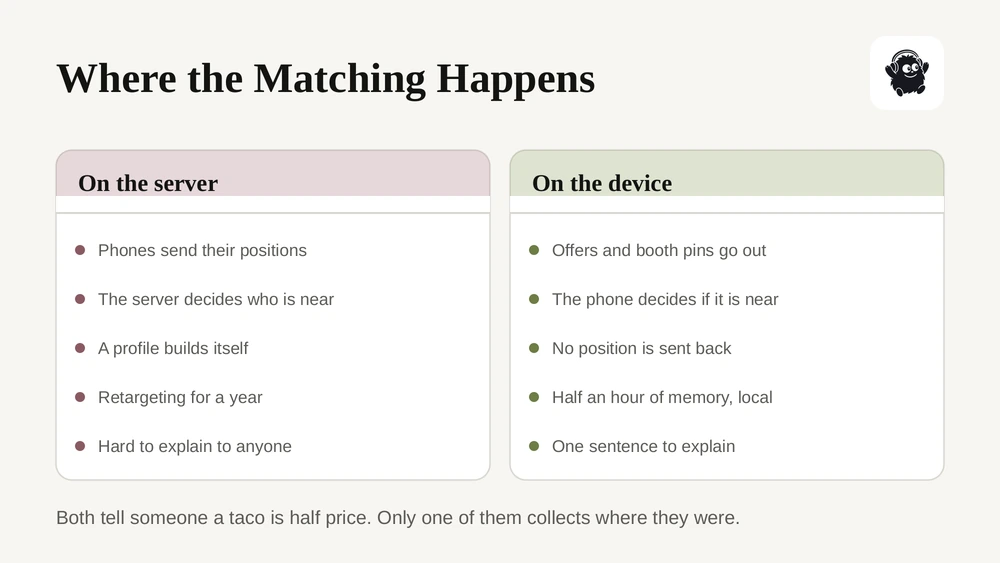
The uncomfortable version of this technology sends your customers' locations to a server, builds a profile, and retargets them for a year. None of that is necessary to tell someone a taco is half price for the next half hour.
- Decide relevance on the device. The offer and the booth's position go to every open map. The phone, which knows where it is, decides whether to show it. The server never learns who was where.
- Use a short memory. Thirty minutes of recent positions, kept on the device, is enough to catch someone who has just wandered off. A month of history is a liability.
- Do not tie it to an identity. An offer does not need to know who someone is, only that they are near.
- Tell people the rule in one sentence, such as "vendors near you can post offers while you are on the map", not in three paragraphs.
Where Eventist fits
Eventist lets a vendor post an offer from their own booth onto the event's live map, within the allowance the host sets.
The vendor writes the message, chooses whether it goes to people near the booth or everyone on the map, and sets when it starts and ends. A deal with a start time in the future is simply a scheduled one; nothing has to run for it to go out or expire. They can withdraw it, and an offer withdrawn before it starts does not count against their allowance.
The near case is matched on the attendee's phone. Every open map receives the offers and the booth positions, and the device decides whether it is within about a hundred metres now, or was at any point in the half hour before the offer went out, using a short trail kept on the device itself. The attendee's position is not sent anywhere to make that decision. Offers can be sorted by nearest booth or by what ends soonest.
The host sets how many offers each vendor gets per event, in the map builder, and zero switches the whole thing off. There is no web push and no app: the offer is there the next time the attendee opens the map, beside the pin it came from.
Our guide to festival vendor management covers the rest of the vendor relationship, and the festivals page has the live map features.
Frequently Asked Questions
What is proximity marketing at an event?
Proximity marketing means delivering an offer based on where someone is. At an event that usually means a vendor posting a time-limited deal that reaches attendees within walking distance of their booth, through the event's own map or app. It works better at events than in most settings because everyone is on one site at one time and already using the map to get around.
Do you need an app for location-based offers?
No, and at most events an app is the wrong tool, because only a small share of attendees install one. A web-based event map can receive offers and decide on the device whether the attendee is near the booth, which reaches everyone who uses the map without an install or a notification permission. The trade-off is that a web page cannot interrupt, so the offer is seen the next time the map is opened.
How many offers should a vendor be allowed to send?
Few. Two or three for a weekend is enough for most events, and the limit should be set by the host rather than the vendor. Caps exist because the channel's value is collective: a handful of vendors sending constantly will train attendees to ignore every offer, including the good ones.
Is proximity marketing legal in Canada?
The pieces are governed by existing law rather than anything special. Using someone's location means collecting personal information under PIPEDA, which requires a stated purpose and meaningful consent. Sending promotional messages electronically engages Canada's Anti-Spam Legislation, with consent, identification and unsubscribe requirements. Price claims must be truthful. Designs that decide relevance on the attendee's device, and never send a position to a server, carry much less of this weight.
What makes an event offer actually work?
Three things together: it is near enough to walk to, it runs out soon enough to prompt a decision, and it is a specific thing at a specific price. Offers that fail usually fail on the third, because they were written weeks ahead as brand messages rather than in the moment by someone watching a quiet booth.
How do you stop vendor offers becoming spam?
Cap them per vendor, keep them out of the way of the things attendees need, require the booth name on every offer, and make them easy to ignore. Tell vendors what works before the event, so the offers that go out are time-boxed and specific rather than generic. If attendees start ignoring offers, the cap was too high.
Sources
- Canada's Anti-Spam Legislation: commercial electronic messages
- Guidelines for obtaining meaningful consent, Office of the Privacy Commissioner of Canada
- Competition Bureau Canada: deceptive marketing practices cases and outcomes
Recommended
Tags
Ready to simplify your events?
Join hundreds of organizers, studios, and festival directors who trust Eventist to run their events.