Vendor Contract Management for Event Organizers
Vendor contract management is the work of selecting suppliers, agreeing terms in writing, tracking what each vendor owes you and when, and reviewing how they performed once the event is over. For an event, that means every caterer, AV crew, rental company, security provider and booth vendor has a written scope, a payment schedule, a deadline list and a named person who checks each item. This guide walks through the lifecycle, the clauses worth negotiating, and a simple system for keeping contracts from becoming forgotten PDFs.
This article is general guidance for event organizers, not legal advice. For permits, insurance, security, AV obligations, tax treatment or any contract dispute, ask a lawyer or the relevant professional in your province.
TL;DR
- Treat each vendor contract as a living document with dates, owners and alerts, not a file in a shared folder.
- Work through four phases: planning, negotiation and signing, coordination, and evaluation after the event.
- Write load-in and load-out windows, cancellation terms and force majeure wording into the contract itself.
- Score every vendor after the event so next year's choices rest on records, not memory.
- Keep contracts, tasks, booths and staff roles in one place where your tools allow it.
What vendor contract management covers at an event
Event vendor management is commonly described as selecting, contracting, coordinating, monitoring and evaluating suppliers, with the aim of controlling budgets and reducing operational risk. Contract management is the written backbone of that process. One way to separate the two: vendor management is the ongoing relationship, while contract management focuses on the terms and the contract's timeframe.
For a festival, conference, trade show or concert, that backbone covers a wide range of agreements:
- Production and technical suppliers: sound, lighting, staging, video, power.
- Hospitality: catering, bars, food vendors, accessibility and sanitation services.
- Site services: security, first aid, fencing, waste, shuttle transport.
- Commercial partners: sponsors, exhibitors, merchandise sellers and market vendors.
- Talent and speakers, where agreements usually follow a different template.
Contract risk is not only an operational issue. A law firm advising trade associations argues that contract management is a governance issue, not just an administrative task, because vendor, event, sponsorship and partnership contracts each carry distinct risks. If you answer to a board, a funder or a committee, that framing is useful: someone senior should know which contracts carry the most exposure.
The four phases of the contract lifecycle
The CIPS Contract Management Cycle describes a continuous 12-stage process across strategy, structure, implementation and lifecycle management. Event guidance condenses that into four phases, which map well to an event calendar.
| Phase | What happens | Event example |
|---|---|---|
| Pre-award (planning) | Define needs, request quotes, shortlist | Writing a brief for AV: stages, hours, power needs |
| Award (negotiation and signing) | Agree scope, price, terms; sign | Final quote, deposit schedule, cancellation terms |
| Management (coordination) | Track deliverables, deadlines, payments | Insurance certificates, guest counts, load-in times |
| End of lifecycle (evaluation) | Review, score, renew or replace | Post-event scorecard, final invoice check |
Most problems come from skipping the first and last phases. Organizers who sign from a single quote, or who never record how a vendor performed, repeat the same mistakes next season.
Phase one: write the brief before you request quotes
A vendor can only price what you describe. Put the following in a one-page brief that goes to every bidder:
1. Event dates, site, expected attendance and the schedule by stage or room.
2. Exact deliverables, such as number of microphones, hours of coverage or servings per hour.
3. Site constraints: access points, power capacity, noise bylaws, curfew.
4. Insurance and licensing you expect each vendor to hold.
5. How you will assess bids: price, references, availability, fit.
Asking every bidder the same questions makes quotes comparable, and it gives you a record of why you chose who you chose.
Phase two: negotiate for a working relationship
Negotiation is not about winning every clause. Contract management practitioners point to active listening during negotiation as a way to uncover vendor constraints, such as staffing limits or equipment timelines, that can be addressed in the contract before they turn into onsite emergencies. Ask each vendor what usually goes wrong on events like yours, then write the answer into the agreement.
Phase three: coordinate against the contract
This is where most of the work sits. Each contract creates obligations on both sides: you owe deposits, access and final numbers, and the vendor owes certificates, staffing and delivery. The next section covers how to track these.
Phase four: evaluate and record
Public buyers do this formally. The Government of Canada's vendor performance management policy points to standardized scorecards covering cost, schedule, quality and management, with evaluations at the end of shorter contracts or at regular intervals on long ones. You are not bound by federal procurement rules, but a short scorecard is a sound habit. Score each vendor within two weeks of the event, while details are fresh.
Clauses worth negotiating before you sign
A verbal agreement may start a relationship, but it will not protect you when details change or payments run late. Written agreements are how you settle scope disputes when two people remember it differently. Here are the clauses that tend to matter most for events.
Scope and deliverables
List what is included and, just as important, what is not. "Sound system" is vague. "Two-stage PA with named engineer, soundcheck from 2 p.m., and strike by midnight" is enforceable. State quantities, hours, staffing levels and any substitution rules.
Payment schedule and cancellation
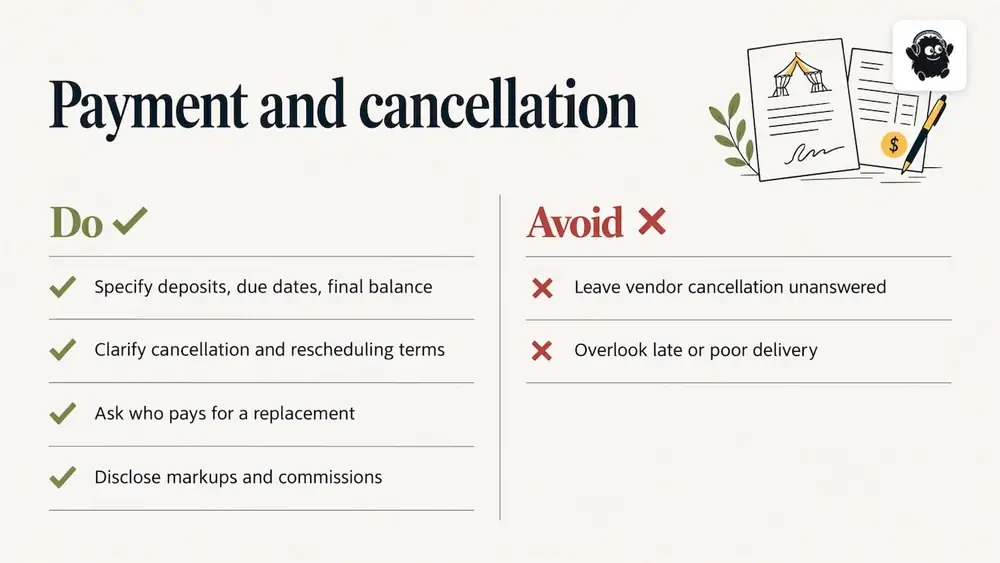
Spell out deposit amounts, due dates, the final balance and what happens if you cancel or reschedule. Ask the vendor the reverse question: what do you owe if they cancel, and who finds and pays for a replacement? A planning contract checklist from an event company lists these same questions: last-minute vendor cancellation, replacements, late or poor delivery, and whether anyone earns a markup or commission. Disclosure of markups and commissions is worth asking about.
Force majeure that covers vendor-side shortages
Force majeure is a clause meant to protect the parties from events beyond normal business risk. The Office of the Procurement Ombud explains it as relief when an unexpected event outside a party's control leaves it unable to perform, and suggests parties consider insurance for the risks involved. For events, define the clause in plain terms. Does it cover severe weather, a power failure at the site, a permit withdrawn by the city, a supplier's own supply shortage? Vendors often prefer to avoid complex disputes, so clear, collaborative force majeure wording, including vendor-side shortages and not only natural disasters, tends to be a productive point to raise. Wording and enforceability vary by province, so have a lawyer review it.
Load-in, load-out and technical requirements
The most common operational failure is leaving these details until too late. Build load-in schedules directly into the contract specifications, which helps prevent onsite bottlenecks, overtime fees and stress for both your staff members and the vendor. A good load-in clause names:
- The arrival window per vendor and the gate or dock they use.
- Power, water, rigging and floor-load requirements.
- Who supplies labour for unloading.
- The strike deadline and any penalty for overrunning it.
- The on-site contact for each side, with a mobile number.
Insurance, permits and compliance
State which insurance each vendor must carry, the coverage limits you require and the date by which they must send a certificate. Name who holds permits for food service, alcohol, amplified sound or road closures. Requirements differ by municipality and venue, so confirm with your city, your venue and your insurer. This is general guidance, not legal advice.
Termination and dispute handling
Define what counts as a breach, how much notice and chance to fix it a vendor gets, and how disagreements are escalated. Even a short "talk first, then mediate" step saves time compared with going straight to legal action.
Keep contracts alive: dates, owners and alerts
Successful organizers treat vendor contracts as living documents tied to project workflows, where tasks and deadlines such as insurance certificate requests or guest count cut-offs trigger alerts, instead of relying on manual tracking and scattered email threads. The practical version of this is a contract register: one row per vendor, with the same columns every time.
| Column | Example entry |
|---|---|
| Vendor and service | Stage lighting, Main Stage |
| Contract value and payments | Deposit due 60 days out, balance 7 days out |
| Key dates | Certificate of insurance, final headcount, load-in |
| Owner | Production manager |
| Status | Signed / awaiting certificate / paid |
| Post-event score | Cost, schedule, quality, communication |
A few habits make the register work:
- One owner per contract. Shared responsibility usually means nobody checks.
- Dates become tasks. Every deadline in a contract gets its own task with an assignee and a reminder ahead of it.
- One version of the truth. Signed copies and amendments live in the register, not in someone's inbox.
- Change log. If a quantity or time changes by phone, confirm it by email and attach it.
If you are comparing tools to run this, a roundup of project management tools for event planners can help you weigh task tracking and collaboration features against a spreadsheet. A spreadsheet is fine for a one-day event with ten vendors. Once you have multiple stages, dozens of exhibitors and rotating staff, a system that connects contracts to tasks pays for itself in missed-deadline avoidance.
Different vendors need different contracts
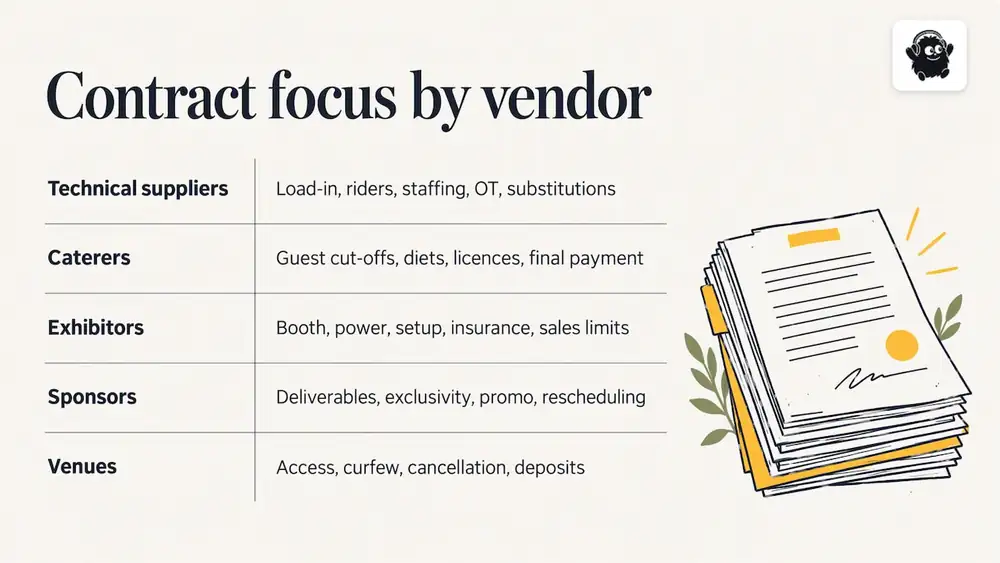
A single template rarely fits everyone. Adjust the weight you put on each term by vendor type.
Technical and production suppliers. Focus on load-in, technical riders, staffing, overtime rates and equipment substitution. These vendors affect your schedule most.
Caterers and food vendors. Focus on guest count cut-offs, dietary requirements, health and licensing documents, and the payment terms for final numbers.
Exhibitors and booth holders. These are customers as well as vendors. Their agreements cover booth size and location, power, set-up and tear-down windows, insurance and rules on what they may sell or give away. For the tooling side, see our overview of festival vendor management software.
Sponsors and partners. Define deliverables, exclusivity, logo and promotion rights, and what happens if the event is rescheduled.
Venues. Check access hours, capacity, curfew, in-house supplier requirements, cancellation and deposit schedules.
How to evaluate vendors after the event
Evaluation is the phase that makes the next event easier. A simple method:
1. Within two weeks, gather the people who worked directly with the vendor: production, operations, volunteer and staff leads.
2. Score cost against quote, schedule adherence, quality of work and ease of working together, on a consistent scale.
3. Compare the final invoice with the contract line by line, and flag extras that were not agreed in writing.
4. Note what the contract missed: an unclear access time, an unstated power draw.
5. Decide: rebook, rebook with changed terms, or replace.
6. Update your template with the lessons while they are fresh.
The federal approach to scorecards also weights past performance in future bids; the CanadaBuys policy describes how recorded performance informs later decisions. Your version can be lighter, but the principle is the same: a vendor's record should decide who you hire next year.
Our perspective
We see the same pattern across festivals, conferences and trade shows: contract problems rarely come from a bad clause. They come from a good clause that nobody tracked. The deposit was paid on time but the insurance certificate arrived the morning of load-in. The booth map changed but the exhibitor's contract still named the old spot.
That is why we build Eventist around the whole event rather than only the ticket. Vendor and exhibitor booths, staff roles, contract signing, task management and the run of show sit alongside ticketing and registration, so a deadline in a contract can live next to the person responsible for it and the schedule it affects. Our view is that the best contract process is the one your team will actually follow under pressure, so keep it short, give every date an owner, and review it after every event.
Where Eventist fits
If your event involves exhibitor booths, vendors, staff roles and a run of show, Eventist brings contract signing, task management and booth management into the same platform as ticketing and check-in. For festivals and conferences, pricing is a flat fee per paid ticket: as of October 2026, Canadian organizers pay $4.99 CAD per paid ticket, as listed on the pricing page. Card processing fees are paid to Stripe or Square at their own rate, and free tickets and registrations run on monthly plans starting from $100 CAD. For conference-specific tools, see our conference registration and management page. If you are still comparing options, our buyer's guide to event management software lays out the criteria.
A starter checklist for your next vendor contract
- Written brief sent to every bidder, with the same questions.
- At least two comparable quotes for any major supplier.
- Scope, quantities, hours and substitutions stated plainly.
- Deposit and balance dates, cancellation terms for both sides.
- Force majeure wording that covers vendor-side shortages.
- Load-in and load-out windows, power and access requirements.
- Insurance, permits and licences named, with due dates.
- Named on-site contacts with mobile numbers.
- Every deadline entered as a task with an owner.
- Post-event scorecard and invoice reconciliation.
Frequently Asked Questions
What is vendor contract management?
It is the process of creating, negotiating, signing, monitoring and reviewing agreements with the suppliers who help deliver your event. It covers terms such as scope, payment, insurance and cancellation, as well as tracking deadlines and evaluating performance afterwards.
What is the difference between vendor management and contract management?
Vendor management is the ongoing relationship with a supplier: selecting, briefing, coordinating and evaluating. Contract management concentrates on the agreement itself and the period it covers. At events you need both, since the contract sets the rules and the relationship decides how smoothly they are applied.
What should an event vendor contract include?
At minimum: a precise scope, price and payment schedule, cancellation terms for both sides, force majeure wording, load-in and load-out times, insurance and permit requirements, on-site contacts and a way to resolve disputes. Have a lawyer review the template once, since this article is general guidance and not legal advice.
How often should I review vendor performance?
For a single event, review within a couple of weeks of the close. For long-term suppliers, public-sector guidance such as the CanadaBuys policy uses evaluations every six months. A recurring festival or venue could follow a similar rhythm.
Do I need software to manage vendor contracts?
Not for a small event: a register in a spreadsheet with owners and reminders works. When you manage many vendors, exhibitors, stages and staff members, software that links contracts to tasks and schedules reduces missed deadlines and scattered email threads.
Sources
- Contract Management Cycle, CIPS
- Vendor Performance Management Policy, CanadaBuys
- Trade Association Governance: Making Contract Management a Leadership Priority, ArentFox Schiff
- What to Include in an Event Vendor Agreement, Foundation Vibes
- How to Manage Event Vendors, AMW
- What Is Event Vendor Management?, Event Study
- Force majeure, Office of the Procurement Ombud
- What to Include in Your Event Planning Contract, CWS Event
Recommended
Tags
Ready to simplify your events?
Join hundreds of organizers, studios, and festival directors who trust Eventist to run their events.