Early Bird Ticketing: How to Price, Schedule and Sell
Early bird ticketing means releasing the first batch of tickets at a reduced price, in limited quantity or for a limited time, so people commit before the regular price applies. Done well, it brings in cash early, shows you how much demand to expect and gives your marketing a reason to ask for action now. Done badly, it trains your audience to wait. This guide covers how to set the price gap, how many tickets to release, how to schedule the phases and what to do when a phase closes.
TL;DR
- An early bird ticket is a separate ticket type with its own price, quantity and sales period, for the same admission you sell later at a higher price.
- A discount of roughly 15% to 25% off the regular price, paired with a quantity cap or a firm end date, is a sensible starting range for most events.
- Two or three phases (early bird, advance, regular) work better than one long discount, because each deadline gives buyers a new reason to act.
- Watch sales pace per phase, not just the running total: a slow early bird is the earliest warning you get about demand.
- Close every phase on the schedule you announced, or the next offer will not be believed.
What early bird tickets are, and how they differ from advance tickets
An early bird is the first release of tickets for an event, usually limited in number and sold below the later price. Organizers use three labels that often get mixed up:
- Early bird: the first and lowest price, available when sales open or during a short launch window.
- Advance: a middle price, available before the event but after the early bird has ended or sold out.
- Regular, standard or door: the full price, often charged in the final weeks and at the gate.
The conference registration resource published by the Association of Science and Technology Centers for its 2026 annual conference shows this split in practice: separate Early Bird, Advance and Regular phases for the same conference access, each with its own dates and price.
The idea is older than online ticketing. Marketing researchers describe advance selling as selling a service in a period before it is consumed, and they note that it can work as price discrimination: price-sensitive buyers purchase early at a discount, while price-insensitive buyers pay higher spot prices. A student on a tight budget books months ahead; a manager who cannot commit until the calendar clears pays more later. The same seat or pass serves both, and you earn from each kind of buyer.
A related idea runs the other way. Academic work on pricing separates advance purchase discounts, which reward early buyers, from clearance sales, which discount for late buyers. Early bird ticketing is the first kind. Last-minute deals on unsold seats are the second, and mixing the two in one event without a plan leaves buyers unsure which price is the real one.
Why early bird pricing works
There are four practical reasons organizers use it.
Cash flow. Deposits for venues, artist fees, staging and marketing fall due long before doors open. Revenue from the first tickets can cover part of those costs.
Demand signal. The number sold in the first week or two tells you whether your forecast is realistic while you still have time to change the programme, the room size or the marketing budget.
Commitment. Someone who has paid is more likely to show up, tell friends and plan travel or time off. Early buyers often become your first promoters.
A reason to act. A deadline gives interested but undecided people something concrete to respond to. The research above also tells you who this appeals to: buyers who are price-sensitive and flexible about timing.
The cost is real too. You sell some tickets for less than you might have achieved, and a buyer who would have paid full price may take the discount. That is why quantity, depth and timing matter more than the label.
How to set the early bird price
Start from the regular price, not the discount
Decide the regular price first, using your costs, the venue capacity and what comparable events in your city charge. Then work backwards. If the regular price is wrong, no discount fixes it. For events where prices should move with demand rather than on a fixed calendar, see our explainer on dynamic ticket pricing.
Pick a depth buyers notice
Eventist's own pricing guide suggests early bird tiers with a 15% to 25% discount, along with clear limits and deadlines. That range is a useful starting point for two reasons:
- Below about 10%, the saving is easy to ignore and the deadline stops feeling urgent.
- Beyond about 30%, you shift the whole audience to a lower price point and make the regular price look inflated.
The right figure depends on your audience. A nonprofit gala with a loyal donor base can use a small discount or none at all and lean on perks instead. A first-year festival with no track record may need to be more generous to get the first wave moving.
Consider perks instead of price
A discount is not the only lever. Early buyers can receive an extra: first choice of seats, a welcome drink, a workshop add-on or priority entry. Perks usually cost you less than they are worth to the buyer, and they protect your headline price.
A worked example: 300 tickets, three phases
Take an indoor event with 300 places and a regular price of $60.
| Phase | Tickets | Price | Discount | Revenue if sold out |
|---|---|---|---|---|
| Early bird | 100 | $45 | 25% | $4,500 |
| Advance | 120 | $54 | 10% | $6,480 |
| Regular | 80 | $60 | none | $4,800 |
| Total | 300 | $15,780 |
If every ticket sold at $60, revenue would be $18,000, so the schedule gives up $2,220 on paper, an average of $52.60 per ticket. What you buy with that is time: a third of your capacity is paid for in the first phase, and you know within days whether those first 100 tickets move quickly.
The discount only costs you when those buyers would have paid $60 anyway. For a new event, a new venue or a new city, many would not have bought at all.
What the ticketing fee does to the arithmetic
Discounts shrink revenue per ticket, and the fee model decides whether your costs shrink with them. With a flat fee per paid ticket, the fee is the same at $45 as at $60. With a percentage fee, it falls as you discount, but it also takes a larger bite from every full-price sale.
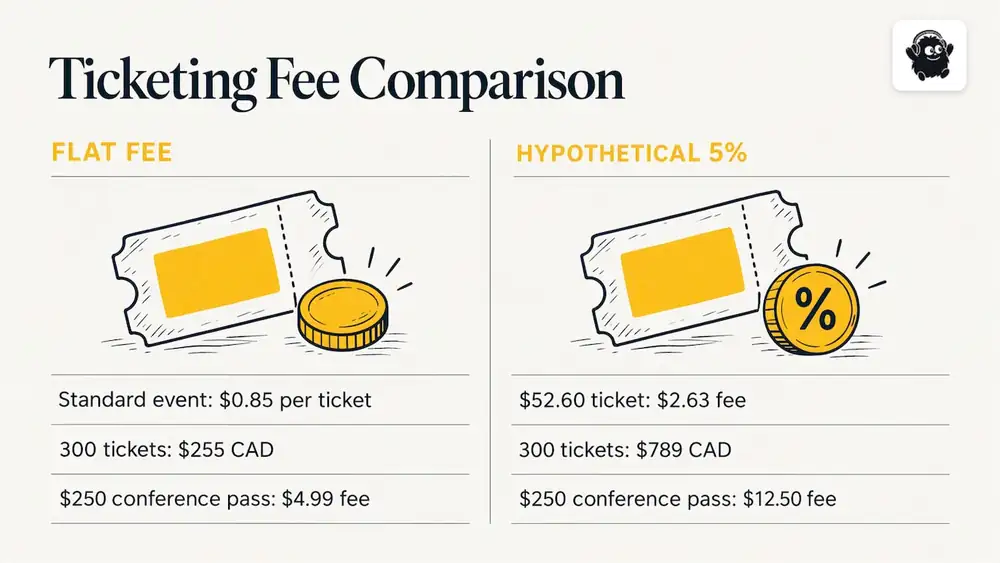
As of October 2026, Canadian organizers pay $0.85 CAD per paid ticket for event ticketing on Eventist and $4.99 CAD per paid ticket for festivals and conferences. Card processing fees are paid to Stripe or Square at their own rate, on top. For the 300-ticket example, that is 300 × $0.85 = $255 CAD in ticketing fees, about 1.6% of the $15,780 total.
To see why a flat fee is usually cheaper, compare it with a hypothetical percentage fee of 5%. On the average ticket of $52.60 that is $2.63 per ticket, or $789 across 300 tickets, against $255. The 5% figure is an illustration, not any provider's quote, so replace it with the real rate on the platform you are comparing. The higher your ticket price, the wider the gap in favour of a flat fee: on a $250 conference pass, 5% is $12.50 against $4.99 or less.
How many early bird tickets to release
There are two ways to limit an early bird, and the strongest offers use both.
By quantity. Release a fixed number, commonly somewhere between a fifth and a third of capacity, and stop when they are gone. This suits events with a hard cap, such as a seated concert or a venue with a permitted occupancy. The sell-out itself becomes your message.
By time. End the price on a set date regardless of how many have sold. This suits conferences and multi-day festivals where you want a steady flow of registrations and the date drives your email calendar.
Use a quantity cap when you worry about giving away too many cheap tickets, and a date when you worry about last-minute decisions. When you use both, say in the offer which one ends it first: "first 100 tickets or until the end of the month, whichever comes first."
Build the schedule backwards from the event
A workable calendar for an event with about four months of lead time:
1. Launch window (first two to three weeks): early bird at the deepest discount, announced to your mailing list before anyone else.
2. Advance phase (the next two months): a smaller discount, ending a few weeks before the event.
3. Regular phase (final weeks): full price, with reminders focused on remaining capacity.
Short lead times need fewer phases. For an event announced six weeks out, a one- or two-week early bird followed by regular price is enough. A festival with a year of lead time can run a limited first release, a second release and a final one, each at a higher price. Publish the end date of each phase on the ticket page itself, so nobody has to guess.
If you sell timed slots rather than open admission, the early bird logic applies per slot; our guide to timed entry ticketing covers how capacity is set.
How to promote early bird pricing
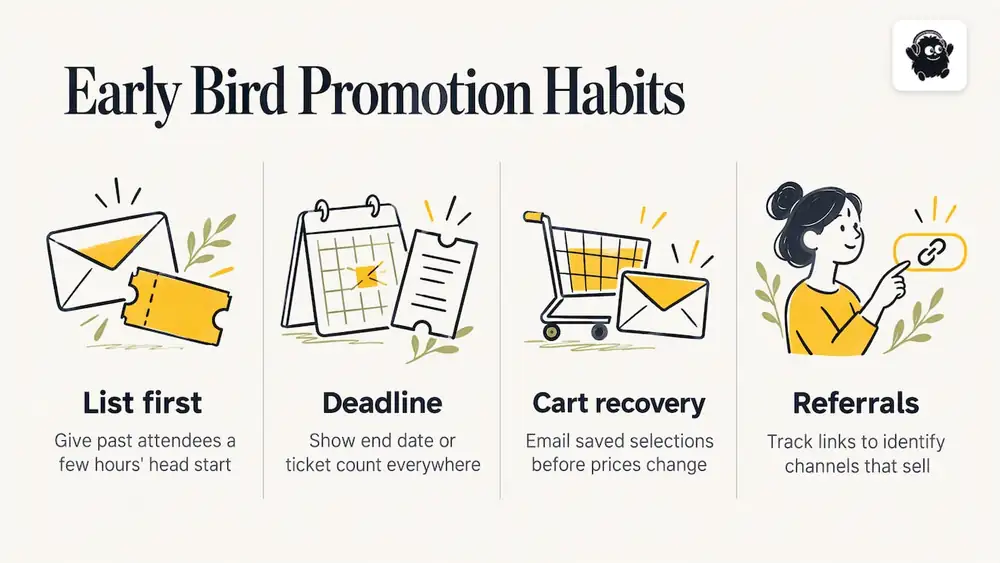
An early bird price that nobody sees does nothing. Three habits make the difference.
Tell your own list first. Past attendees, newsletter subscribers and followers should hear about the early bird before the public does. A few hours of head start is enough to make them feel like insiders.
Make the deadline specific and visible. Put the end date, or the number of tickets left, in the email subject line, on the ticket page and in every social post. The message should state what the buyer saves in dollars, not only in percent. Clear calls to action help here: one button, one verb, one deadline.
Recover the near-buyers. Some visitors add tickets to a cart and leave. A reminder email about their saved selection, sent before the price changes, is often the cheapest sale you will make. SMS reminders do a similar job as a deadline approaches.
Also consider referral links for promoters, partners or community leaders. When each has a trackable link, you learn which channel fills the early bird and can put more effort there.
Read the pace: tracking early bird sales
Early bird sales are data as much as revenue. Track three numbers:
- Tickets sold per day during the first week, compared with your plan.
- Share of the early bird allocation sold at the halfway point of the window.
- Source of sales: email, social, referral links, direct.
Then act on what you see:
| What you see | What it suggests | What to do |
|---|---|---|
| Early bird sells out in days | Price may be too low or demand is strong | Open the next phase on time, consider a higher regular price |
| Steady sales across the window | Pricing and message are well matched | Keep the schedule, repeat the pattern |
| Slow start, sales only in the last days | The deadline is doing the work, the offer is not | Strengthen the promotion; consider a perk rather than a deeper discount |
| Almost nothing sells | Demand, awareness or the event itself needs attention | Revisit the audience and channels before cutting price |
The worst reaction to a slow early bird is a panic discount. Buyers who purchased early will notice, and the next event will be harder to sell.
What to do with unsold early bird tickets
When the date arrives, end the phase. Extending it "by popular demand" when it has not sold out teaches your audience that deadlines are negotiable. Move unsold early bird tickets into the next phase at the next price, or retire them.
If you want to reward a specific group later, use a code or a private link with a clear reason, such as members, previous attendees or a partner community, instead of reopening the public offer. Keep the rule simple enough to explain in one sentence.
Our perspective: early bird pricing works best when you can run the whole event
We see early bird ticketing as the first step of event operations, not a standalone trick. The discount only pays off when the rest of the system backs it up: seat maps that match the quantities you released, analytics that show pace as it happens, abandoned-cart recovery emails that win back near-buyers, SMS reminders as a deadline nears and referral links that show which promoter brought which sale. Later the same tickets feed QR check-in and door sales, so the numbers you tracked in the early weeks line up with the people who arrive.
Pricing is part of this. We charge a flat fee per paid ticket instead of a percentage, which means your early bird discount reduces your revenue but not by an extra fee layer on every sale. Organizers also get setup help from a Canadian team, which matters most when the first phase opens and the schedule has to be right. A flat fee is usually cheaper than a percentage once ticket prices rise, and the arithmetic above shows how to test that for your own event.
Setting up your sales on Eventist
If you are planning early bird phases for a concert, festival, conference or everyday ticketed event, Eventist handles the ticketing and the rest of the event in one place. Canadian organizers pay $0.85 CAD per paid ticket for event ticketing, $4.99 CAD for festivals and conferences and $9.99 CAD for competitions, as of October 2026. Venues pay 0.5% to 1.9% of what they charge on everything they sell, single tickets included. Free tickets and registrations run on monthly plans starting from $100 CAD.

See the current pricing page for the full list, or read the longer guide to event ticketing if you are still choosing a platform.
Frequently Asked Questions
What is the meaning of early bird price?
An early bird price is a reduced ticket price offered to people who buy before a set date or while a limited quantity lasts. The ticket is usually identical to the regular one. What you are paying for, and being rewarded for, is committing early.
Is early bird pricing worth it?
It usually is when you have costs to cover before the event, an audience that plans ahead or a new event whose demand you cannot yet predict. It is less useful when capacity is certain to sell out at full price. Test it against your own numbers, as in the 300-ticket example above.
What is the difference between early bird and advance tickets?
Early bird is the first, lowest-priced release. Advance tickets come after, at a middle price, still before the regular or door price. Some events use only one of the two labels, so what matters is that each phase has its own price and dates.
How much should an early bird discount be?
A range of about 15% to 25% off the regular price is a sensible starting point, with a quantity cap or end date. Smaller discounts can work if you add a perk, and larger ones risk making the regular price look inflated.
Should I extend an early bird if it has not sold out?
Generally no. Ending it on schedule keeps your next deadline credible. If sales are slow, improve the message or add a perk, and keep the regular price unchanged for the next phase.
Sources
- Advance-selling as a competitive marketing tool, International Journal of Research in Marketing
- Advance Purchase Discounts versus Clearance
- ASTC 2026 Annual Conference Registration Resource
Recommended
Tags
Ready to simplify your events?
Join hundreds of organizers, studios, and festival directors who trust Eventist to run their events.