Weather Cancellation Policy for Outdoor Events
At two in the afternoon, with gates at five, somebody has to decide. The radar is orange, the forecast was wrong twice already this week, you have four thousand tickets sold and a stage crew asking whether to keep building. Everyone in the room looks at you.
That decision goes badly when it is made at two in the afternoon. It goes fine when it was made in March, written down, agreed with the venue and the insurer, and published on the event page where every ticket buyer could read it. This is how to write that policy, and how to use the weather alert system Canada rebuilt in 2026 as the scaffold for it.
General guidance, not legal or safety advice: your municipality, your venue agreement and your insurer each have a say, and a structural engineer decides what wind your tents can take, not a blog post.
TL;DR
- Write the policy before the onsale, publish it on the event page, and make the ticket terms match it. A policy invented on the day is a refund argument with extra steps.
- Environment and Climate Change Canada now colour-codes every alert — yellow, orange, red — by impact rather than by hazard. That ladder maps cleanly onto proceed, prepare and stop, which is exactly what an event needs.
- Since August 2026, severe thunderstorm and tornado warnings are issued to a targeted polygon rather than a whole forecast region, so "a warning for the county" and "a warning for your field" are now different facts.
- Your own triggers matter more than the public alerts: wind limits on temporary structures, a lightning radius and wait time, heat and cold thresholds. Pick numbers, write them down, give them to the person with the radio.
- Decide the money question in advance: full refund, credit, or rain date. Partial events are the hard case, so define what counts as "substantially performed" before you need the phrase.
- The twenty minutes after the decision is a communications problem. Have the channels ready and the first message drafted.
The alert colours are your decision ladder
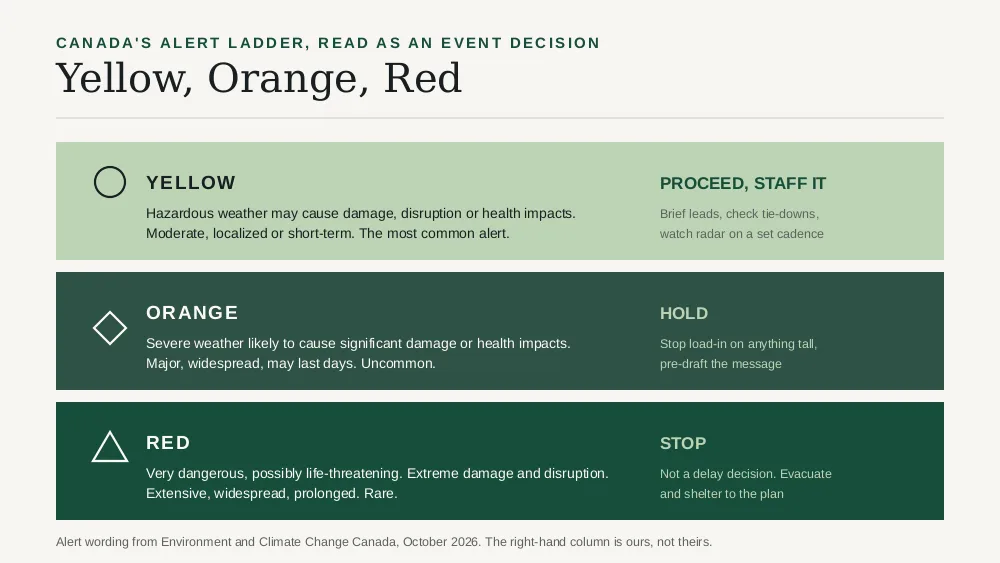
Canada rebuilt its weather alerting in a way that happens to suit event operations better than the old system did. Every alert — warnings, advisories and watches — now carries a colour, and the colours describe impact, not hazard type. In ECCC's own words, they "move from yellow, to orange, to red, as the potential risk increases".
| Colour | What ECCC says | What it should mean on your site |
|---|---|---|
| Yellow | "Hazardous weather may cause damage, disruption, or health impacts"; impacts "moderate, localized and/or short-term"; the most common alert | Proceed, but staff the decision. Brief leads, check tie-downs, watch the radar on a named cadence |
| Orange | "Severe weather is likely to cause significant damage, disruption, or health impacts"; impacts "major, widespread and/or may last a few days"; uncommon | Hold. Stop load-in on anything tall, move the decision point forward, pre-draft the message |
| Red | "Very dangerous and possibly life-threatening weather will cause extreme damage and disruption"; impacts "extensive, widespread, and prolonged"; rare | Stop. This is not a delay decision, it is an evacuation and shelter decision |
Two more things changed in August 2026 that matter to anyone running a field.
Warnings are now targeted. ECCC issues severe thunderstorm and tornado warnings to a polygon drawn around the area most likely to take the impact, updated as the storm moves, rather than to a large predetermined zone. Watches still go out to the broad zones. So a severe thunderstorm warning "for your region" no longer means what it used to, and your policy should say whose location it refers to: the site, not the county.
Only the extreme end reaches phones automatically. Alert Ready broadcast intrusion covers tornado warnings and severe thunderstorm warnings meeting specific criteria — gusts of 130 km/h or greater, or hail the size of a baseball. Everything below that, your attendees will only know if you tell them.
Your own triggers, which matter more
The public alert system is a floor, not a plan. Most event weather decisions happen well below warning criteria, and they come down to numbers you set.
Wind on temporary structures. This is the one with a real engineering answer and no room for judgement on the day. Tents, stages, towers, screens and inflatables each have a manufacturer's wind rating and an evacuation threshold in the structure's own documentation. Get those numbers from the supplier in writing when you book, put them on one page, and give that page to the site manager. An anemometer on site costs very little and ends the argument about whether it is "about 60".
Lightning. Decide a radius and a wait time, write both down, and name who watches the strike data. The specific numbers matter less than the fact that they were chosen in advance by someone calm, because the pressure on the day runs entirely one way: towards carrying on.
Heat and cold. Humidex and wind chill decisions are about your crowd rather than your structures: water, shade, warming space, and the length of time people are queuing outdoors. A heat plan that only covers the audience and not the crew in black polo shirts on tarmac is half a plan.
Rain alone. Rain is rarely a safety decision and almost always a comfort and ground-conditions decision. The question it actually raises is whether the field will survive the vehicle movements, which is why the parking and site plan is part of the weather plan — see parking and shuttle passes for the capacity side of that.
The money question
Three options, and the policy has to pick one per scenario rather than leaving it open.
Full refund. Clean, expensive, and the right answer for an event cancelled before it starts. It is also the one buyers expect, so anything else needs to be conspicuous at the point of sale.
Credit or transfer to a rain date. Preserves the cash and the relationship, works when your audience is local and repeat. It fails when people travelled, so pair it with an opt-out refund for anyone outside a radius.
No refund once substantially performed. The standard position for a festival that ran most of a day and lost the headliner to lightning. It is also the one that causes chargebacks, because "substantially performed" means nothing to someone who came for the headliner. If you use it, define it numerically in the terms — a percentage of the programme, a number of hours, a named set of acts — and say what happens on either side of the line.
Whatever you choose, the terms on the ticket and the policy on the event page have to say the same thing, and both have to be visible before purchase rather than in a PDF linked from a footer. Our guide to writing an event refund policy has the wording patterns; the thing to add here is the weather-specific scenario list.
One thing a policy cannot do is make the cancellation free. That is what event cancellation coverage is for, and it is a different product from the liability policy your venue asks for — worth knowing before you need it, especially this year, since the easiest online source of Canadian event liability is about to stop selling it.
The twenty minutes after the decision
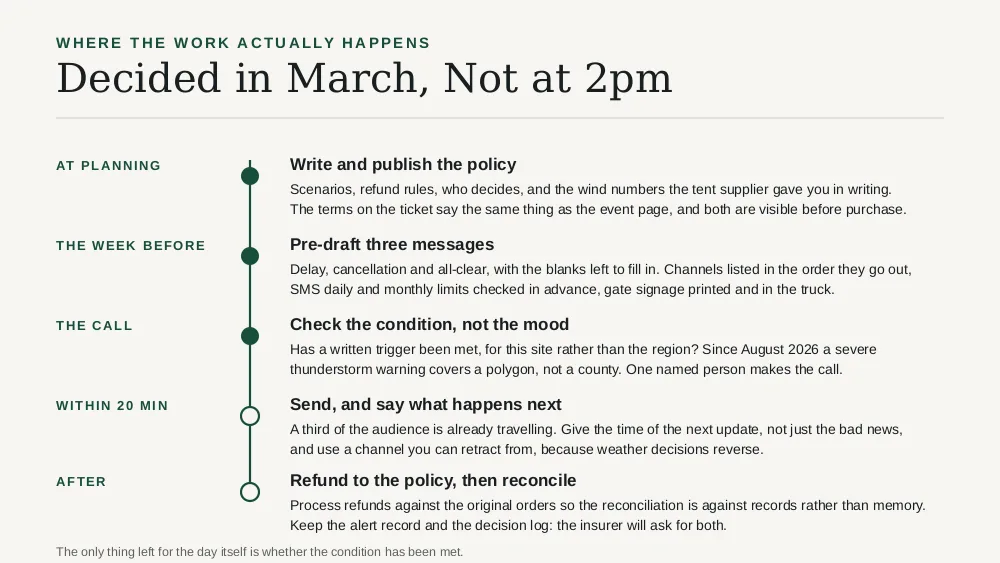
The decision is the easy half. The hard half is that four thousand people need to know within twenty minutes, and a third of them are already in cars.
Name the channels in the plan, in order. The event page banner, the attendee portal, email, SMS, your social accounts, the sign at the gate, and local radio if the event is big enough to warrant it. Each has a different latency, and email is slower than people think.
Pre-draft three messages. Delay, cancellation, and the all-clear. Fill in the blanks on the day. Nobody writes well at 2pm with a crowd outside.
Say the next thing, not just the bad thing. "Gates delayed to 7pm, next update at 6pm" prevents far more phone calls than "gates delayed", because it tells people what to do with the next hour.
Keep the retraction cheap. Weather decisions reverse. A channel you cannot take a message back from is a channel that will embarrass you when the cell passes north. In Eventist, a broadcast to attendees appears in the portal during the event and can be withdrawn when the situation changes, which is the property you want when the forecast turns around twice in an evening.
Mind the limits on SMS. Text is the fastest channel and the one with a per-event cost and a sending cap, so it is worth checking your daily and monthly limits in advance rather than discovering them while sending.
Our perspective
The reason weather policies get written badly is that writing one feels like planning to fail. It is the opposite: the policy is what lets you make the call early, because the cost of calling it early is known in advance rather than argued about in the moment.
The organizers who handle weather well are not the ones with better forecasts. They are the ones who decided in March what orange means, who holds the radio, what the refund is, and which message goes out first — so that at two in the afternoon there is nothing left to decide except whether the condition has been met.
Where Eventist fits
Four parts of this live in the platform, and the rest lives in your binder.
Telling people. A broadcast goes to attendees, to staff, or to everyone, appears in the attendee portal and on staff dashboards during the event, and can be retracted when the situation changes. SMS is available per event with daily and monthly sending limits you set in advance.
Selling through a delay. A hold is not a closure. The point of sale runs in the dashboard on any staff phone, so when doors slip by two hours the gate can keep selling on a connected reader, a keyed-in card number or cash, and an unpaid sale can be held under a name until the buyer comes back. It needs a connection to work, so treat it as a gate tool rather than a storm tool.
Rebooking without reopening the storefront. If you move to a rain date, an additional checkout gives that date its own checkout page at its own address, with its listings hidden from the main storefront and its registrations, tickets, scanning and reports shared with the rest of the event. Send the link to the people who were affected; nobody else finds it.
The money. Refunds, credits and transfers run through the order they came from, with add-ons and fees still broken out on it, so the reconciliation afterwards is against real records rather than a spreadsheet of who said what.
What the platform does not do is decide. It has no weather feed, no wind thresholds and no opinion about your tents, and it should not: that decision belongs to the person on site with the structural documentation and the municipal permit conditions in front of them.
Frequently Asked Questions
What do the new weather alert colours mean for an event?
Yellow means hazardous weather that may cause moderate, localized or short-term impacts and is the most common alert; orange means severe weather likely to cause major, widespread impacts; red means dangerous, possibly life-threatening weather with extensive and prolonged impacts, and is rare. For an event they map naturally onto monitor, hold and stop, which is why they are a better scaffold for a policy than hazard type alone.
Do I have to refund tickets if an outdoor event is rained out?
That depends on what your published terms say and on what actually happened, which is exactly why the terms need writing before the onsale. A cancelled event almost always means a refund. A shortened or interrupted event is the contested case, and the policy should define numerically what counts as substantially performed rather than leaving it to argument afterwards.
When should we cancel rather than delay?
Delay when the hazard is passing and the schedule can absorb it; cancel when the hazard is arriving, when the site cannot be made safe, or when the delay would push the event past a curfew or permit condition you cannot move. The permit conditions are often the binding constraint rather than the weather, which is a good reason to know them: our event permits guide covers where they hide.
How quickly do we need to tell ticket holders?
Treat twenty minutes as the target from decision to first message, and assume a third of your audience is already travelling. That is only achievable with the channels named in advance and the messages pre-drafted, which costs an hour in planning and saves the evening.
Does a weather warning for my region mean a warning for my site?
Not necessarily, and not since August 2026. Severe thunderstorm and tornado warnings are now issued to a targeted polygon covering the area most likely to be affected, updated as the storm moves, while watches still cover the broad predetermined zones. Your policy should be explicit that it refers to the site's location.
Sources
- Colour-coded weather alerts, Environment and Climate Change Canada
- New targeted warnings for severe thunderstorms and tornadoes, Environment and Climate Change Canada
- Weather alerts, Environment and Climate Change Canada
Recommended
Tags
Ready to simplify your events?
Join hundreds of organizers, studios, and festival directors who trust Eventist to run their events.