Sustainable Event Management: A Practical Guide for Organizers

Sustainable event management means planning an event so that its environmental, social and economic footprint is as small as you can make it, and so that it leaves something useful behind for the host community. In practice that comes down to five habits: build sustainability into the plan from day one, measure what you emit, cut the biggest sources first (usually travel), buy with criteria, and report honestly afterwards. This guide walks through each one for festivals, conferences, trade shows, venues, concerts and everyday ticketed events.
TL;DR
- A sustainable event is designed to minimize negative impacts and leave a beneficial legacy, and that work has to start in the planning phase, not after the event.
- Measure first: list emission sources, collect activity data, apply emission factors and calculate. Travel is often the largest source.
- Use a recognized framework such as ISO 20121:2024 so your goals, roles and reporting have structure.
- Set measurable targets, assign an owner to each one, and share the results with attendees and the public.
- Digital registration, QR check-in and good data cut paper and guesswork, and they make carbon reporting easier.
What sustainable event management means
The ICLEI sustainable events guidelines describe a sustainable event as one that is designed, organized and implemented to minimize potential negative impacts and leave a beneficial legacy for the host community and everyone involved. The same guidelines note that doing this well can bring financial and social benefits, strengthen your reputation, trigger innovation and raise awareness.
Two points in that definition are worth underlining.
First, it is not only about carbon. Sustainability covers the environment, but also inclusion, labour practices, safety and the well-being of attendees, staff members and neighbours. A festival that cuts its generator fuel but ignores accessibility or fair scheduling for volunteers is only half done.
Second, it is a management discipline, not a checklist of green gestures. The guidelines add that sustainable systems may cost more up front but typically lead to long-term savings through resource efficiency and better access to credit and sponsorship. That is the business case you can take to a board, a sponsor or a municipal partner. EarthCheck makes a similar argument in its business case for sustainable events, describing sustainable strategies as drivers of efficiency, resilience and competitive edge that reduce costs and waste.
Where an event's impact comes from
Events affect air, soil, water, resources and people. Participants use materials, energy and water, generate waste and emissions, and can strain local communities, according to the ICLEI guidelines. Before you plan anything, map those sources for your own event type:
- Travel and transport: attendees, artists, speakers, exhibitors and freight.
- Venue and energy: heating, cooling, lighting, staging, temporary power and generators.
- Food and beverage: sourcing, menus, packaging and surplus.
- Materials and waste: signage, badges, programs, booth builds, giveaways and single-use items.
- Social impact: noise, crowd flow, local hiring, accessibility, safety and fair working conditions.
In the measured data we have, travel dominates. The carbon report for BRIDGES by RARE 2025 names travel as the largest emissions source, with delegate travel contributing 55.494 tCO₂e. That is one conference, so do not treat it as a universal ratio, but it is a reminder to check travel before you spend effort on smaller items.
Plan across the full event lifecycle
The most reliable approach is a full-lifecycle one: sustainability is integrated from the very start of planning through to the follow-up period, as set out in the ICLEI guidelines and in the German federal environment ministry's guidelines on sustainable event organisation. The guidelines break the work into four stages.
1. Plan. Build a dedicated sustainability team, even if it is two people at a small event. Define your scope, your stakeholders and your measurable objectives.
2. Implement. Apply the measures during production: venue choice, procurement, transport, catering, waste handling and communications.
3. Run. Track what actually happens on site, from energy use to waste volumes and attendance.
4. Evaluate. Review results against objectives, report them and write down what to change next time.
If you already manage a long task list, a tool helps keep sustainability tasks from slipping. This overview of project management tools for event planners is a starting point for comparing options. Whatever you use, give each sustainability task an owner and a due date, exactly as you would for load-in or ticketing.
How to measure your event's carbon footprint
You cannot reduce what you have not counted. The BRIDGES by RARE 2024 emissions measurement and verification report lays out a process any organizer can follow at a smaller scale:
1. Identify your emission sources.
2. Collect activity data for each one (kilometres travelled, kWh used, kilograms of waste, meals served).
3. Select the relevant emission factors and quantification method.
4. Calculate the emissions.
That report followed ISO 14068-1:2023 and the GHG Protocol. The GHG Protocol sorts emissions into three scopes, and the report applies them to events as follows:
| Scope | What it covers | Typical event example |
|---|---|---|
| Scope 1 | Direct fuel use | Generators, on-site vehicles, propane heaters |
| Scope 2 | Purchased electricity | Venue power, lighting, AV, hall climate control |
| Scope 3 | Indirect activities | Attendee travel, accommodation, waste, water, food |
For most events, Scope 3 is where the bulk of the footprint sits, and it is also the hardest to collect. A carbon assessment is worth doing even when it is imperfect: the report notes it can quantify emissions, set benchmarks to judge your mitigation efforts and show where to improve.
Collecting travel data without a survey nobody answers
The International Congress and Convention Association piloted a simple method at its congress: QR codes that let delegates voluntarily share travel and accommodation details. The lesson for any organizer is to ask at the moment people are already engaged, such as registration or check-in, keep it optional and keep it short. A postcode or departure city, a transport mode and the number of nights away are enough to estimate travel emissions.
If your site is part of the footprint too, digital emissions are real. This piece on sustainable web practices is useful when you set targets for your event website and carbon assessments of your digital channels.
Cut emissions where it counts
Once you have a baseline, work through the categories below. The measures come from the ICLEI guidelines and the best-practice guidance published by World Athletics, backed where possible by event results.
| Area | What to do | Evidence |
|---|---|---|
| Travel | Set a transport hierarchy that puts public transit and other low-carbon modes ahead of flying; consider virtual or hybrid options for some sessions | World Athletics guidance; ICLEI |
| Venue | Choose a venue with sustainability in mind, and ask about energy sources, waste handling and transit access | ICLEI |
| Food | Serve vegetarian and vegan options, and rescue surplus food for social use | ICCA reduced meal-related emissions by 33.55% (ICCA) |
| Materials and waste | Reduce first, then reuse, then recycle; audit back-of-house waste | IMEX and Messe Frankfurt teams ran waste-oriented back-of-house audits (IMEX report) |
| Procurement | Write sustainability criteria into tenders and supplier agreements | ICLEI |
Make procurement do the heavy lifting
Procurement is the lever many small organizers overlook. The ICLEI guidelines say sustainable procurement means including sustainability criteria in tendering and agreements and considering each supplier's social, environmental and economic policies. World Athletics goes further, saying sustainable procurement redefines quality to include a product or service's social, ethical and environmental impacts as well as how it looks, feels and performs.
In practical terms, add three questions to every request for proposals: what is your waste plan, what energy source do you use, and how do you treat your staff members and subcontractors? Score the answers alongside price. This is general guidance, not legal advice; have a lawyer review supplier contracts and insurance terms before you sign.
Offsets come last
Some events buy credits for what remains. BRIDGES by RARE 2025 offset its emissions through carbon removal and avoidance-based credits. Treat that as the final step after measuring and reducing, not a substitute for either, and say plainly in your report how much you reduced and how much you offset.
Go digital where it removes waste
Paper programs, printed tickets and clipboard check-in lists are among the easiest items to remove. Our own notes on the benefits of going paperless for event registration cover the practical side. A digital setup also gives you cleaner data: registration answers, scan times and attendance counts feed straight into your footprint calculation and your post-event review. If you want to go deeper on using numbers well, see the importance of data analytics for event organizers.
Eventist, for example, supports QR check-in from any phone, which removes printed lists and gives you a timestamped attendance record to use in your reporting.
Choose a framework: ISO 20121 and others
A framework turns good intentions into a system you can audit. ISO 20121:2024 specifies requirements and provides guidance for an event sustainability management system, giving you a way to manage social, economic and environmental impacts in planning and delivery. Other frameworks the guidance points to include the Events Industry Council Sustainable Event Standard and the Global Reporting Initiative's event-organizer supplement.
Two features of the standard matter for decision-makers. The text of ISO 20121:2024 makes top management commitment and clear roles and responsibilities mandatory for a working system. It also allows you to demonstrate conformity in three ways: a first-party self-declaration, confirmation by a second party such as a client, or independent third-party assessment. A small festival can start with self-declaration and move to third-party assessment when sponsors or public funders ask for it.
Set goals, monitor progress and report credibly
Good sustainability goals are specific enough to fail. The ICLEI guidelines recommend measurable objectives and KPIs in an action plan, with responsibilities and monitoring actions assigned, followed by measurement, reporting and evaluation to improve the next edition.
Examples of measurable goals:
- Waste per attendee, in kilograms, compared with your last edition.
- Share of attendees arriving by transit, walking, cycling or shared transport.
- Share of meals that are vegetarian or vegan.
- Percentage of suppliers scored on sustainability criteria.
- Onsite energy use per attendee or per square metre.
Results can move in the right direction even as the event grows. At IMEX Frankfurt 2023, attendance rose by 26% while waste per attendee fell by 3 kg, and onsite energy consumption fell by 12% despite a 22% increase in exhibitors. Normalizing results per attendee, as that report does, keeps growth from hiding progress.
Communicate the measures too. The German ministry's guidelines say sustainability measures should be communicated to participants and the public, particularly for larger events. ICCA goes a step further and shares its event findings publicly, which supports transparency and lets other organizers learn from them. Report what worked and what did not, with the numbers.
A starting checklist by event type
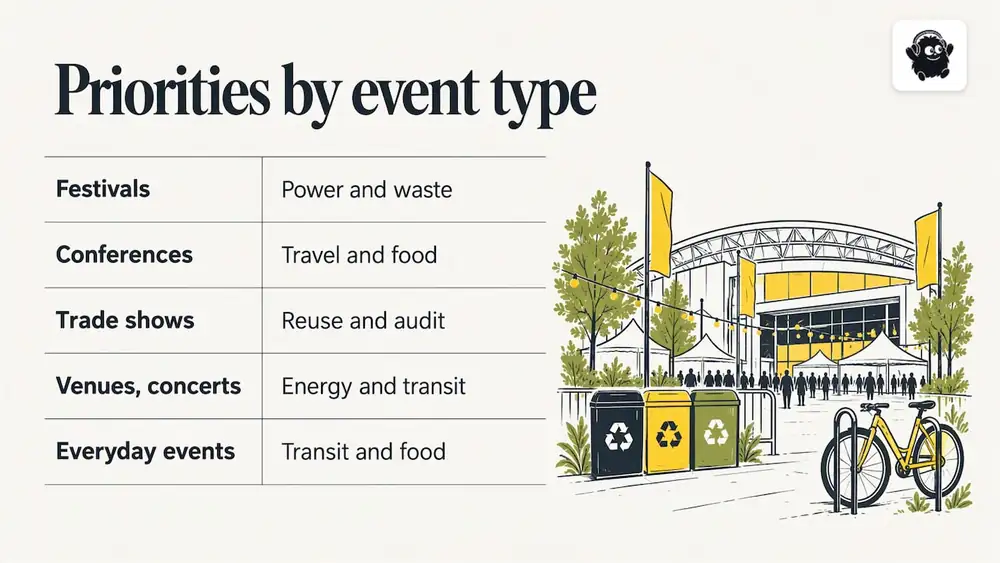
Festivals. Audit generator fuel and move to grid or low-carbon power where the site allows. Set a vendor code covering packaging and waste. Publish a transit and carpool plan with the ticket confirmation. Track waste per attendee by day.
Conferences. Offer a virtual option for sessions where in-person travel adds little. Collect optional travel data at registration. Choose a venue near transit and hotels. Reduce meal-related emissions with plant-based menus and a surplus-food plan.

Trade shows and expos. Put reuse requirements into exhibitor rules for booth builds and giveaways. Score exhibitors and contractors on sustainability criteria. Run a back-of-house waste audit as IMEX did.
Venues and concerts. Track energy per event, offer digital tickets only, and publish transit options on the event page. Ask promoters to share attendance and travel survey data so your venue can report consistently.
Everyday ticketed events (workshops, comedy nights, community events). Pick a walkable or transit-friendly location, skip printed material, serve rescued or plant-based food, and send reminders digitally.
Permits, noise limits, security plans and insurance vary by municipality and province. Treat everything here as general guidance, not legal advice, and confirm requirements with your local authority and a qualified adviser.
Our perspective
Sustainability tends to fail at events for an operational reason: the data is scattered. Registration lives in one tool, ticket sales in another, check-in on paper, vendors in a spreadsheet and the run of show in someone's email. When it is time to calculate a footprint or report waste per attendee, nobody can find a clean number.
We build for that problem. When ticketing, registration, check-in, schedules, vendor and exhibitor booths and staff roles sit in one system, the facts you need for a sustainability report are already recorded as the event runs. QR check-in from any phone replaces printed lists, and digital registration replaces paper forms, so less is printed and more is measured.
Our view is that sustainable event management is mostly good operations: clear roles, measurable targets and one place where the numbers live. Organizers who run the whole event from one system find it easier to set a target, assign it to a staff member and check the result afterwards.
— Ciara
Run the whole event, and the numbers, in one place
If you want registration, QR check-in, schedules, booths and staff roles in a single system, Eventist is built for festivals, conferences, trade shows, venues and concerts. Canadian organizers pay a flat fee per paid ticket rather than a percentage. As of October 2026, the pricing page lists $0.85 CAD per paid ticket for event ticketing and $4.99 CAD per paid ticket for festivals and conferences. Card processing fees are paid to Stripe or Square at their own rate, and free ticketing and registration run on monthly plans starting from $100 CAD.

Here is the arithmetic for a 1,000-ticket community event: 1,000 paid tickets at $0.85 CAD is $850 CAD in Eventist ticketing fees, before card processing. Because a flat fee does not grow with your ticket price, Eventist is usually cheaper than percentage-based pricing as ticket prices rise. Venues are priced differently, at 0.5% to 1.9% of what they charge on everything they sell, so see the venue page for details. Our team in Canada also helps organizers set up their event; see our services.
Frequently Asked Questions
What is the first step in sustainable event management?
Start by listing your emission sources and your stakeholders, then set two or three measurable objectives. The ICLEI guidelines recommend building a sustainability team and tying each objective to a responsible person. Even a short list of targets, such as waste per attendee and share of low-carbon travel, gives you something to measure.
How do I make an event eco-friendly on a small budget?
Focus on the free or low-cost choices: a venue near transit, digital tickets and programs, plant-based menus and a surplus-food plan. ICCA's food measures cut meal-related emissions by 33.55%, and they cost little to copy. Add sustainability questions to supplier quotes so your purchasing decisions improve without a separate budget line.
How do I calculate the carbon footprint of an event?
Identify sources, collect activity data, choose emission factors and calculate, following the GHG Protocol's three scopes. Direct fuel use is Scope 1, purchased electricity is Scope 2, and travel, waste, water and food fall under Scope 3. Collect optional travel details at registration so your largest source is based on real data.
Do I need ISO 20121 certification?
No. ISO 20121:2024 is a voluntary standard, and you can demonstrate conformity by self-declaration, confirmation from a second party or independent third-party assessment. Many organizers use it as a framework first and pursue external assessment later if sponsors or funders ask for it.
Sources
- ICLEI: Sustainable Events Guidelines
- EarthCheck: What is the Business Case for Sustainable Events?
- German Federal Environment Ministry: Guidelines on Sustainable Event Organisation
- BRIDGES by RARE 2025 emissions report
- BRIDGES by RARE 2024 GHG emissions measurement and verification report
- ICCA: Sustainability as Strategy
- World Athletics: Sustainable Event Management Best Practice Guidance
- IMEX Frankfurt 2023 Sustainable Event Report
- ISO 20121:2024 Event sustainability management systems
- ISO 20121:2024 full text
- Sustainable web practices
Recommended
Tags
Ready to simplify your events?
Join hundreds of organizers, studios, and festival directors who trust Eventist to run their events.