Showpass Alternatives for Canadian Event Organizers (2026)

Showpass is a Canadian ticketing and event management company, and for many venues and promoters it does the job well. Organizers start looking elsewhere for specific reasons: a different fee structure, a stronger festival or conference toolset, a built-in marketplace, or one system that also runs the schedule, booths and staff. This guide compares the main Showpass alternatives on fees, seating, registration and on-site operations, so you can match a platform to the event you actually run.
Prices below are as of October 2026. Fees change, so confirm each one on the provider's own pricing page before you commit.
TL;DR
- There is no single best replacement: Eventbrite suits events that rely on marketplace discovery, Ticket Tailor suits organizers who bring their own audience, TicketSpice suits custom-branded sales pages, and Whova suits networking-heavy conferences.
- Percentage fees grow with ticket price; flat per-ticket fees stay predictable. Run your own numbers on your average ticket price.
- Card processing is separate on almost every platform, so compare the platform fee and the processing fee as two lines.
- If you need seat maps, registration, check-in, door sales, schedules, booths and staff roles in one place, favour platforms built for operations, not just checkout.
What Showpass does, and why organizers compare it
Showpass describes itself as a ticketing and event management software company that helps venues and event organizers create a connected experience for their audiences, as its Tripadvisor listing puts it. It is based in Alberta and is widely used by Canadian venues, promoters and festivals.
That Canadian footing is the reason many organizers shortlist it. It is also the reason a comparison is worth doing: the right tool depends on four things that differ between events.
1. Event type. A comedy night with 200 seats and a three-day festival with four stages have very little in common operationally.
2. Fee model. A percentage of the ticket price, a flat per-ticket fee and a monthly subscription behave differently as you scale.
3. Operations. Selling tickets is one job. Scanning at the door, selling at the door, scheduling talks, placing exhibitors and assigning staff are other jobs.
4. Audience source. Some platforms bring you buyers through a marketplace. Others assume you already have them.
How we compared the options
We used five criteria, in the order most organizers feel them:
- Cost per paid ticket, including whether the fee is a percentage or a flat amount and who pays it by default.
- Seating and ticket types: general admission, reserved seating and seat maps.
- Registration and check-in: custom forms, QR scanning and door sales.
- Event operations: schedules, maps, vendors, staff and run of show.
- Fit and limits: payment options, data ownership and geography.
Publicly listed pricing was used wherever a provider publishes it. Where a provider does not publish organizer pricing, the table says so rather than guessing.
Showpass alternatives at a glance
| Platform | Best for | How it charges | Strongest point |
|---|---|---|---|
| Eventbrite | Events that benefit from marketplace discovery | 3.7% + $1.79 service fee per paid ticket plus 2.9% processing, paid by buyers by default | Built-in audience of ticket browsers |
| Ticket Tailor | Organizers with their own audience | Per-ticket model; check its current Canadian rate | White-label checkout, attendee-data ownership |
| TicketSpice | Custom-branded sales pages | Flat per-ticket fee, no percentage cut | Drag-and-drop page builder |
| Whova | Engagement-heavy conferences | Per-ticket fee; confirm on its pricing page | Mobile app for networking and polling |
| Tixr | Concerts, sports and festivals with exclusive access | Organizer pricing not publicly listed as of October 2026 | Access-controlled ticket drops |
| Cvent | Large corporate events | Quote-based | Venue and hotel management, CRM integrations |
| Eventist | Festivals, conferences, trade shows, venues and everyday ticketed events | Flat fee per paid ticket; venues pay 0.5% to 1.9% of charges | Whole-event operations in one system |
The sections below explain each in practical terms.
Eventbrite
Eventbrite is the default name in the category. Its main advantage is the marketplace: millions of people browse it for things to do, and a first-time organizer with no mailing list can pick up buyers there. Organizer tools include discount codes, multiple ticket types and a check-in app, according to this platform roundup.
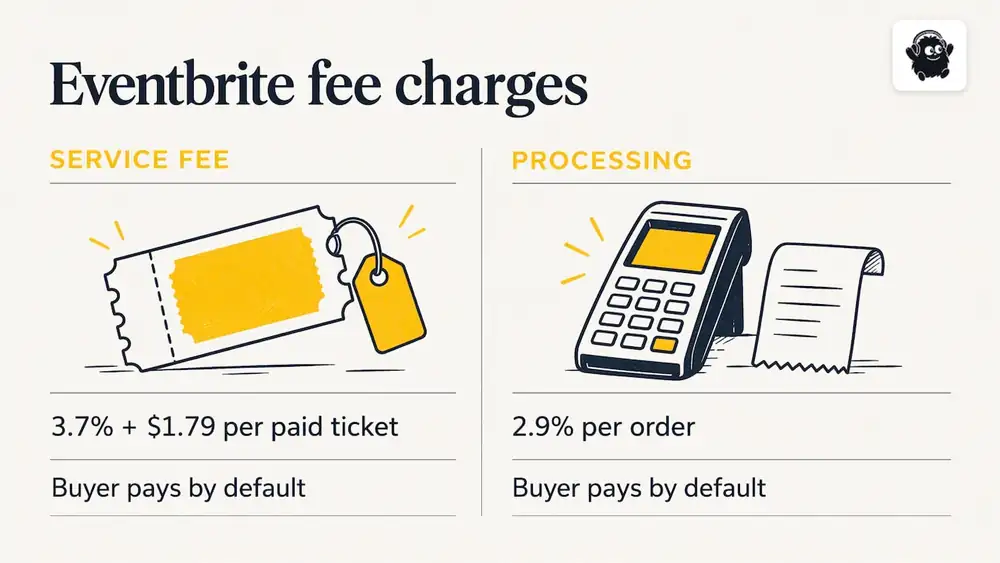
On cost, Eventbrite's own organizer pricing page lists a 3.7% + $1.79 service fee per paid ticket and a 2.9% payment processing fee per order. By default the buyer pays these fees, though you can choose to absorb them when you set up ticket types.
Watch for: a percentage fee rises with your ticket price. If you absorb the fee to keep prices clean, your cost per ticket is higher than the flat headline suggests. Also note that Eventbrite's free-event publishing carries no ticketing fee, which suits small community listings.
Ticket Tailor
Ticket Tailor suits organizers who already have an audience and want checkout on their own terms. The same roundup points to it for organizers who bring their own crowd, and other comparisons highlight its white-label checkout and attendee-data ownership.
That last point matters more than it sounds. If you plan to market to past attendees, check who owns the list, what privacy tools the platform provides and whether you can export it. Organizers with strict data-control needs sometimes go further and commission custom operational software that they own outright, though that is a larger project than most single events justify.
Watch for: confirm the current Canadian rate, whether you buy credits in advance, and how card processing is billed, since pricing varies by region and plan.
TicketSpice
TicketSpice is built around a drag-and-drop page builder for custom branding, and the roundup describes a flat per-ticket fee with no percentage cut. It is a sensible choice if the look of your sales page matters to your brand and your event is a straightforward ticketed night.
Watch for: page design is only one part of an event. If you also need seat maps, multi-stage schedules or exhibitor management, check what is native and what needs another tool.
Whova
Whova focuses on engagement-heavy conferences. Its mobile app handles attendee networking, session polling and sponsor management. If your conference lives or dies on attendee interaction, that app is the reason to shortlist it.
Planning teams that coordinate conferences also tend to need task and workflow tools alongside the attendee app, and a roundup of project management tools for event planners covers the options for that side of the work.
Watch for: it is conference-oriented, so a venue selling single tickets to weekly shows is not its natural fit.
Tixr
Tixr focuses on exclusive ticket access for concerts, sports and festivals. Organizer pricing is not publicly listed as of October 2026, so budgeting means requesting a quote. That is workable for an established promoter, but it makes early comparison harder.
Cvent
Cvent is built for large corporate programs: venue and hotel management, CRM integrations and registration at scale. The tradeoff, as reviewers of event registration tools commonly note, is a more complex setup and a learning curve. For a regional festival or a community conference, that weight is usually more than needed.
Eventist
Eventist is a Canadian event management and ticketing platform. It sells tickets and also helps organizers run the event itself. The ticketing side covers general admission and reserved seating with seat maps, registration, QR check-in from any phone and a built-in point of sale for door sales. The operations side covers multi-stage and multi-track scheduling, live maps, speaker and artist dashboards, vendor and exhibitor booths, staff roles and the run of show. Marketing tools include abandoned-cart recovery emails, SMS reminders and influencer referral links.
For Canadian organizers, as published on the pricing page in October 2026:
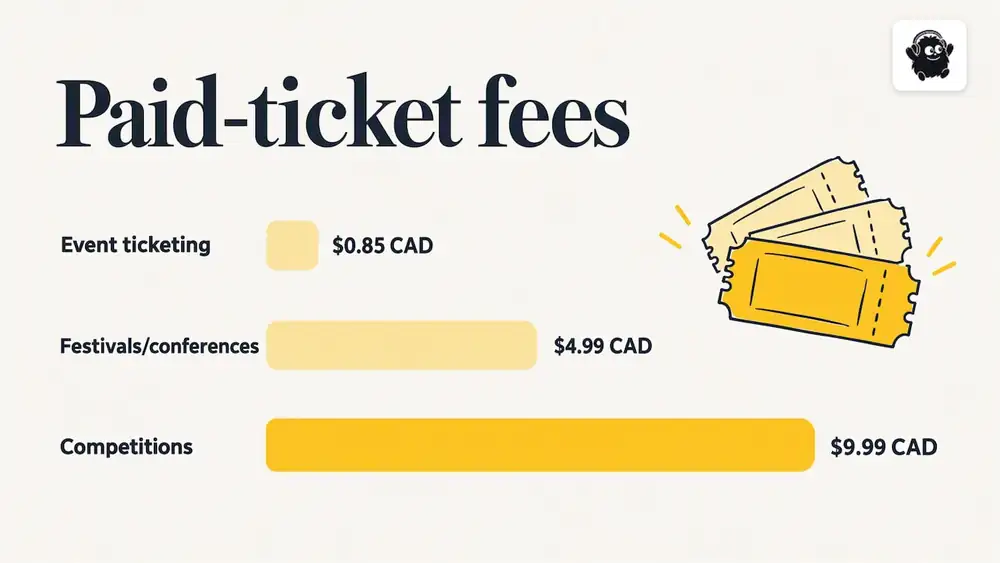
- Event ticketing: $0.85 CAD per paid ticket.
- Festivals and conferences: $4.99 CAD per paid ticket.
- Competitions: $9.99 CAD per paid ticket.
- Venues: 0.5% to 1.9% of what they charge on everything they sell, single tickets included.
- Free tickets and registrations run on monthly plans starting from $100 CAD.
There is no subscription for paid ticketing. Card processing fees go to Stripe or Square at their own rate, as with most platforms.
What the fees look like in practice
Headline rates are hard to compare, so here is one worked example using only published figures.
Say you sell 500 tickets at $40 each for a workshop series or a club night, and compare platform fees only, excluding card processing on both sides.
| Calculation | Platform fee total | |
|---|---|---|
| Flat $0.85 CAD per paid ticket | 500 × $0.85 | $425.00 |
| Eventbrite service fee (3.7% + $1.79) | 500 × ($1.48 + $1.79 = $3.27) | $1,635.00 |
The difference is $1,210 on a $20,000 gross. On those numbers the flat fee is cheaper, and the gap widens as ticket prices rise, because the percentage grows while the flat fee does not. That is why we say Eventist is usually cheaper rather than always cheaper: at a very low ticket price, or if a platform's fee is passed entirely to buyers, the picture changes. The festival and conference rate also includes a much larger toolset than basic ticketing, so compare it against the total cost of the separate tools you would otherwise need for seat maps, scheduling, booths and staff.
Two cautions apply to any comparison:
1. Compare who pays. A fee passed to the buyer still affects your sales if it makes the ticket look expensive.
2. Compare the full stack. A cheap ticketing fee plus a separate scheduling tool, a separate check-in app and a spreadsheet for vendors is rarely cheap.
Which Showpass alternative fits which event
Festivals
Festivals need multi-stage schedules, live maps, vendor booths and staff roles as much as tickets. Platforms that only sell tickets leave the rest to spreadsheets and group chats. If this is your event, look at the festival ticketing comparison of onsite features and our guide to festival ticketing software.
Conferences and trade shows
Conferences need registration forms, speaker management, multi-track agendas and badge or QR check-in. Trade shows add exhibitor booths and floor plans. Whova leans toward attendee engagement, Cvent toward enterprise scale, and an all-in-one platform toward running the schedule, speakers and exhibitors together. For registration needs, see our page on conference registration software.
Venues and concerts
Venues selling reserved seats need accurate seat maps, door sales and fast scanning. Check how the platform handles seat-level inventory and whether door sales are built in or need separate hardware and software. Our comparison of check-in apps covers scanning in detail.
Everyday ticketed events
Workshops, parties, comedy nights and community events rarely need a heavy system. A clean checkout, discount codes, QR check-in and reasonable fees are enough. Eventbrite's marketplace, Ticket Tailor's own-audience model and TicketSpice's page builder are all credible here.
What to check before you switch
Before moving off Showpass or any current platform, run through this list.
- Payments. Which processors are supported, how fast do payouts arrive, and what are the refund rules? Payment options are among the first limits organizers should verify.
- Integrations. Does it connect to your CRM and email tools, or will you export lists by hand?
- On-site capability. Can you scan, sell at the door and print badges without extra hardware surprises?
- Data ownership. Can you export attendee data, and who controls it?
- Migration. Existing tickets, resale or waitlist rules and published event pages need a plan. Switch between events, not during an on-sale.
- Support. Ask who sets up the first event and how quickly someone answers on show day.
For contracts, insurance, permits, security and tax questions that come with a larger event, treat any platform guidance, including ours, as general guidance, not legal advice, and speak to a qualified professional.
Our perspective
We see the same pattern in organizers who outgrow a ticket-only tool. The first event goes fine. Then the second event adds a second stage, a vendor area, volunteers and a door sale, and the organizer ends up running five apps and a spreadsheet that only one person understands.
Our view is that ticketing is the start of the job, not the whole of it. A flat fee per paid ticket is easier to forecast than a percentage, and one system for tickets, seat maps, check-in, schedules, booths and staff roles means fewer handoffs on the day. That does not make one platform right for everyone. A small club night may be perfectly served by a simple checkout, and a conference built around attendee networking may want a dedicated app. Pick the tool that matches the event you run, and test it on one event before you move everything.
Setting up with a Canadian team
If you want one platform for ticketing and operations, we can set up your event with you. Organizers get help from a Canadian team, and optional services such as done-for-you setup, team training and on-site support are priced on the page. Ticketing fees are on the pricing page, and the flat-fee ticketing page shows what the basic tier covers.

For a wider shortlist, see our comparison of event ticketing platforms.
Frequently Asked Questions
What does Showpass do?
Showpass is a Canadian ticketing and event management company serving venues and event organizers. It handles ticket sales and related event tools, with a focus on connecting organizers with their audiences. Check its own site for current features and fees.
What is the cheapest Showpass alternative?
It depends on your ticket price and volume, so no platform is cheapest for everyone. Flat per-ticket fees tend to win on higher-priced tickets, and percentage fees can win on very cheap ones. Calculate the platform fee and card processing separately for your own average ticket.
Which alternative is best for festivals?
Choose a platform that covers more than checkout: multi-stage schedules, live maps, vendor booths, staff roles and on-site scanning. Ticket-only tools force you to assemble those pieces elsewhere. Ask each provider to show your own festival setup before you decide.
Do I need a marketplace like Eventbrite?
Only if you rely on strangers finding your event. If you sell to your own audience through social media, email and referral links, a marketplace adds less. First-time organizers with no list may value the discovery.
Sources
- Showpass listing on Tripadvisor
- Eventbrite organizer pricing
- Best Platform to Sell Event Tickets in 2026
Recommended
Tags
Ready to simplify your events?
Join hundreds of organizers, studios, and festival directors who trust Eventist to run their events.