Raffle and Silent Auction Rules for Canadian Events
Somebody always suggests a 50/50 draw. It is the easiest fundraising idea in the room: a bucket, a roll of tickets, half the pot to the winner. It is also, in every Canadian province, a licensed lottery scheme, and the licence is not available to most of the organizations that want to run one.
This is the part organizers find out late. A raffle is regulated under the Criminal Code and licensed provincially; a silent auction, run properly, is not regulated at all. Knowing which side of that line your fundraiser sits on is the difference between a licence application eight weeks out and a last-minute decision to cancel the draw. General guidance, not legal advice: the regulator named for your province is the authority, and the rules below are theirs, quoted from their own pages in October 2026.
TL;DR
- A raffle, including a 50/50, is a lottery scheme under section 207(1)(b) of the Criminal Code. Manitoba's regulator puts it bluntly: "Conducting a raffle without a licence is a criminal offence."
- Only charitable and religious organizations can be licensed. Alberta's regulator states that "for-profit businesses, individuals and government are not considered charitable or religious and are not eligible to apply for a licence". A commercial festival cannot run a raffle, no matter where the money goes.
- A silent auction is not gaming. The winner is decided by the highest bid, not by chance, so the three-part test the regulators publish does not catch it.
- Free draws are not gaming either. Manitoba: "Draws for door prizes do not require a licence if there is no charge or consideration to enter the draw."
- Electronic ticket sales change the licensing path everywhere. In Ontario any electronic raffle goes to the AGCO regardless of prize value; in BC an electronic raffle system must be approved on the licence.
- Apply early. These are approvals with eligibility reviews behind them, not permits you pick up on the way to the event.
The test the regulators actually apply
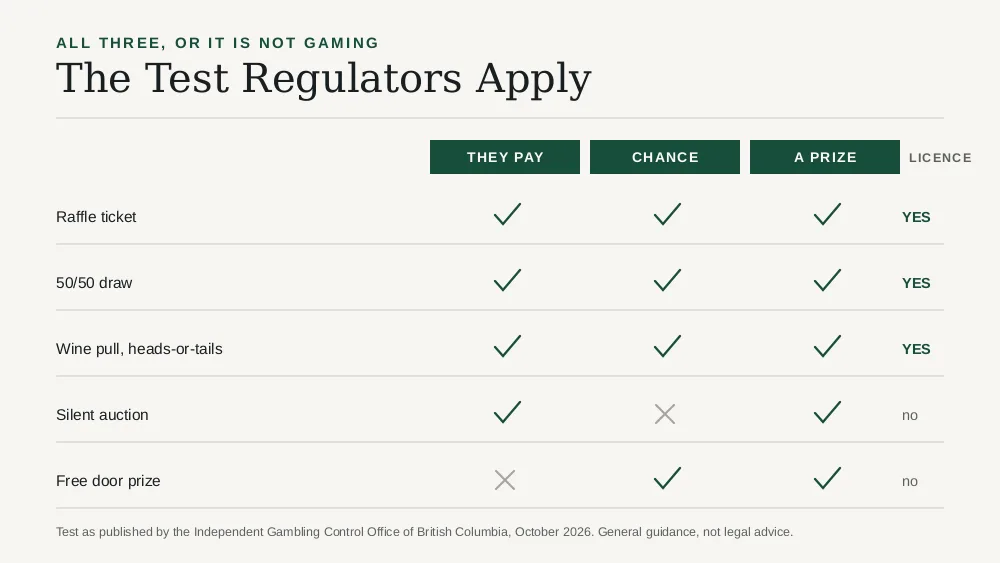
British Columbia's Independent Gambling Control Office publishes the clearest version of the test, in its Licensed Charitable Gaming Event Guidance: "If your event charges an entry fee and involves chance and prizes, you likely need a licence. If your event is free, based on skill, or only includes door prizes or promotions, you probably don't need a licence."
Three elements, all of which have to be present: consideration (people pay), chance (the winner is drawn, not chosen on merit) and a prize. Take any one away and you are outside the licensing regime.
That is why a silent auction is in the clear. Bidders pay, and there is a prize, but the highest bidder wins — there is no chance in it. It is also why a skill contest is fine, and why a genuinely free door-prize draw is fine.
It is also why the clever variations people invent at the last minute usually are not. A wine pull where every ticket wins a random bottle has all three elements. Heads-or-tails, where everyone pays five dollars and the coin decides, has all three. "Buy a ticket and you are entered to win" has all three, whatever you call the ticket.
Who can be licensed, and who cannot
This is the part that stops most festival raffles before they start.
Ontario's AGCO lists the requirements to run a raffle: the group must be non-profit, located in Ontario, and doing charitable activities for at least a year, providing services in Ontario that relieve poverty, advance education, advance religion or benefit the community. The same page lists groups that do not qualify, and the list is instructive: unions or employee groups, social clubs, professional associations, and political, government, lobby or advocacy groups.
Alberta's AGLC is equally direct: "For-profit businesses, individuals and government are not considered charitable or religious and are not eligible to apply for a licence." It adds a useful piece of relief, though — "an organization does not need to be registered as a charity with Canada Revenue Agency to be considered a charitable organization with AGLC."
British Columbia's guidance names its ineligible list explicitly, and it is longer than people expect: for-profit businesses or groups, not-for-profit groups supporting a for-profit business, political lobby groups, agents of government, hospitals and healthcare facilities (though their foundations are eligible), educational institutions and schools, penal institutions, and government-operated libraries, museums, galleries and recreation centres.
Manitoba's LGCA answers the question organizers actually ask — can my business run one and give the money away? — with a flat no: "Businesses and individuals do not qualify for raffle licences. Section 207(1)(b) of the Criminal Code (Canada) states that you must be a charitable or religious organization to be licensed to conduct a lottery scheme, which includes raffles."
So if you run a commercial festival and want a 50/50 at the beer tent, the honest options are to partner with an eligible charity that holds the licence and runs the draw, or to do something that is not a raffle.
Two exceptions are worth knowing. Manitoba licenses a social occasion raffle for "individuals, groups or businesses that are not a charitable or religious organization" holding a one-time event at a venue such as a banquet hall, restaurant, bar or community centre, which "allows raffles such as 50/50s or player's choice to be offered at the event". And British Columbia issues a Class C licence for fairs and exhibitions, a category that exists precisely because agricultural fairs and exhibitions did not fit the charitable classes.
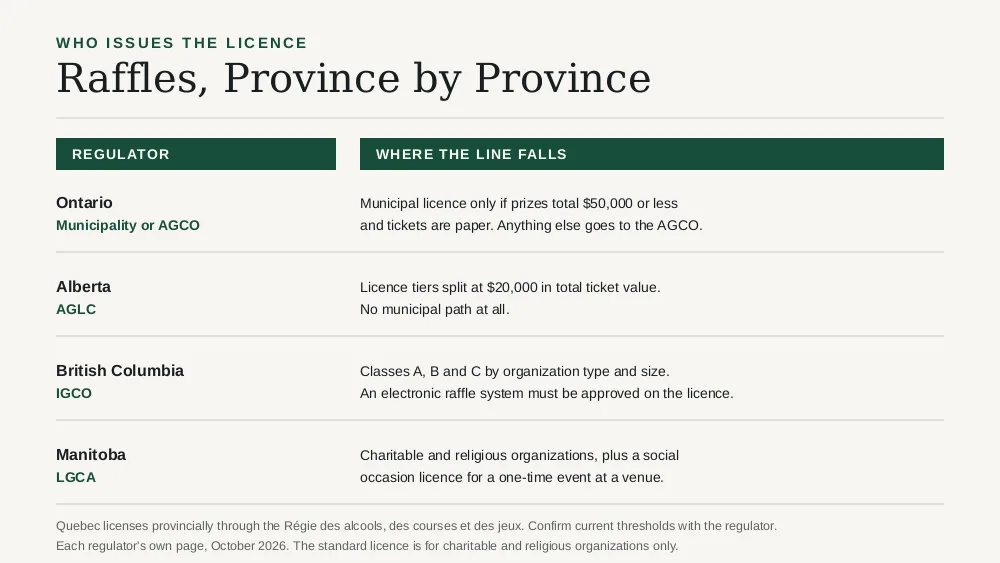
Who issues the licence, and at what size
| Province | Regulator | Where the line falls |
|---|---|---|
| Ontario | Municipality, or the AGCO | Municipal licence requires total prizes of $50,000 or less and paper tickets; anything larger, or any electronic raffle, goes to the AGCO |
| Alberta | AGLC | Licence tiers split at $20,000 in total ticket value; no municipal path |
| British Columbia | Independent Gambling Control Office | Classes A, B and C by organization type and size; an electronic raffle system must be approved on the licence |
| Manitoba | LGCA, and First Nations gaming commissions on reserve | Charitable and religious organizations, plus a social occasion licence for one-time events |
| Quebec | Régie des alcools, des courses et des jeux | Provincial licensing only; confirm the current class thresholds with the Régie |
Ontario's split is the one most organizers meet first. The AGCO's own instruction is that to get a licence from your municipality you must "guarantee that total prizes won't be more than $50,000" and "use paper-based tickets", and that "if you can't guarantee the prize will be less than $50,000, or if you will be using an electronic solution, you must apply with the AGCO".
Read the second half of that twice. Selling raffle tickets online is not a smaller version of selling them on paper. It moves the file to the provincial regulator, and in several provinces the software itself has to be on an approved list. That is a procurement decision with a lead time, not a checkout setting.
Running the silent auction instead
If you are not eligible for a raffle licence, the silent auction is the fundraiser that is actually open to you, and it raises more per guest at most events anyway. A few things make the difference between one that works and one that limps.
- Fewer, better items. Twenty items that people want beat sixty that fill a table. Bidding is social, and a crowded sheet splits the crowd.
- A real opening bid. Set it at roughly 40 to 50 per cent of retail value. Too low and the first bid anchors the item down; too high and nobody starts.
- A hard close, announced twice. Auctions die quietly when nobody knows the sheets are about to be pulled. Announce the close, then announce it again at five minutes.
- Collect payment at the table. Every minute between the win and the payment is a chance to lose it. A phone that takes a card where the winner is standing is worth more than a tidy spreadsheet at the door.
- Do not promise a tax receipt you have not checked. Receipting for auction purchases has its own Canada Revenue Agency rules and is not automatic. Ask whoever handles your charity's receipting before you print anything that implies one.
And if you want the chance element back, the clean way is a free draw: no purchase, no consideration, entry open to anyone who walks past the table. That is a promotion, not a lottery, and it needs no licence — but it also has to be genuinely free, not free-with-a-ticket.
Our perspective
The raffle question comes up at the operations meeting, which is six weeks out, and by then the answer is usually no. Not because the rules are unreasonable — they exist because the alternative is unlicensed gambling at every event — but because eligibility is an organizational fact rather than a form. You are a registered charity doing charitable work in the province, or you are not, and six weeks is not long enough to become one.
The practical move is to decide the fundraising format at the same time you decide the event, and to put the licence application in the project plan beside the permits. Our event permits guide covers the rest of that stack. If you are a commercial organizer with a charity partner, settle early which organization holds the licence, runs the draw, banks the proceeds and files the report, because all four have to be the licensee.
Where Eventist fits
Plainly: do not sell raffle tickets through Eventist. It is not an approved electronic raffle system in any province, and in Ontario, Alberta and British Columbia an electronic raffle needs a system the regulator has approved. That is a line we are not on, and selling a draw through general-purpose ticketing software would put the licence at risk rather than yours.
What the platform is for is the event around the fundraiser. Gala seats, dinner tickets and table sponsorships are ordinary ticket types with their own capacity. The built-in point of sale takes a card at the auction table rather than at the door. Attendee questions capture the dietary note or the bidder number you want printed. And the sales reports give you the attendance figure that your insurer, your venue and your board all ask for afterwards.
If you are shopping for a platform for the fundraising side specifically, the nonprofit comparison is the better page.
Frequently Asked Questions
Do I need a licence for a 50/50 draw in Canada?
Yes. Every provincial regulator treats a 50/50 as a raffle, which is a lottery scheme under section 207(1)(b) of the Criminal Code, and all of them require a licence. Manitoba's regulator states that conducting a raffle without a licence is a criminal offence.
Can a for-profit business run a raffle and donate the proceeds?
No, in most of the country. Alberta's AGLC says for-profit businesses, individuals and government are not eligible. Manitoba's LGCA says businesses and individuals do not qualify "regardless of the intended use of profits". The workable route is a partnership where an eligible charity holds the licence and runs the draw; Manitoba also offers a social occasion raffle licence for one-time events at a licensed venue.
Does a silent auction need a gaming licence?
No. The regulators' test needs consideration, chance and a prize together. A silent auction is decided by the highest bid rather than by chance, so it falls outside the test. A draw among the bidders, a wine pull or a heads-or-tails game at the same event is a different matter and would need a licence.
Can I sell raffle tickets online?
Only with the right licence and, in several provinces, approved software. In Ontario any electronic raffle must be licensed by the AGCO rather than the municipality, whatever the prize value. In British Columbia an electronic raffle system has to be approved on the licence. General event ticketing platforms, Eventist included, are not on those approved lists.
How far ahead should we apply?
Treat it like a permit rather than a form. Eligibility reviews come first — Ontario requires a year of charitable activity before you can be licensed at all — and provinces ask for the application well before tickets go on sale. Eight weeks is a reasonable floor, and a first-time applicant should allow longer.
Sources
- Apply for a raffle lottery licence, Alcohol and Gaming Commission of Ontario
- Licensed Charitable Gaming Event Guidance, Independent Gambling Control Office of British Columbia
- Raffle: $20,000 and less, Alberta Gaming, Liquor and Cannabis
- Raffle, Liquor, Gaming and Cannabis Authority of Manitoba
Recommended
Tags
Ready to simplify your events?
Join hundreds of organizers, studios, and festival directors who trust Eventist to run their events.