Duuo Event Insurance Alternatives for Canadian Hosts
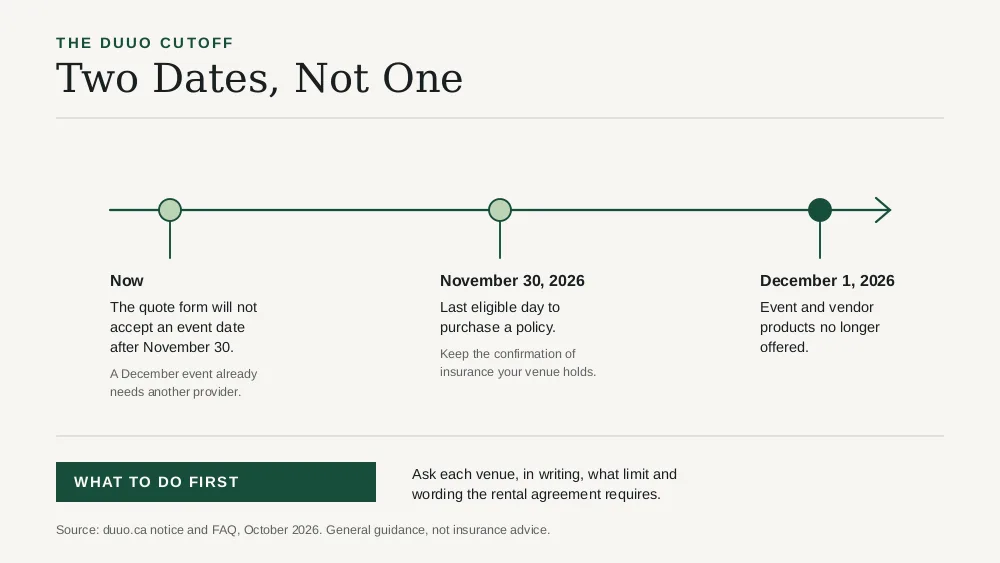
Duuo, the Co-operators-backed app that turned event liability insurance into a five-minute online purchase, is leaving the business. Its own notice is blunt: "We are exiting the event insurance space as of November 30th, 2026." For the many Canadian organizers who have spent years emailing a Duuo certificate to a hall manager the week before the event, that means finding a new provider — and sooner than the December 1 date suggests, because the quote form already refuses December event dates.
This is the practical version: what Duuo actually covered, the four routes Canadian organizers can take instead, and the five things on a certificate that decide whether the venue accepts it. General guidance, not insurance advice. The limits and wording you need are in your rental agreement or your municipal permit, and a licensed broker is the person who should read those.
TL;DR
- Duuo stops offering event and vendor insurance on December 1, 2026. November 30 is the last eligible day, and the quote form will not let you select an event date past it, so a December event needs a different provider now.
- What you are replacing: $5 million event liability, $1 million tenant's legal liability (extended to $5 million at municipally owned venues), $10,000 medical payments, no deductible, limits fixed, and a maximum of seven consecutive days.
- Two of Duuo's limitations travel with you whatever you buy next. It never covered third-party vendors, bands or performers, and a weekly series needed one policy per date.
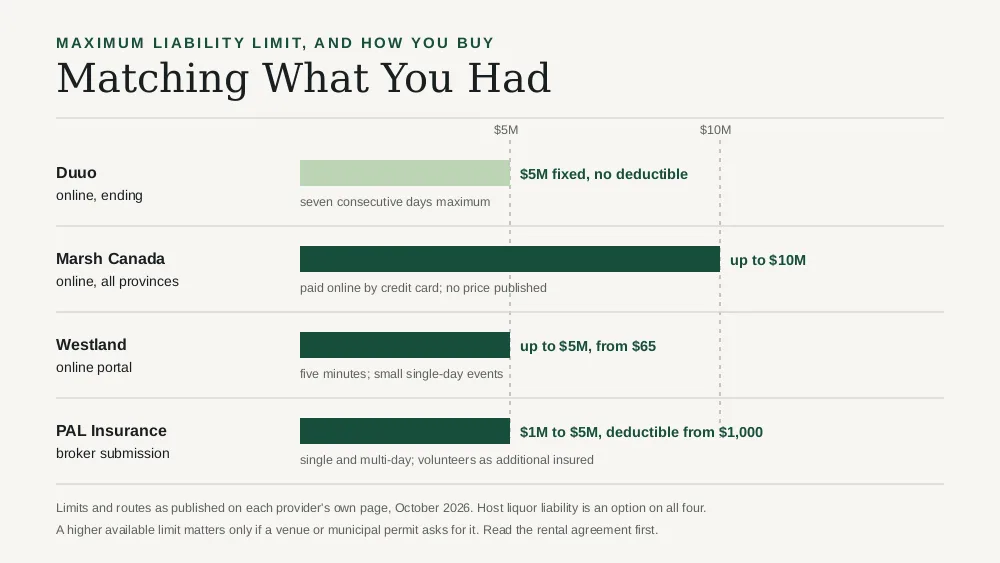
- Four routes, all verified on the providers' own pages in October 2026: Marsh Canada's online program (limits to $10 million, every province), Westland's online program (up to $5 million, from $65), PAL Insurance Brokers (single and multi-day events including festivals, $1 million to $5 million with a deductible from $1,000), or your own broker on an annual policy.
- Nobody publishes a festival price. Expect a quote, and expect the application to ask about attendance, alcohol and whether anyone is performing.
What Duuo actually said
Three statements, all from duuo.ca as of October 2026, are worth reading exactly rather than second-hand:
- "We are no longer accepting registration of partner venue or promo code requests. We are exiting the event insurance space as of November 30th, 2026." That is the notice page, and it covers vendor insurance as well as event insurance.
- From the FAQ, under the question "Why can't I select an event date past November 30th for insurance?": "November 30th is the last eligible day to purchase a policy as Duuo by Co-operators vendor and event insurance products will no longer be offered as of December 1st."
- "If you have questions regarding an existing policy, please contact our customer support team for assistance."
Read the second one carefully, because it is the part that changes what you do this week. The question is about the event date, not the purchase date. A policy you buy today cannot be dated into December. If your event is a New Year's Eve party, a December craft fair or a January recital, Duuo is already not an option, whatever the December 1 headline says.
If you hold a Duuo policy for an event before November 30, it is a policy with an insurer behind it and the event-date logic is unchanged. Keep the confirmation of insurance document, because that is what the venue has on file.
What you are replacing
Duuo's appeal was that there was nothing to decide. The limits were fixed and published, so a venue either accepted them or did not. Take this table to whoever quotes you next, because matching it is the fastest way to know you are covered to the same level.
| Coverage | Duuo's limit |
|---|---|
| Event liability (bodily injury and property damage) | $5,000,000 |
| Tenant's legal liability | $1,000,000, extended to $5,000,000 at municipally owned venues |
| Medical payments | $10,000 |
| Deductible | None |
| Host liquor liability | Add-on at extra cost, non-sporting events only |
| Maximum length | Seven consecutive days, with no option to add a second policy |
Two details in that table are the ones organizers get caught by.
The seven-day cap is why Duuo was never the answer for a long-run festival or a season. Duuo's own FAQ says the coverage "is not designed to cover longer event" and that buying an additional policy to extend it is not an option. If you have been splitting a longer event or a series across policies, the replacement conversation is simpler than you think: a broker will write one policy for the run.
The performer and vendor exclusion is the one that causes arguments on site. Duuo stated plainly that its event policy does not cover third-party vendors, bands, performers or musicians, and that the host agrees to obtain certificates of insurance from third parties. Every route below works the same way. The band's liability is the band's problem, and your job is to collect the paper proving it — which is also the reason a vendor and exhibitor contract process earns its keep.
The four routes, compared
1. Marsh Canada's online event liability program
The closest structural replacement, in that it is an online purchase rather than a broker conversation. Marsh Canada's own program page describes "an easy online application process allowing for event insurance policies to be generated, accepted, and paid for online by credit card", liability limits "of up to $10,000,000", "broad acceptance criteria", and availability "in Ontario, BC, Alberta, and all other provinces across Canada".
Higher available limits than Duuo matter more than they sound. Municipal permits and arena rentals increasingly ask for $5 million as a floor, and a few ask for more; a program that tops out at $5 million leaves you without a route when a city asks for $10 million.
No price is published. The page says "competitive rates", which is a quote, not a number.
2. Westland Insurance's online event program
Westland runs a self-serve portal with the same shape as Duuo's: answer the rating questions, pay by card, get the certificate. Its own event insurance page says an event "can be insured online with a credit card in five minutes or less, providing up to $5,000,000 in general liability coverage", that prices "start at just $65", and that wedding packages start at $75 for a 100-person wedding. Optional host liquor liability is available through the online program, with the caveat — Westland's own — that host liquor liability "is not a substitute for primary liquor liability coverage required by businesses and licensed caterers".
The $65 is for a small, low-risk, single-day event, in the same way Duuo's cheapest policy was. It is not a festival price. Westland's own page sends festival organizers to a specialist entertainment program rather than the self-serve portal, which is a fair signal about where the portal's box ends.
3. PAL Insurance Brokers Canada
The one built for the events the online programs decline. PAL's Special Events Liability page states limits "from $1,000,000 to $5,000,000 with deductibles from $1,000", and lists what is included: commercial general liability with third-party property damage and bodily injury, medical payments ($2,500 per person, $25,000 maximum), non-owned auto, food and beverage product coverage, cross liability, employees and volunteers as additional insured, and tenant's legal liability from $500,000. Host liquor liability is available as an option up to $5,000,000.
Two things to notice. First, it is written for "hosts of single/multi day events", and the event examples on the page are music festivals, concerts, conventions, film festivals, craft shows, rodeos and ball tournaments — the things a seven-day online policy could not hold. Second, volunteers as additional insured is included, which is not a given and is worth asking every provider about if your event runs on volunteers.
The trade-offs are a deductible where Duuo had none, and a form submission to a broker instead of an instant certificate. PAL's page also warns that changes after the policy is issued are "subject to a $25 fee and / or additional premium", so read the venue contract before you submit, not after.
4. Your own broker, on an annual policy
If you run more than two or three events a year, the per-event purchase was probably costing you more than a commercial general liability policy would, and it was certainly costing you more admin. An annual CGL policy with your events scheduled on it gives you one certificate to re-issue, a broker who has read your rental agreements, and no quote form in the week before each event.
This is the route nobody advertises, because there is no landing page for "phone a broker". It is also the one that fits a recurring organizer best: a studio with four recitals, a league with a season, a festival with a winter fundraiser.
Five things to check before you pay
The certificate is the deliverable, and venues reject certificates for boring reasons.
1. The limit the contract asks for, not the limit you assume. Read the rental agreement or permit. Municipal venues commonly require $2 million or $5 million; a few require more. Our event permits guide covers where the requirement usually hides.
2. The venue named as additional insured, spelled their way. "City of Kingston" and "Corporation of the City of Kingston" are not the same string to the person checking.
3. A waiver of subrogation, if the permit says so. Duuo applied one automatically at municipally owned venues. Elsewhere it is a request you have to make.
4. The right dates, including set-up and tear-down. A one-day policy for a Saturday event does not cover the Friday night load-in, which is when a surprising share of property damage happens.
5. Host liquor liability if alcohol will be anywhere near the event. Duuo's position, and it is the standard one, is that both the venue and the host can be named in an alcohol-related suit even when the venue pours. Your provincial licence or permit is a separate obligation.
Our perspective
Duuo leaving is a nuisance, not a crisis, and it is worth being accurate about why. On-demand event insurance at consumer prices depends on a very narrow box: one event, a known type, a stated head count, under a week, fixed limits. That box served weddings, hall rentals and small community events well, and it never served festivals. Most organizers we talk to who used Duuo were using it for the small stuff and already had a broker for the main event.
The thing genuinely worth doing in the next five weeks is not shopping. It is finding out what your venues actually require, in writing, before the season starts — because that is the number that decides which of these four routes works for you, and it is the one organizers habitually guess.
Where Eventist fits
Eventist does not sell insurance and is not a broker, so this is a short section.
What it does cover is the paperwork either side of the policy. Every insurance application asks for an attendance number, and the honest answer is in your sales reports rather than your memory. Waivers can be written in the editor or uploaded as your own document, set to require a signature, and attached to a whole event or to one checkout, so the signed copy exists for every attendee who needs one. Contracts work the same way: upload the agreement, assign it to a role, and collect signatures.
What it does not do is chase certificates of insurance from your vendors and performers. That is still a person with a spreadsheet and a deadline, and the exclusion in your own policy is the reason it matters.
Frequently Asked Questions
When exactly does Duuo stop selling event insurance?
Duuo's notice says it is exiting the event insurance space as of November 30, 2026, and its FAQ says November 30 is the last eligible day and that the products "will no longer be offered as of December 1st". The practical cutoff is earlier for most people, because the quote form will not accept an event date past November 30.
Is my existing Duuo policy still valid?
Duuo's FAQ directs anyone with questions about an existing policy to its customer support team. Keep your confirmation of insurance document, since that is the proof your venue holds, and raise anything specific with Duuo directly before November 30 while support for the product is still staffed.
What is the cheapest replacement for a one-day event?
Westland's online program publishes the only entry price we could verify in October 2026, starting at $65 for an event policy and $75 for a wedding package covering 100 guests. Whether that is the cheapest for your event depends on attendance, alcohol and venue, so quote at least two routes.
Does any of this cover my performers or food vendors?
No. Duuo excluded third-party vendors, bands, performers and musicians, and that exclusion is normal rather than unusual. Those parties need their own liability policies, and PAL, for example, sells exhibitor, caterer and performer policies specifically so they can hand you a certificate.
My festival runs ten days. What changes?
The online programs are out: Duuo capped coverage at seven consecutive days with no option to extend, and the self-serve portals are built for short events. A broker programme written for single and multi-day events, such as PAL's, is the normal answer, and it is also where cancellation coverage and equipment extensions live.
Sources
- Event Insurance Update, Duuo
- Event Insurance from Duuo, including the FAQ on dates, limits and performers
- Event Liability Insurance, Marsh Canada
- Event insurance, Westland Insurance
- Special Events Liability, PAL Insurance Brokers Canada
Recommended
Tags
Ready to simplify your events?
Join hundreds of organizers, studios, and festival directors who trust Eventist to run their events.