Event Risk Management: A Practical Guide for Organizers
Event risk management is the habit of finding what could go wrong at your event, judging how likely and how serious each problem is, and deciding in advance what you will do about it. The Events Council risk guidebook frames it as assessing risks to attendees, the event itself, the organizer and partner suppliers, then applying measures that reduce their probability and consequences. This guide walks through the process in the order you would actually do it: identify, rate, control, plan for failure, insure, assign people, and review.
The approach suits festivals, conferences, trade shows, concerts, venue nights and smaller ticketed events. Only the scale changes.
TL;DR
- Risk management is a loop: identify hazards, rate likelihood and consequence, apply controls, then monitor and review. It is not a one-off form.
- Rate every risk on the same matrix so you spend time on the few that can seriously hurt people or the budget.
- A contingency plan is a pre-agreed second option (an indoor backup venue, a replacement supplier, a communication fallback), not a vague intention.
- Insurance transfers part of the financial risk. Read the certificate and the exclusions, and check what your venue or municipality requires.
- Name who does what, rehearse the response with your staff, and debrief afterwards so the next event starts from better records.
What event risk management covers
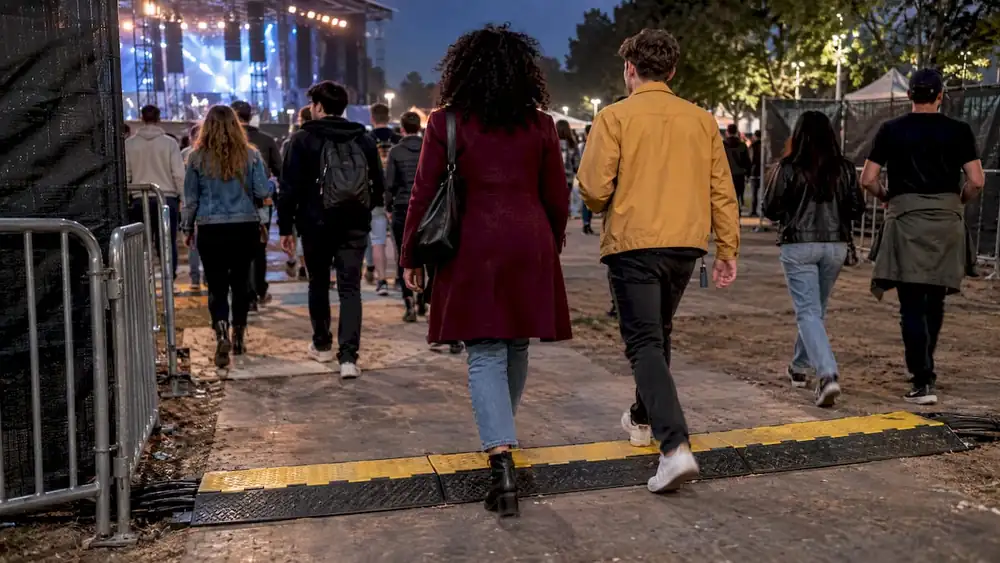
A risk is a hazard combined with the chance it causes harm or loss. A cable run across a walkway is a hazard. A crowd leaving at night over that walkway is the exposure. The risk is someone falling, and the control is a cable cover, a different route or lighting.
Official guidance describes the same cycle. WorkSafe New Zealand sets out identifying hazards, assessing the risks, applying controls to eliminate or minimize them, and reviewing those controls regularly. Rules differ by country and province, so check the requirements of your own authority. The method itself transfers anywhere.
Risk is wider than physical safety. A useful event plan covers at least these categories:
- Attendee safety: crowd density, entrances and exits, heat, medical incidents, alcohol, accessibility.
- Site and infrastructure: stages, rigging, power, temporary structures, weather exposure.
- Operations: supplier no-shows, late load-in, staffing gaps, ticketing or check-in failures.
- Financial: low sales, deposits at risk, cancellation, liability claims.
- Reputation and data: a public incident, a payment or privacy problem, misinformation during an emergency.
- Security: access control, theft, hostile behaviour. Major Events New Zealand notes that security planning should sit on top of integrated risk and safety planning, never in isolation.
This article is general guidance, not legal advice. Permits, security, audio-visual and rigging, insurance, contracts and tax all have rules that depend on your province, municipality and venue, so confirm them with your local authority, insurer or a qualified professional.
Step 1: Map the event and the people involved
Before listing hazards, list everyone with a stake. A Canadian municipal insurer's guidance on special events, from Intact Public Entities, starts with mapping the involvement of all parties. That matters because many failures sit at the seams: the venue assumes the promoter is handling it, the promoter assumes the vendor is.
Write one page that answers:
1. Who owns the site, and who is the operator on the day?
2. Who are your suppliers (staging, power, sound, security, catering, medical, parking)?
3. Which authorities are involved (municipality, fire, police, health)?
4. Who are the participants (attendees, performers, speakers, exhibitors, volunteers)?
5. What does each party control, and what do they expect you to control?
Then follow the event through its whole life, not only the show hours. The same guidance in the research stresses the event cycle and the attendee's journey: buying a ticket, travelling, entering, moving around, leaving. Risks hide in each stage.
Include the quiet phases
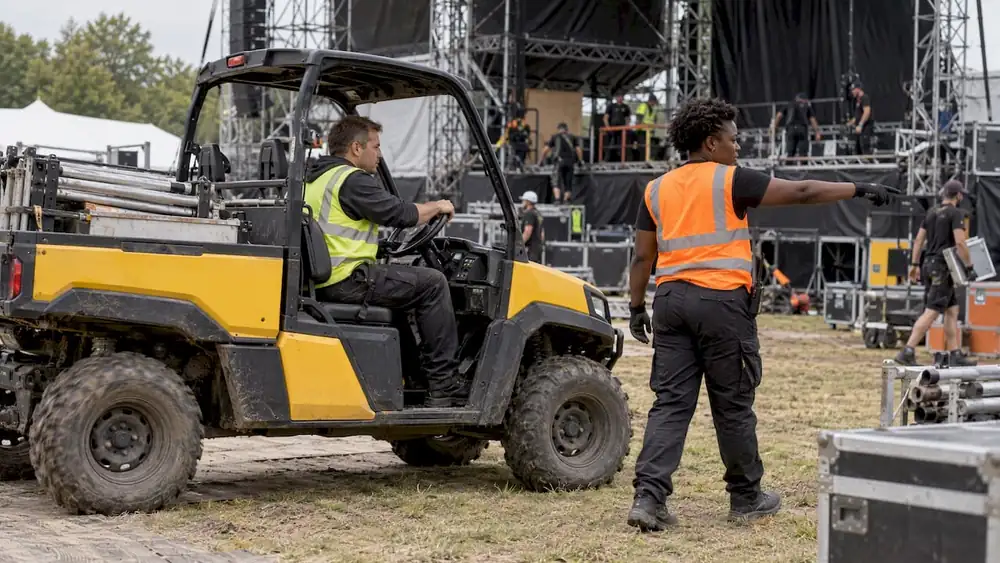
The UK Health and Safety Executive warns that build-up, load-in, breakdown and load-out often involve fewer people but are frequently the highest-risk periods. Vehicles move around crews, structures are half built and people are tired. If your risk register only covers doors-open to doors-closed, extend it.
Step 2: Identify the hazards
Bring the people who will actually do the work into this step. WorkSafe New Zealand points out that involving workers and their representatives at every stage brings operational knowledge that makes the assessment more accurate. The person who has loaded out a stage in the rain will name risks you will not find at a desk.
Use prompts rather than a blank page. Walk the site plan and ask, for each zone and each time block, what could injure someone, stop the event, cost money or damage trust.
| Area | Typical risks to check |
|---|---|
| Entry and ticketing | Queues building outside, scanner or network failure, counterfeit or duplicate tickets, capacity exceeded |
| Crowd movement | Pinch points at stages and exits, blocked emergency routes, poor signage |
| Weather | Heat, cold, wind on stages and tents, lightning, rain affecting ground and parking |
| Power and equipment | Generator failure, overloaded circuits, trip hazards, equipment failure |
| Food and alcohol | Allergens, food handling, intoxication, service to minors |
| Suppliers and staff | No-shows, untrained staff, overlong shifts, unclear authority |
| Medical and welfare | Slow response, no first aid post, lost children, accessibility needs |
| Money | Cancellation, supplier deposits, refund volume, cash handling at the door |
On the staffing line, our guide to event staff scheduling looks at how shift design affects safety, and event logistics planning covers the six logistics areas where gaps most often turn into incidents.
Step 3: Rate and rank the risks
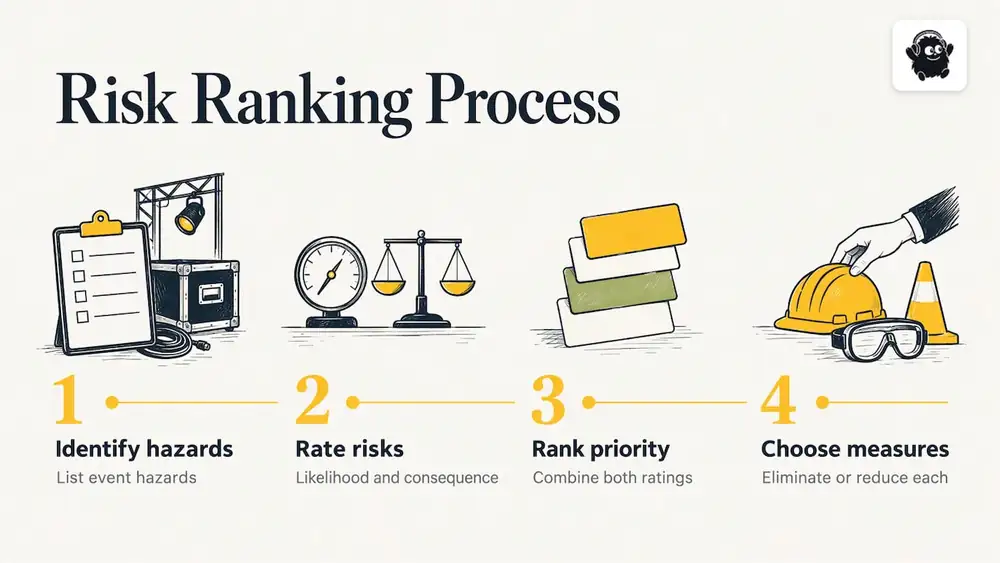
A list of fifty hazards is useless if they all look equally urgent. Rate each one on two scales, likelihood and consequence, and rank by the combination.
The City of Greater Geelong in Australia describes this method: identify the hazards, rate likelihood and consequence using a risk ranking matrix, and identify practical measures that eliminate or reduce each. The NSW Government's event starter guide likewise advises analysing risks by likelihood and impact so that you prioritise those with significant consequences.
A simple matrix you can use
Score likelihood from 1 (rare) to 5 (almost certain) and consequence from 1 (minor) to 5 (severe harm or event-ending). Multiply the two scores.
| Score | Rating | What it means |
|---|---|---|
| 1 to 4 | Low | Monitor, assign an owner |
| 5 to 9 | Medium | Add controls and check them before the event |
| 10 to 15 | High | Controls required before doors open, senior sign-off |
| 16 to 25 | Extreme | Redesign the activity or do not proceed |
The bands are an example you can adapt, not an official standard. What matters is using one scale for the whole register so that a catering delay and a structural collapse are never confused.
A worked example
Imagine a 3,000-person outdoor concert with a single main entrance. Crowd crush at the gate before opening might be likelihood 3, consequence 5, a score of 15: high. A late headliner might be likelihood 3, consequence 2, a score of 6: medium. The first needs design changes (more lanes, staggered arrival times, a second entry point, trained gate staff). The second needs a stage manager with authority to adjust the running order. The ranking tells you where your planning hours go.
Step 4: Choose controls that actually reduce the risk
Not all controls are equal. Council guidance, such as Runnymede Borough Council's risk assessment guidance, sets out a hierarchy: remove the hazard, prevent access to it, use safer procedures, train staff, and use personal protective equipment only as a last resort. Work down that list in order.
Examples in event terms:
- Remove: cancel the fireworks over a dry, wind-exposed site.
- Prevent access: fence off generators and rigging areas, use barrier lines at stage fronts.
- Safer procedures: one-way flow for load-in, banksmen guiding reversing vehicles, scheduled breaks for crews.
- Train: brief every staff member and volunteer on the emergency plan, their station and who they report to.
- Protect: high-visibility clothing, hearing protection and gloves for crews as the final layer.
For each high or extreme risk, record the control, the person who owns it, the date it must be in place and how you will verify it. A control with no owner is a wish.
Keep watching once it is running
A risk assessment is a snapshot. The MIABC guide for community events, published by a British Columbia municipal insurer, recommends monitoring before, during and after the event so that new risks surface and controls respond to changing conditions. In practice that means a walk-through the morning of the event, scheduled check-ins during it and a standing rule that anyone can raise a concern.
Step 5: Build the contingency plan
Controls reduce the chance of a problem. A contingency plan assumes the problem happens anyway. The Texas local government risk guidebook gives a clear, small example: a contract for an indoor venue held in reserve in case an outdoor venue is rained out.
A good contingency plan is specific about three things: the trigger, the decision maker and the action. "If lightning is detected within the agreed distance, the event director halts the show, the stage manager clears the stage and the gate team holds entry" is a plan. "We will monitor the weather" is not.
Contingencies worth writing down
| Scenario | Trigger | Backup |
|---|---|---|
| Severe weather | Forecast threshold or on-site warning | Indoor or sheltered alternative, delayed start, evacuation routes to shelter |
| Headliner or speaker cancels | Confirmation of absence | Named replacement, adjusted programme, refund policy decided in advance |
| Power failure | Loss of mains or generator | Backup generator, battery lighting, hand-held public address |
| Ticketing or check-in outage | Scanners cannot validate | Offline attendee list, extra staff at gates, manual verification process |
| Supplier no-show | No arrival by the agreed time | Second supplier on call, with agreed call-out terms |
| Overcrowding | Gate or zone count at limit | Hold entry, redirect, open a further area |
Plan your communications as carefully as your actions. The Texas guidebook advises having multiple, redundant systems in an emergency, such as landlines, mobile phones and hand-held radios, so that internal and external connectivity survives one failure. Mobile networks often clog with a large crowd, so radios for your core team matter.
Keep the plan alive. The Swedish Civil Contingencies Agency's event safety guide states that the contingency process must evolve as conditions change, with risk analyses, safety plans and operational plans updated along the way. Digital tools help here, and a roundup of project management tools for event planners is a reasonable place to look at ways of keeping one shared, current version of the plan instead of scattered files.
Step 6: Understand insurance for events
Insurance does not remove a risk. It moves part of the financial consequence to an insurer, and only for what the policy actually covers. This section is general guidance, not legal advice or a recommendation of a product, so speak with a licensed broker about your event.
Types of cover to consider
An events insurer's sample policy wording from the UK lists the kinds of cover organizers commonly weigh up: public liability, employers' liability, equipment and cancellation. Terms differ by country, so use it as a map of the questions to ask, not as Canadian policy language.
- Public liability protects against civil claims for injury to third parties or damage to their property caused by negligence, as Cheshire West and Chester Council's event guidance explains.
- Cancellation or abandonment typically covers irrecoverable expenses from unforeseen events outside your control. The same policy wording notes such cover often excludes pandemics, adverse weather and lack of financial success, so read the exclusions before you rely on it.
- Equipment and property covers hired or owned gear.
A UK policy example also shows how cancellation terms of the policy itself can bite: one Irish event policy allows cancellation within 14 working days if the event has not started, with no refund after it begins or once a claim is made. Check the equivalent terms in any policy you buy.
What venues and municipalities ask for
Many public-land and venue agreements require proof of liability insurance, and the figures vary. In British Columbia, MIABC's guide says third-party organizers should provide proof of Commercial General Liability cover, typically a minimum of $2 million per occurrence, with the local government listed as an additional insured. In the US, the Illinois Municipal League checklist lists limits of not less than $1 million per occurrence and $2 million aggregate for events run by separate entities. Neither number is a rule for your event. Ask your venue and municipal permit office for their exact limit, additional insured wording and the dates the certificate must cover.
Finally, ask your insurer what it expects of your risk management. A documented assessment, trained staff and a written emergency plan are things a broker will often want to see, and they strengthen your position if a claim arises.
Step 7: Assign roles and prepare people to respond
A plan nobody has read does not work at 10 pm in a storm. Cheshire West and Chester's guidance says the event plan should set out roles and responsibilities, emergency plans and evacuation procedures, and a timeline showing what happens and who is responsible. Its emergency plan content is a useful checklist: how to alert emergency services, contain the situation, treat casualties and manage public information during incidents such as severe weather, equipment failure or overcrowding.
Turn that into practice:
1. Name an incident lead and a deputy for each shift, with authority to stop an activity.
2. Write a one-page run sheet with times, locations and who owns each task.
3. Brief everyone, including volunteers and contractors, before doors open. Cover the nearest exit, the first aid post, the radio channel and the escalation path.
4. Rehearse the response. Walk through two scenarios with your leads, such as a medical emergency at a stage and a weather hold. MPI's process article also advises practising the response before you need it.
5. Agree the public message. Decide who speaks to the crowd, through which channel, and what the first announcement says.
If your roles live in a spreadsheet, version confusion is a risk in itself. Keeping staff assignments, shifts and the run of show in one system helps everyone work from the same plan.
A view from our side of the event
We build software for organizers, and what we see repeatedly is that risk plans fail at the handover, not at the analysis. The assessment is thorough, and then on the day the gate team has an old attendee list, the stage manager has a different schedule, and nobody is sure who is on shift.
For that reason we treat risk management as an operations question. Staff roles, the run of show, schedules for multiple stages or tracks, and check-in all belong in the same place the plan lives, so a change reaches everyone at once. A ticketing or scanning outage is a scenario in nearly every plan, which is why an offline fallback and a rehearsed manual process deserve a line in your contingency table. Whatever tools you use, ask of each risk control: who sees it, who owns it and what happens when it changes at the last minute?
The other pattern we notice is that organizers over-invest in rare disasters and under-invest in ordinary friction: long queues, unclear signage, understaffed gates. Ordinary friction is what most attendees remember and where small incidents begin.
Where ticketing and check-in fit into your risk plan
Ticketing touches several risks at once: capacity control, queue length, fraud and refunds. If you use Eventist, the platform supports reserved seating with seat maps, QR check-in from any phone and a built-in point of sale for door sales, alongside staff roles and the run of show, so entry and operations can sit in one system. For paid events, pricing as of October 2026 on the pricing page is a flat $0.85 CAD per paid ticket for event ticketing and $4.99 CAD per paid ticket for festivals and conferences. Card processing fees are paid to Stripe or Square at their own rate. Venues are priced differently, at 0.5% to 1.9% of what they charge on everything they sell, so check the page for your case.
As a rough comparison, a platform that charges a percentage fee of, say, 3% on a $40 ticket takes $1.20 before any fixed fee, against $0.85 CAD flat. On 1,000 tickets that is $1,200 against $850, a $350 difference. That is why Eventist is usually cheaper, though your result depends on the other platform's actual fee and your ticket price. The percentage here is an illustration, not a quoted competitor rate. If you want hands-on help setting up your event, the services page lists options.
Step 8: Review after the event
The loop closes after the show. The NSW Government guidance advises keeping records of your risk management so you can review and improve them next time. The HSE adds that debriefing, especially after significant incidents, means listening to both problems and successes with stakeholders such as police and local authorities.
A short debrief can use five questions:
1. Which risks happened, and did the controls work?
2. Which near misses did staff report?
3. Which risks on the register never appeared, and which appeared that we never listed?
4. Where did communication slow down?
5. What do we change in the register, the contingency plan and the briefing for next time?
File the answers with the original plan. Next year's assessment should start from this document, not from a blank template. Our guide to the best event management software can help if you are reviewing which tools hold those records.
Common mistakes
- Treating the form as the goal. A completed template means little if nobody acts on it.
- Ignoring build and breakdown. These phases carry a high share of the risk with a small crew.
- Contingencies without owners. Every backup needs a person who can trigger it.
- Assuming the venue or supplier has it covered. Confirm responsibilities in writing.
- Buying insurance without reading exclusions. Weather, pandemic and poor sales are frequent carve-outs in cancellation cover.
- Never updating the plan. Conditions change in the week before and on the day.
Frequently Asked Questions
What is event risk management?
It is the process of identifying what could harm attendees, the event, your organization or your suppliers, rating each risk and applying measures that reduce its likelihood or consequence. It continues through planning, the event and the review afterwards.
How do I do a risk assessment for an event?
List the hazards by zone and time block, rate each on likelihood and consequence using one matrix, and rank the results. Then assign a control and an owner to every high-rated item, and record the assessment so you can review it later.
What is the difference between a risk plan and a contingency plan?
The risk plan aims to prevent or reduce problems before they happen. The contingency plan sets out what you do if a problem happens anyway, including the trigger, the decision maker and the backup, such as an indoor venue held in reserve for rain.
Do I need insurance for my event?
Often, yes, because venues and municipal permits commonly require proof of liability cover at set limits. Ask your venue and permit office for their exact requirements, then speak with a licensed broker. This is general guidance, not legal advice.
Sources
- Risk Management Guidebook, Events Council
- Managing risks at events, WorkSafe New Zealand
- Event planning, Major Events New Zealand
- Risk Management Considerations for Special Events, Intact Public Entities
- Managing an event, HSE
- Developing your event Risk Assessment, City of Greater Geelong
- Event risk assessment and management, NSW Government
- Risk assessment guidance 2025, Runnymede Borough Council
- MIABC Risk Management Guide for Local Government Community Events
- Risk Management Guidebook, Texas Local Government
- Event Safety Guide, Swedish Civil Contingencies Agency
- Event Insurance Policy wording, May 2024
- Guidance for Event Planning 2025, Cheshire West and Chester Council
- ACGS Event Combined Wording, 2023
- Special Events Checklist, Illinois Municipal League
- Event Risk Management Process, MPI
Recommended
Tags
Ready to simplify your events?
Join hundreds of organizers, studios, and festival directors who trust Eventist to run their events.