Selling Merchandise at Events: Pre-Order and Door
Merchandise is the second revenue line at most events and the worst-run one. The tickets are counted, reconciled and reported to the dollar; the merch is a folding table, a float of twenties, three boxes of mediums and whatever the person running it remembers at the end of the night.
It does not have to be that way, and the fix is not a better table. It is deciding, before you order anything, which of three businesses you are actually in: taking pre-orders against a print run, running a shop on site, or selling online after the event to people who already know what they missed.
TL;DR
- Pre-order is the only version with no inventory risk. You sell first, count the sizes, then print. The margin is better because nothing is wasted and the cash arrives before the invoice does.
- A booth on site is a retail operation with a queue, a float and a staffing cost. Run it if the event is long enough for people to come back, and accept that you are buying stock on a guess.
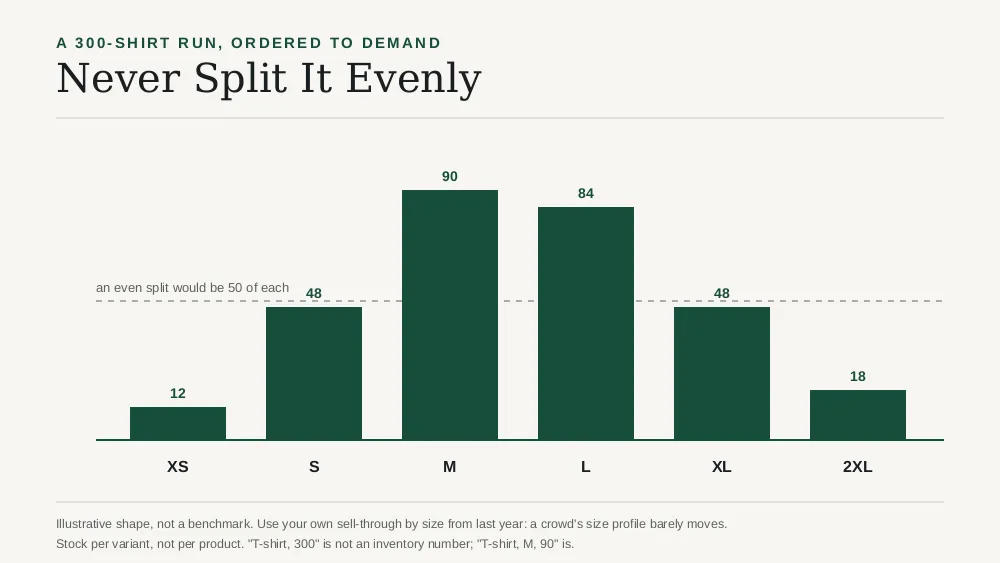
- Order on the size curve, not evenly. Mediums and larges carry most apparel runs; a flat order across six sizes is how you end up with a box of XS for three years.
- Take cards at the table. A cash-only merch table costs you the sales of everyone who stopped carrying cash, which is most people under forty.
- Youth-sized shirts are taxed differently in Ontario, Nova Scotia and PEI. The provincial part of the HST is rebated at the point of sale on qualifying children's clothing, so a youth tee is 5 per cent, not 13. Ticketing checkouts usually apply one rate per event, so plan how you will handle that before you list kids' sizes.
- Keep two numbers: per-head spend and sell-through by size. Everything you decide next year comes out of those two.
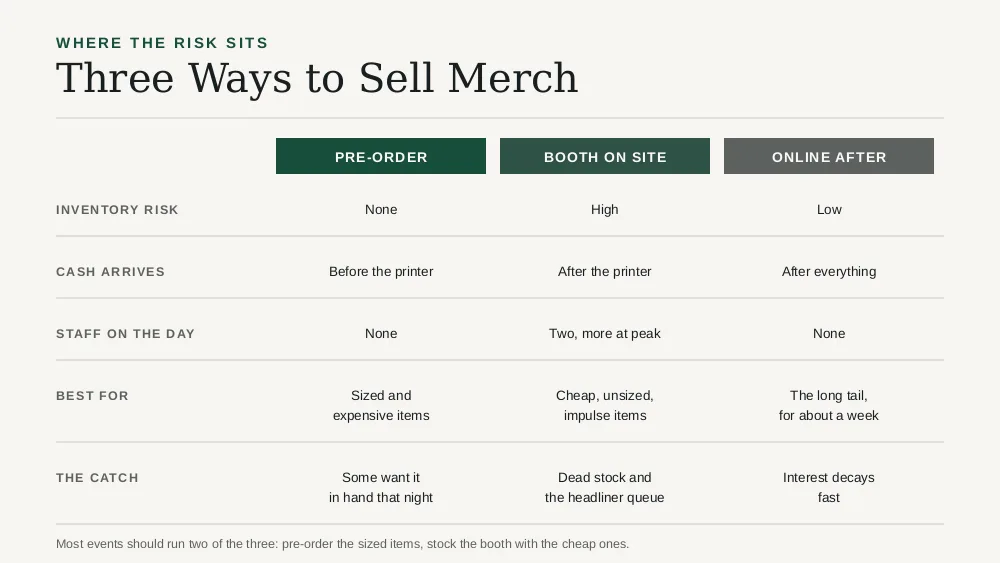
Three ways to sell, and what each one costs
| Pre-order with the ticket | Booth on site | Online after the event | |
|---|---|---|---|
| Inventory risk | None. You print to orders | High. You buy on a guess | Low, if you print on demand |
| Cash timing | Before you pay the printer | After you pay the printer | After everything |
| Staffing | None on the day, if you ship | Two people minimum, more at peak | None |
| Best for | Hoodies, anything expensive, anything sized | Impulse items, low-price, one-size | The long tail and the people who ran out of cash |
| The catch | People want it in their hands at the show | Dead stock, and the queue at the headliner | Interest decays within about a week |
Most events should be doing two of these three. Pre-order the expensive, sized items; stock the booth with the cheap unsized ones; and open an online window for a week afterwards while the photos are still circulating.
Pre-order is a different business
The reason to pre-order is not convenience. It is that a sized apparel run is a forecasting problem, and pre-ordering deletes the forecast.
Sell the item as an add-on attached to the ticket types that should see it, with its own price and its own stock, and set it to one per item if you want to cap how many a single order can take. Close pre-orders at least three weeks before the gate, because that is the printer's lead time plus the week you will lose to a proof revision.
Then decide one thing: collection or shipping. Collection at a clearly signed table is cheaper and brings people to the merch area, where they buy a second thing. Shipping costs more and works better for an audience that travelled, but it turns a merch run into a fulfilment project with addresses, postage and the four people who typed their street wrong.
The honest trade-off is that some of your audience wants the shirt in their hands at the show and will not pre-order. That is what the booth is for.
The size curve
The single most expensive mistake in event merch is ordering evenly across sizes.
Apparel demand is not flat. A typical adult run skews heavily to M and L, with S and XL meaningfully behind and XS and 2XL in the tail. Order to that shape, not to a spreadsheet that divides 300 by six. If you have run the event before, use last year's actual sell-through rather than any general rule: your crowd's shape is your crowd's shape, and it is stable year to year.
Two practical rules:
- Stock per variant, not per product. "T-shirt, 300" is not an inventory number. "T-shirt, M, 90" is. If your system cannot hold stock per size, you will sell shirts you cannot supply.
- Let the shortage be visible. Sold-out sizes should show as sold out, not fail at the table. People accept that a size is gone; they do not accept being told after they paid.
The booth on the day
A merch booth is a retail operation that you staff for about four hours of real demand spread across the event's whole run.
Queue, not table. Demand arrives in two spikes, straight after doors and straight after the headliner. One person serving and one person on payment doubles throughput over one person doing both, because the two jobs block each other.
Take cards. This is the single biggest lever. A merch table that takes only cash loses every sale from the people who no longer carry it, and at an event where tickets were bought online, that is most of the room. Eventist's point of sale runs on a staff phone, so the merch table takes a tap, an insert, a keyed-in number or cash without a separate terminal, separate float or separate end-of-night count, and anything that is not a ticket type rings up as a custom item.
Count in and count out. Opening count, closing count, and the difference reconciled against sales. Without it you have no shrinkage number and no sell-through data, which means next year's order is another guess. The same discipline as reconciling your event revenue applies here, and merch is where it is skipped most often.
The tax detail nobody plans for
Here is the one that catches Canadian organizers, and it is worth knowing before you list a kids' size.
Ontario, Nova Scotia and Prince Edward Island rebate the provincial part of the HST at the point of sale on qualifying children's goods. The Canada Revenue Agency's own guidance puts the provincial part at 8 per cent in Ontario, 10 per cent in Nova Scotia and 9 per cent in PEI. A supplier that credits the rebate "will collect only the 5% federal part of the HST".
What counts as qualifying children's clothing is specific: garments designed for babies, and "children's garments in sizes up to and including girls' Canada Standard Size 16 and boys' Canada Standard Size 20, or garments designed for girls or boys in sizes extra small, small, medium or large if the garment does not have a designated Canada Standard Size". Adult-sized garments do not qualify even when bought for a child, and neither do garments of a class used exclusively in sports or recreational activities. For footwear the line is an insole of 24.25 cm or less.
In plain terms: your youth tee in Ontario should ring up at 5 per cent, and your adult small should ring up at 13 per cent even if a ten-year-old is wearing it.
The practical catch is that a ticketing checkout generally applies one sales tax rate per event, which is correct for admissions and wrong for a mixed merch table. Eventist is no exception today: the rate is set on the event, not on the individual item. So if you are selling youth sizes in a participating province, either sell them through a channel that applies the rebate properly, or price and remit them deliberately and keep the paperwork. This is general guidance rather than tax advice, and your bookkeeper should see the plan before the onsale.
Pricing
Merch pricing at events is not retail pricing, because your costs are different and so is the moment.
- Price in whole dollars, tax included at the booth. "Thirty dollars" moves a queue. "$26.55 plus tax" does not.
- Keystone is the floor, not the target. Double the landed cost is the usual starting point for apparel; event merch routinely clears more because the buyer is buying the night, not the garment.
- Bundle one thing with the ticket. A ticket-plus-shirt bundle at a small discount converts better than the shirt alone and moves the sale to pre-order, where it has no inventory risk.
- Do not discount on the day. The people who paid full price at 7pm are still in the room at 11pm.
The numbers worth keeping
Two, and they are both easy if you sell merch through the same system as the tickets.
Per-head spend. Merch revenue divided by attendance, which is only honest if your attendance number is a scan count rather than a ticket count — the distinction is the whole point of tracking attendance properly.
Sell-through by variant. What percentage of each size actually sold. This is next year's order, and it is the number most events never capture because the booth was a cash box.
Our perspective
The reason merch gets run badly is not that organizers do not care about it. It is that it sits outside the system that runs everything else, so it inherits none of the discipline. The tickets have stock limits, a scan and a report. The shirts have a table.
Pulling merch into the ticketing system is not about the software; it is about the shirt getting an inventory number, a sales report and a reconciliation at the end of the night, the same as every other finite thing you sell. Once it has those, the decisions get easy: you know what to print, what to price it at and what to stop making.
Where Eventist fits
Merchandise behaves as ordinary inventory in Eventist, with three shapes worth knowing.
Add-ons, for the pre-order. An add-on carries its own price and its own stock number, attaches to the ticket types that should offer it, and can be capped at one per item. Its revenue stays broken out on the order rather than folded into the ticket price, which is what makes a pre-order report usable. For sized apparel, each size is its own add-on, so the stock number means something and a sold-out medium says so at checkout instead of at the table.
Point of sale, for the table. The point of sale runs in the dashboard on any staff phone, so the merch table takes a tap or insert on a connected reader, a keyed-in card number, or cash, with no separate terminal and no separate end-of-night count. A one-off amount can be rung up as a custom item when the thing in front of you is not a ticket type, an unpaid sale can be held under a name while somebody goes to find cash, and a station printer produces the receipt. Add-ons are an online pre-order mechanism rather than a POS one, so stock the table as its own sale.
An additional checkout, for the merch itself. An additional checkout is a second checkout page for the same event at its own address, with its listings hidden from the main storefront and its registrations, reports and scanning shared with the rest of the event. That is the clean way to run the week-long online window after the show, or a crew and artist store the public should never see, without cluttering the page that sells tickets.
What is not there today is a per-item tax rate: sales tax is set on the event, not on the individual item, which is the limitation to plan around if you sell children's sizes in Ontario, Nova Scotia or PEI.
Frequently Asked Questions
Should I pre-order merch or just bring stock?
Pre-order anything sized or expensive, because that is where the forecasting risk lives, and bring stock of the cheap unsized items that sell on impulse. Most events should do both. Close pre-orders about three weeks before the gate to cover the printer's lead time.
How many of each size should I order?
Not an even split. Apparel demand concentrates in medium and large, with small and extra large behind and the extremes in the tail. If you have run the event before, use your own sell-through by size from last year rather than any general rule, because a crowd's size profile is remarkably stable.
Do I have to charge tax on event merchandise in Canada?
Generally yes, and separately from how you handle admissions. The wrinkle is that Ontario, Nova Scotia and PEI rebate the provincial part of the HST at the point of sale on qualifying children's clothing and footwear, so a youth-sized shirt is charged at the federal 5 per cent only. Adult sizes do not qualify even when bought for a child. Check the plan with your bookkeeper before you list kids' sizes.
Can I sell merch through my ticketing platform?
For pre-orders, yes — an add-on with its own price and stock does exactly this, and it keeps the revenue broken out from ticket sales. For the table on the day you want a point of sale that takes cards; in Eventist that runs on a staff phone rather than a rented terminal.
What is a good per-head merch number?
It varies far too much by audience and price point for a benchmark to be useful, which is why the number worth having is your own from last year. Capture merch revenue and scanned attendance in the same system and the figure falls out; guess at either and it does not.
Sources
- Point-of-Sale Rebate on Children's Goods, GI-063, Canada Revenue Agency
- HST: Ontario point-of-sale rebates, Government of Ontario
Recommended
Tags
Ready to simplify your events?
Join hundreds of organizers, studios, and festival directors who trust Eventist to run their events.