How to Sell Festival Parking and Shuttle Passes
Parking is the first thing an attendee experiences at your festival and the last thing they remember, and at most events it is the only part of the operation with no inventory control at all. Tickets are capped, the bar is staffed to a number, the gate has a scan rate — and the field just fills until someone stands at the entrance waving cars away.
Selling parking in advance fixes that, and it fixes three other things on the way: cash handling at a road entrance, the queue that forms while someone makes change, and the argument at 7pm about whether the lot is actually full. This is how to build it, what capacity you can honestly sell, and the two ways to attach it to a ticket.
TL;DR
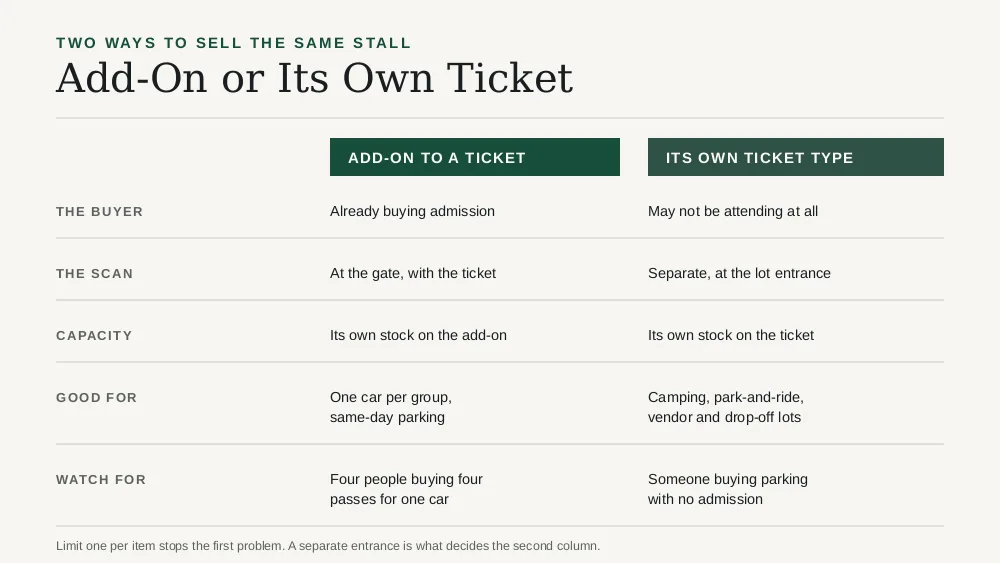
- Sell parking as an add-on to a ticket when every buyer already has a ticket and one car serves a group. Sell it as its own ticket type when the buyer may not be the driver, when you need a separate scan at a separate entrance, or when you are selling overnight and camping spots.
- Count stalls, not guesses, then subtract the holdbacks before you set the number for sale. Accessible, staff, vendor, artist, emergency lane and tow space all come off the top.
- Ontario's accessibility standard sets the benchmark worth planning to: 4 per cent of a 13-to-100 space lot, and two spaces plus 2 per cent between 201 and 1,000 spaces, split between wider van-accessible and standard widths.
- Scan parking passes the same way you scan tickets. A phone at the lot entrance that works without signal is the whole requirement, and the lot usually has worse signal than the gate.
- For park-and-ride, sell the shuttle by departure window rather than by day, and the ride back is the half people forget to plan.
- Free parking still deserves a pass. Capacity, not money, is the reason to issue one.
Decide what you are actually selling
A parking pass is one of three things, and they behave differently.
A stall for the day. The common case: one car, one lot, one date. The buyer wants certainty that they will not be turned away.
A spot for the run. Multi-day festivals with a car that stays. This is inventory you cannot resell on day two, so it is priced and counted differently.
Overnight or camping. A different product again, usually with its own rules, its own section of the field and often its own permit. If you sell this, it needs its own capacity and its own map, not a line in the parking description.
Decide which of the three you are selling before you decide how to attach it, because the answer to the second question follows from the first.
Add-on or its own ticket type
| Add-on to a ticket | Its own ticket type | |
|---|---|---|
| Buyer | Already buying admission | May be a driver dropping off, a vendor, or a day-tripper |
| Scan | Usually at the gate with the ticket | Separate scan at the lot entrance |
| Capacity | Its own stock, counted separately from admission | Its own stock, naturally |
| Good for | One car per group, same-day parking | Camping, overnight, park-and-ride, vendor lots |
| Watch for | A group of four buying four passes for one car | Someone buying parking with no admission |
In Eventist the add-on is the simpler of the two: an add-on carries its own price and its own stock number, you attach it to the specific ticket types that should offer it, and you can set it to one per item so a four-person order cannot quietly take four stalls. The breakdown stays on the order, so parking revenue reports separately from admission rather than disappearing into the ticket price.
The separate ticket type is the right answer the moment the parking pass needs its own scan at its own entrance, because that is a gate with its own staff, its own device and its own count.
The capacity number you can honestly sell
This is where most parking plans go wrong: the number comes from the site plan, and the site plan was drawn before anyone walked the field.
Work it in this order.
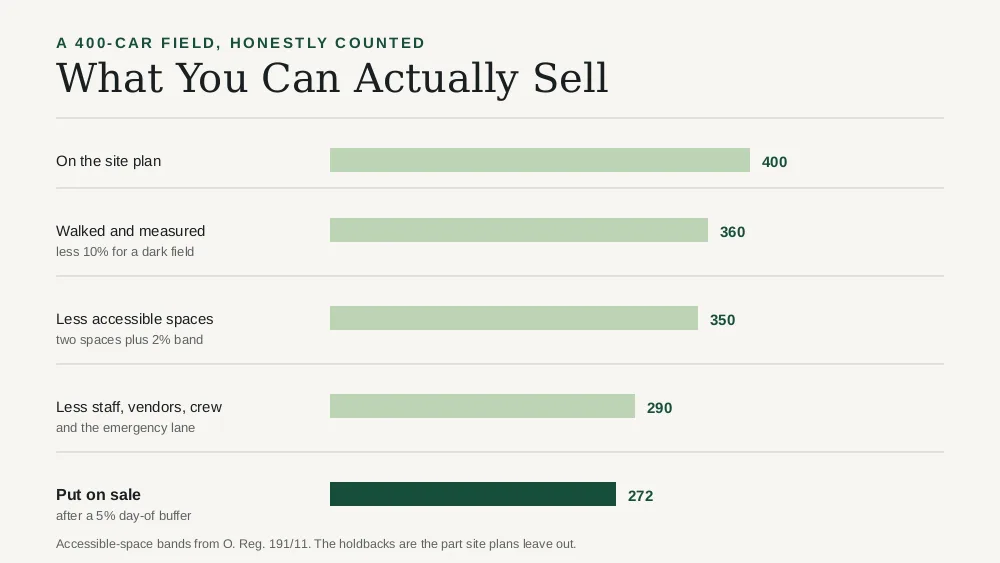
1. Count the stalls that exist. On a marked lot, count them. On grass, lay out a row, measure it, and multiply honestly — then take 10 per cent off for the reality of how people park on a field in the dark.
2. Take out accessible parking first, not last. Ontario's Integrated Accessibility Standards Regulation sets the ratios for off-street parking facilities: one van-accessible space where there are 12 spaces or fewer; 4 per cent where there are 13 to 100; one space plus 3 per cent from 101 to 200; two spaces plus 2 per cent from 201 to 1,000; and eleven spaces plus 1 per cent above 1,000. Those spaces are split evenly between Type A, a wider van-accessible space of at least 3,400 mm, and Type B at a standard 2,400 mm. The regulation is written for the construction and redevelopment of parking facilities rather than a hay field used one weekend a year, so treat it as the planning benchmark rather than an argument about whether it binds you. It is also the number a municipality will ask about when you apply for the event permits you need anyway.
3. Take out the operational holdbacks. Staff and volunteers, vendors and their vans, artists and crew, the emergency lane, and a tow or recovery space near the exit. On a 400-car field this is routinely 60 to 80 cars.
4. Hold back a small day-of buffer. Five per cent covers the misparks, the trailer nobody mentioned and the accessible overflow.
5. Sell what is left. Not the number on the site plan.
Scanning at the lot
A parking pass that is checked by eye is a parking pass that gets screenshotted and shared. Scan it.
The practical requirements at a lot entrance are different from the gate in one way that matters: the signal is worse. Lots sit at the edge of the site, often behind a treeline, and the cell coverage that works at the main gate frequently does not reach them. Scanning has to work from a cached list and reconcile later, or it will not work at all between 4pm and 6pm when you need it.
The rest is the same pattern as any QR code ticketing setup: a phone per lane, one scan per pass, a redeemed pass that refuses the second scan, and a staff member who can look up an order when somebody's email is in a spam folder. Eventist turns any staff phone into a scanner, so adding a second lane during the 5pm crush costs a person rather than a hardware rental.
One detail specific to parking: decide in advance whether a pass is scanned on entry only or on entry and exit. Entry-only is right for almost everyone. Exit scanning is for events reconciling a shared lot with a venue, and it doubles your staffing for a number you will not use.
Shuttles and park-and-ride
Park-and-ride is parking with a schedule attached, and the schedule is the part that needs selling properly.
Sell by departure window, not by day. A shuttle pass that says "Saturday" tells you nothing about how many buses to run at 11am. A pass tied to a window tells you exactly that, and it is the same mechanism as timed entry: finite capacity per slot, visible as it sells, with the demand curve showing up in the sales report weeks before the event.
Plan the return trip as its own problem. Outbound demand spreads across the day. Return demand arrives in one lump when the headliner finishes, and the lump is bigger than the biggest outbound window. The pass does not fix that; knowing the number in advance does.
Price the round trip as one item. Selling legs separately produces a crowd at midnight holding one-way passes and an argument nobody wins.
Pricing, and whether to charge at all
Three defensible positions, and the choice is strategic rather than financial.
- Free with a required pass. You want the count and the capacity control, not the revenue. This is the right default for community and municipally supported events, and it still gets you the data.
- Flat per car, per day. Simple, scans cleanly, and it mildly encourages carpooling because the cost splits.
- Premium close-in, free remote. A small paid lot near the gate and a free field further out. The paid lot subsidises the shuttle, and people self-sort by how much walking they want to do.
Whichever you pick, publish it on the event page before the onsale. The complaint is never about the price; it is about finding out at the gate.
Our perspective
Parking is the clearest example of a pattern worth naming: the parts of a festival that are not ticketed tend to be the parts that fail, because they are the parts with no number attached. Nobody oversells admission — the system will not let them. Everybody oversells parking, because the field has no opinion about how full it is.
The fix is not a bigger field. It is treating every finite thing on site as inventory with a count, a price and a scan, and letting the sales report tell you about Saturday afternoon in September rather than at 5pm on the day.
Where Eventist fits
Parking and shuttle passes are ordinary inventory in Eventist, and four pieces do the work.
Add-ons. An add-on carries its own price and its own stock, attaches to the ticket types you choose, and can be limited to one per item so a group order cannot take four stalls for one car. Its revenue stays broken out on the order rather than folded into the ticket price, so parking reports as parking.
A separate ticket type. With its own capacity, this is the route when the pass needs its own scan at its own entrance, and any staff phone becomes the scanner for it, which is what makes a second lane cheap at the moment you need one. For park-and-ride, the per-window capacity works the same way it does for timed entry.
An additional checkout. Vendor, crew and artist parking does not belong on the public page. An additional checkout is a second checkout page for the same event at its own address, and the listings on it are hidden from the main storefront entirely, while registrations, tickets, scanning and reports stay shared with the rest of the event. Send the vendors the link; the public never sees the lot you are holding back.
Point of sale. Cars arrive without a pass, and the lot entrance is a long way from the box office. The point of sale runs in the dashboard on any staff phone, takes a tap or insert on a connected reader, a keyed-in card number or cash, and will hold an unpaid sale under a name or phone number for the driver who has to go and find a wallet.
What the platform does not do is draw your site plan or count your stalls. That part is a walk around the field with a measuring wheel, and it is worth doing before the passes go on sale rather than after.
Frequently Asked Questions
Should parking be an add-on or a separate ticket?
An add-on when the buyer is already buying admission and one car serves the group — it is fewer decisions at checkout and the stock still counts correctly. A separate ticket type when the pass needs its own scan at its own entrance, when the buyer might not be an attendee, or when you are selling camping and overnight spots.
How many accessible parking spaces should a festival provide?
Ontario's accessibility regulation is the usual benchmark: 4 per cent of a lot of 13 to 100 spaces, one space plus 3 per cent from 101 to 200, two spaces plus 2 per cent from 201 to 1,000, and eleven plus 1 per cent beyond that, split between wider van-accessible and standard spaces. Confirm what your municipality requires for your permit, and plan the spaces closest to the entrance rather than wherever the field allows.
Can I sell parking without selling a ticket?
Yes, and you often should — drivers dropping off, vendors and volunteers all need a stall without needing admission. That is exactly the case for a separate ticket type rather than an add-on.
What happens if the lot fills before everyone with a pass arrives?
It should not, which is the reason for the holdbacks. If it does, the pass is a promise you have broken, so plan the overflow before the event: a named secondary field, the staff who will direct to it, and the message you will send. In Eventist a broadcast to attendees reaches the portal during the event and can be retracted when the situation changes.
Do I need a permit to charge for parking on a field?
Usually there is something: a municipal special-event or parking approval, a site-plan condition, or a clause in the land-use agreement if you are renting the field. Ask the municipality early, because the parking plan is often the part of a permit application that comes back with conditions attached.
Sources
- Integrated Accessibility Standards, O. Reg. 191/11, sections 80.34 and 80.36 (accessible parking)
- Integrated Accessibility Standards Regulation, Government of Ontario
Recommended
Tags
Ready to simplify your events?
Join hundreds of organizers, studios, and festival directors who trust Eventist to run their events.