How to Sell Trade Show Booths and Run the Show Floor
A trade show sells two completely different products to two completely different buyers. Exhibitors buy floor space, months ahead, on a contract, with a position they care about more than the price. Attendees buy a badge, often in the final fortnight, and want to know who will be there. Most event software is built for the second transaction and treats the first as an afterthought, which is why so many shows end up running the floor on a spreadsheet and a PDF.
This guide covers the booth types the industry has standardised on, how organizers price position and size, what belongs in an exhibitor contract, and what has to work on the morning of load-in.
TL;DR
- Price per square foot first, then add premiums for aisle exposure. Corner fees are usually a flat amount per exposed corner, not a percentage.
- Use the standard booth definitions. Exhibitors already know what inline, corner, end-cap, peninsula and island mean, and the height rules that come with each.
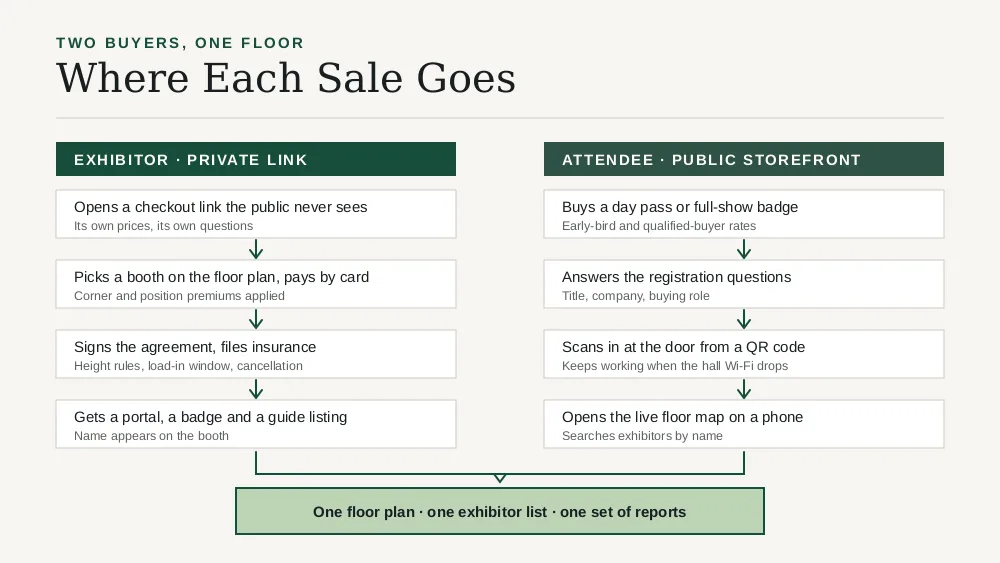
- Sell booths through a private checkout, not your public ticket page. Exhibitor pricing, questions and contracts are nothing like an attendee's.
- Put insurance limits, load-in windows, height rules and cancellation terms in the contract the exhibitor signs, not in an email.
- The floor map is the product for both audiences: exhibitors buy a position on it, attendees use it to find people.
The booth types, and why the names matter
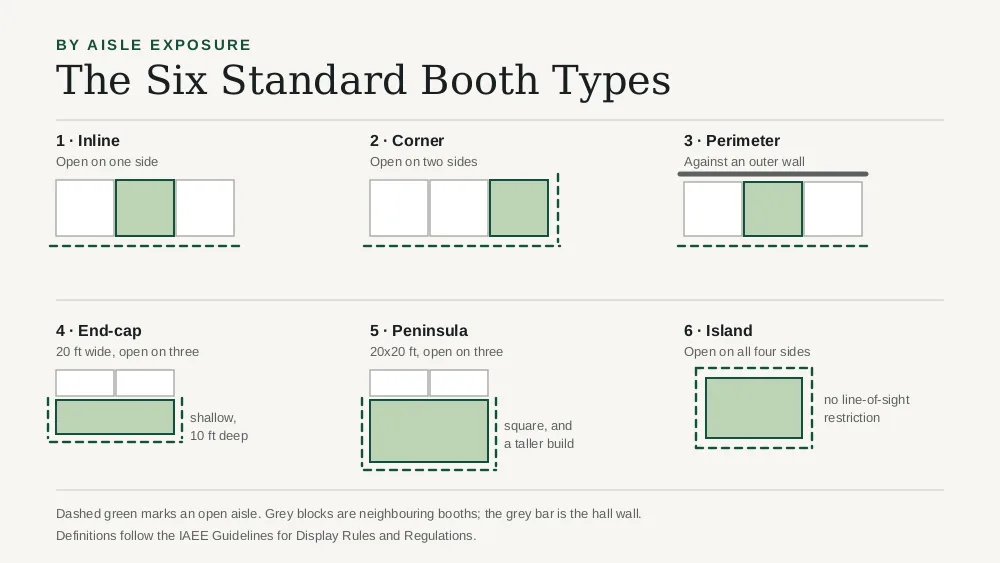
The International Association of Exhibitions and Events publishes the standard definitions in its *Guidelines for Display Rules and Regulations*, and most North American shows write their rules against them. Using the same vocabulary saves you an enormous amount of explaining, because an exhibitor who has done three shows already knows what each one costs them in build.
- Inline, or linear. A booth in a row, open to the aisle on one side. Typically 10 by 10 feet. The usual height rule allows 8 feet at the back half and limits anything in the front half to 4 feet, so it does not block the neighbours.
- Corner. An inline booth at the end of a row, open to aisles on two sides. Same height rules as inline, meaningfully more traffic, and this is where the corner premium applies.
- Perimeter. An inline booth against an outside wall. Because there is no neighbour behind it, the back-half height limit is usually raised, commonly to 12 feet.
- End-cap. Two corner booths combined into a 20-foot-wide by 10-foot-deep space, open on three sides, sitting in the position of a peninsula. It carries line-of-sight restrictions that a true peninsula does not.
- Peninsula. 20 by 20 feet or larger, open to aisles on three sides, backing onto two inline booths. Double-sided signage usually has to be set back 10 feet from the neighbours.
- Island. Open to aisles on all four sides, usually 20 by 20 feet or larger. No line-of-sight restrictions, because an aisle separates it from everyone, so these are where the two-storey builds and hanging signs appear.
How to price the floor
Square footage first
Most shows quote a rate per square foot and let the booth size do the arithmetic, which keeps a 10 by 20 priced consistently against two 10 by 10s. Rates commonly step down as the footprint grows, so the biggest exhibitors pay less per foot than the smallest.
A concrete published example: LBM Expo, run by the Northeastern Retail Lumber Association, lists member pricing at $37 US per square foot for spaces of 200 square feet and under and $34 above that, with non-members at $44 and $43 respectively, as of October 2026. On that structure a member's 10 by 10 is $3,700 and a 20 by 20 is $13,600.
Then premiums for exposure
Aisle exposure is the thing exhibitors actually compete for, and it is priced separately from size. The same show charges a flat $100 per exposed corner for members and $200 for non-members, as of October 2026. A flat corner fee is the common approach because it is easy to explain and it scales correctly: a corner is worth roughly the same extra traffic whether the booth is 100 or 400 square feet.
Beyond corners, organizers routinely charge more for space near the main entrance, the food service, the keynote theatre or the busiest cross-aisle, and less for the back corners and anything behind a structural column. Walk the hall with last year's traffic counts before you set these.
What the rate includes, in writing
Exhibitors budget the booth fee and then get surprised by everything else, so be explicit about what the number buys. Typically the space, a standard booth sign with the company name and booth number, and a listing in the show guide and online map. Typically *not* electrical, internet, furniture, carpet, material handling, drayage or labour, all of which come from the official service contractor and are ordered separately.
Being blunt about this in the contract is in your interest as much as theirs. The most common exhibitor complaint is not the booth price, it is a bill they did not see coming.
Early-bird, renewal rights and the waiting list
Three levers worth deciding before you open sales. An early-bird rate with a hard date pulls cash forward into the months when you are paying deposits. Renewal rights, where a returning exhibitor gets first refusal on their space before general sale, is the single strongest retention tool a show has. And once the hall is sold, keep a formal waiting list rather than improvising, because cancellations always come.
The exhibitor contract: what has to be in writing
An exhibitor agreement is a commercial contract with safety and liability consequences, so it carries more than a ticket's terms. The items that cause the most trouble when they are missing:
1. Insurance limits and additional insureds. Shows commonly require commercial general liability of at least $2 million, naming both the show organizer and the venue as additional insureds, with a certificate filed before load-in. The LBM Expo rules cited above set exactly that limit.
2. Load-in and load-out windows, by booth size. Large island builds need earlier access, and most shows require anything 20 by 20 or larger to be set up by a stated hour on the day before opening.
3. Height and line-of-sight rules for the booth type sold, plus what needs organizer approval.
4. Material handling and hand-carry policy. Who may unload what, with which equipment, at which door. This is where union and contractor rules bite, and where an uninformed exhibitor gets an unexpected invoice.
5. Sound and lighting limits. A common standard is no more than 80 to 90 decibels measured from the centre aisle, with no continuous flashing, and a requirement that any recorded or live music carries its own SOCAN or equivalent licence.
6. Payment schedule and cancellation terms, including what happens to the deposit and whether the space can be resold.
7. Co-exhibitor policy. Whether another company may share a booth, whether they must be registered, and whether they appear on the map and in the guide.
8. No guarantee of competitor separation. Most shows state plainly that they cannot promise a competitor will not be placed nearby, because otherwise every floor plan becomes a negotiation.
This article is general guidance, not legal advice. Have a lawyer in your province review your exhibitor agreement, your insurance requirements and your cancellation terms before you use them.
The exhibitor journey, end to end
Whether you sell first-come or by application changes the whole flow.
First-come selection suits established shows with a known exhibitor base. Open a private link, let exhibitors pick an available booth on the plan, take payment, and the space is theirs. Fast, self-serve, and it rewards the exhibitors who renew early.
Application and curation suits juried or sponsor-led shows, and anything where product-category balance matters. Exhibitors apply, you approve and assign a space, then you invoice. Slower, but you control who ends up next to whom.
Either way the sequence after the sale is the same, and it is where most shows lose time: confirm the space, collect the signed agreement, collect the insurance certificate, collect the show-guide listing copy and logo, collect the staff names for badges, then send load-in details. Every one of those is a deadline with an owner, and every one of them is chased by email at most shows.
The attendee side is a different product
Attendee registration for a trade show looks like conference registration, not festival ticketing. Day passes and full-show badges, often free or heavily discounted for qualified buyers and paid for everyone else, with registration questions that exist so exhibitors get useful lead data: job title, company, purchasing role, product interest.
Two things worth getting right. First, ask only what exhibitors will actually use, because every extra field costs you registrations. Second, decide early whether badges are transferable, because a $500 badge that cannot be reassigned when someone's flight is cancelled generates support work all week.
Show day on the floor
- Registration desk throughput. Pre-registered attendees should scan and go. Plan separate lanes for on-site registration, which is always slower, and expect a peak in the first ninety minutes of day one that will not repeat.
- Scanning that survives the hall. Exhibition halls have notoriously bad connectivity. Any check-in tool you use has to keep validating when the Wi-Fi drops and reconcile afterwards.
- Exhibitor check-in is separate. Exhibitor staff arrive before the doors open and need their own credential, which is not an attendee badge.
- The map has to be live. Booths change hands, exhibitors cancel, and a printed floor plan is wrong by opening morning. Attendees looking up a company by name on their phone is now the default behaviour.
What to test before you sell a single booth
- Sell yourself a booth, end to end, on a phone. Pick a corner, see whether the corner fee is applied and shown, pay, and check the confirmation says which space you bought.
- Check the plan locks the space. Two exhibitors should not be able to buy booth 214 at once. Try it in two browser windows.
- Confirm the private link is private. Exhibitor pricing should not be reachable from your public ticket page.
- Export the exhibitor list and check it contains booth number, signed-contract status, insurance status and show-guide copy in one file.
- Open the floor map as an attendee on a phone and search for a company by name.
Our perspective
The pattern we see is that shows do not struggle with selling booths. They struggle with the ninety days after the sale, when a booth number, a signed agreement, an insurance certificate, a logo, a staff list and a load-in time all belong to the same exhibitor but live in six different places. The floor sells out and the operations work is still ahead of you.
So our view is to treat the floor plan as the record, not the drawing. If the booth an exhibitor bought is the same object that carries their contract, their portal, their badge and their listing, most of the chasing disappears, because the status of each exhibitor is visible rather than reconstructed from an inbox.
Where Eventist fits
Eventist is built for shows that sell both sides. You draw the hall once in the layout builder, with each booth at its own size and grouped by price band, and sell booths through an exhibitor checkout on its own link that the public never sees. Exhibitors pick their space on the plan, answer the questions you set, and pay by card, and their display name appears on that booth as soon as payment completes.
Every exhibitor who books joins your staff list as a vendor, and is emailed a check-in QR code plus a link to their own portal showing the booth they booked, where it sits, and any contract you assign them to sign, from exhibitor rules to a load-in agreement. Attendee badges run on the public storefront with early-bird pricing and per-attendee questions, every ticket carries a QR code, any phone becomes a scanner that keeps working when the hall Wi-Fi drops, and door sales run through the built-in point of sale into the same reports as advance sales. Attendees open the live floor map from their ticket portal and search exhibitors by name, with no app to install.
Trade shows run on the festivals, conferences and trade shows tier, a flat $4.99 CAD per paid ticket as of October 2026, with card processing paid directly to Stripe or Square at their published rate. The trade show management page covers the floor-plan and exhibitor side, and the pricing page shows the full fee list.
Frequently Asked Questions
How do you price trade show booths?
Start with a rate per square foot, commonly stepping down as the booth gets larger, then add premiums for aisle exposure on top. Corner fees are usually a flat amount per exposed corner rather than a percentage, because a corner delivers roughly the same extra traffic regardless of booth size. Position premiums for space near the entrance, food service or main theatre are set from last year's traffic patterns. State clearly what the rate includes, since electrical, internet, furniture, carpet and material handling are normally ordered separately from the official service contractor.
What is the difference between an end-cap and a peninsula booth?
An end-cap is two corner booths combined into a 20-foot-wide by 10-foot-deep space, open on three sides, placed where a peninsula would sit. A peninsula is 20 by 20 feet or larger and also open on three sides. The practical difference is the rules: an end-cap carries line-of-sight restrictions to protect the booths beside it, while a peninsula has more freedom and usually a higher allowed height. Exhibitors building a tall display need to know which one they bought before they commission it.
Should exhibitors buy booths on the same page as attendees buy tickets?
No. Exhibitor pricing, registration questions and contract requirements have almost nothing in common with an attendee badge, and exhibitor rates are usually commercially sensitive. Sell booths through a private link with its own checkout, and keep attendee badges on your public storefront. Both should write to the same floor plan and the same reporting, so you can see total floor revenue and badge revenue in one place.
What insurance do trade show exhibitors need?
Most North American shows require commercial general liability coverage, frequently a minimum of $2 million, with the show organizer and the venue named as additional insureds and a certificate of insurance filed before load-in. Exhibitors remain responsible for their own property in transit and on the floor. Set the limit and the filing deadline in the exhibitor agreement, and track who has filed, because chasing certificates during load-in week is a reliable source of stress.
How far in advance should booth sales open?
Give returning exhibitors first refusal on their space as soon as the current show closes, while the experience is fresh, then open general sales six to nine months out. That window matters to exhibitors as much as to you: booth builds, shipping and travel all get more expensive the later they are booked, so an exhibitor who commits early spends less and is more likely to renew.
Do attendees need an app to use the floor map?
They should not. A floor map that opens in a phone browser from the attendee's ticket or confirmation gets used; one behind an app install mostly does not, because attendees decide whether to bother while standing in the hall. Whatever you use, make sure it reflects booth changes up to the morning of the show, since late cancellations and swaps are normal.
Sources
- Guidelines for Display Rules and Regulations, International Association of Exhibitions and Events
- Booth Pricing and Rules, LBM Expo (Northeastern Retail Lumber Association)
- Exhibit Booth Display Guidelines, ACA International
- Types of trade show booths, Diper
Recommended
Tags
Ready to simplify your events?
Join hundreds of organizers, studios, and festival directors who trust Eventist to run their events.