Nonprofit Event Management Software: What to Look For
Nonprofit event management software has to do one thing general event software does not: keep the money and the people straight for an organization that will be audited on both. A gala, a golf tournament and a volunteer appreciation night each mix paid tickets, sponsor tables, comped guests and donations, and every one of those lines ends up in a different place on the books.
This guide covers what nonprofits actually need from event software, where ticketing and fundraising tools stop overlapping, what to check on tax receipting in Canada, and how to compare costs when every dollar spent on software is a dollar not spent on the cause. It is written for charities, foundations, associations, schools and community organizations running ticketed events.
Key takeaways
- Separate the ticket from the gift. A $200 gala ticket where dinner is worth $80 is not a $200 donation, and your receipting depends on getting that split right.
- Most nonprofits need event management plus a donation at checkout, not a full fundraising platform. Know which you are buying.
- Auctions and peer-to-peer fundraising are a different category. If your event depends on them, you need a tool built for them.
- Comped and sponsor tickets are the hidden complexity. You need to know who sat where without charging them.
- Compare total cost including processing, because a percentage platform fee on a $250 ticket is real money off the cause.
What makes a nonprofit event different
The event itself looks like any other. The accounting does not.
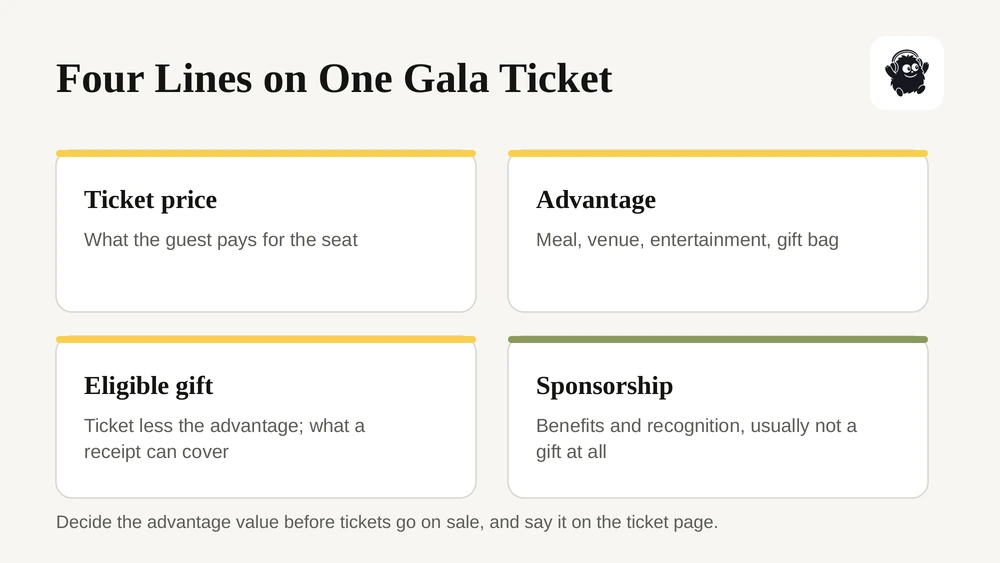
A ticket is often part gift. When someone pays $200 for a gala seat and the meal, venue and entertainment are worth $80, the remaining $120 may be an eligible gift. Your software has to let you record both halves, or someone rebuilds it in a spreadsheet at year end.
Guests are not all buyers. Sponsors get tables, board members get comps, honourees bring family. You need names on seats without money attached to them, and you need to tell the auditor which is which.
The donor record matters more than the order. For a concert, the sale is the record. For a charity, the person is: this is their third gala, they gave at the last one, they are a monthly donor. Whether that lives in your event tool or your CRM is a decision to make deliberately.
Volunteers run it. Most nonprofit events are staffed by people who will touch the software twice a year. Complexity costs you more here than almost anywhere else.
Ticketing, fundraising, or both
The category is muddled because three different kinds of tool are sold to the same buyer.
| Tool | What it is for | Watch for |
|---|---|---|
| Event management and ticketing | Selling seats, running the night, checking people in | May have donations at checkout but not auctions or receipting |
| Fundraising platform | Donations, campaigns, peer-to-peer, recurring giving | Event tooling is often thin: no seat maps, no staff scheduling |
| Auction software | Silent and live auctions, mobile bidding, paddle raise | A specialist tool; usually bought alongside, not instead |
Most organizations running a few ticketed events a year need the first with a donation step, not the second. Organizations whose events *are* the fundraising, where the auction raises more than the tickets, need the second or third as well. Our rules explainer on raffles and silent auctions in Canada covers the licensing side, which catches people out.
Be honest with yourself about which you are. Buying a fundraising platform for its event module, or an event platform for its donation box, is the most common expensive mistake in this category.
Tax receipting in Canada
This is the part worth getting advice on rather than guessing, and the part most event platforms do not do.
Under the Income Tax Act, a registered charity may issue a receipt for the eligible amount of a gift: what was given, less the value of any advantage received. For a gala ticket, the advantage is the meal, the entertainment, the parking and the gift bag. The Canada Revenue Agency publishes how to calculate it, including the de minimis threshold below which an advantage can be ignored.
Three practical consequences:
- Decide the advantage value before tickets go on sale, and state it on the ticket page. Working it out afterwards is how receipts get reissued.
- Most ticketing platforms will not issue a charitable receipt. They can record the split and export it, but the receipt usually comes from your CRM or accounting system.
- Sponsorship is usually not a gift at all. A sponsor receiving recognition and benefits is generally buying marketing, which is a different line on the books. Our sponsorship packages guide covers how to structure that.
This is general information, not tax or legal advice. Confirm with your accountant or the CRA before you set a receipting policy.
What to check on an event platform
Donations at checkout. Can a buyer add a gift while buying a ticket, at a suggested amount or their own, and does it report separately from ticket revenue? Separately is the whole point.
Comped and sponsor seats. Can you issue a ticket with no payment, assign it to a named guest, and have it appear in the attendee list and on the seating plan without distorting revenue?
Tables, not just seats. Galas sell tables of eight or ten, bought by one person who then names the guests. That is a group order where the buyer and the attendees are different people, which not every platform handles. Our group registration forms guide covers the mechanics.
Reserved seating. If you seat a dinner, you need a seat map, and you need to move people on it the week of the event.
Guest list at the door. A volunteer with a phone should be able to find a name fast, mark them arrived, and see who is at which table. Guest list management covers that.
Exports that match your books. Ticket revenue, donation revenue, comped seats and fees as separate lines. If it exports as one number you will unpick it by hand. Our event revenue reconciliation guide shows where the gaps appear.
What it costs, and why it matters more here
Every dollar of platform fee is a dollar not going to the cause, and boards ask about it.
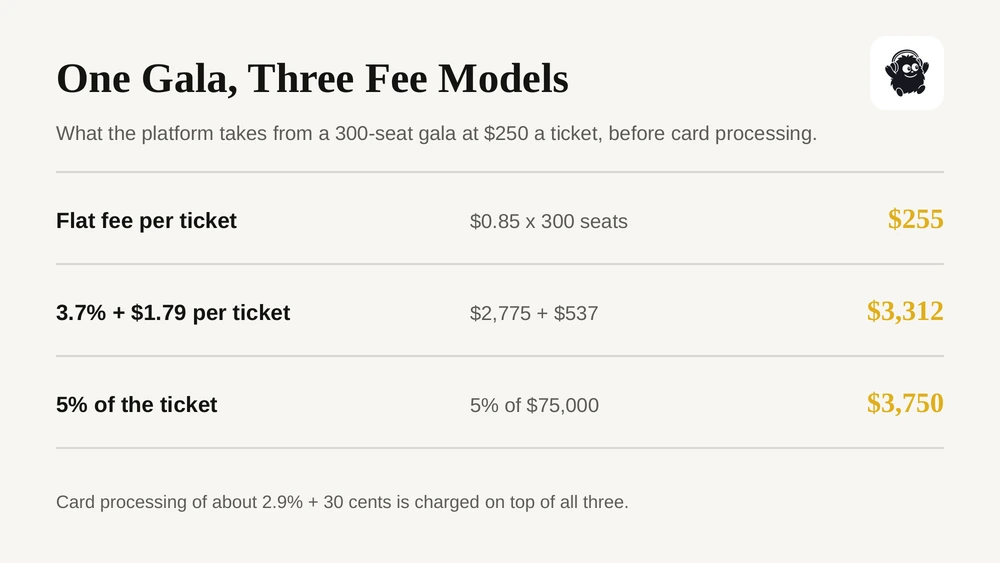
The two models behave very differently at nonprofit price points. On a $250 gala ticket, a percentage platform fee of 3.7% plus a fixed amount is roughly $11 per seat; a flat fee of under a dollar is under a dollar. Across 300 seats that is the difference between about $3,300 and about $250, before card processing, which is charged either way.
Some platforms price specifically for charities: reduced percentages, or models funded by an optional contribution asked of the buyer at checkout rather than taken from you. Those can genuinely cost the organization nothing, at the cost of asking your donors for a tip on top of their gift, which some boards dislike. Our breakdown of event management software costs compares the published rates, and all-in ticket pricing in Canada covers the rule that the first price shown must include mandatory fees.
Also budget the unglamorous line: who sets it up. A platform a volunteer can run without training is worth more than a cheaper one that needs a staff member every time.
Where Eventist fits
Eventist is event management and ticketing, with donations collected at checkout and reported as their own line rather than mixed into ticket revenue. Tables sell as group orders where one buyer names the guests afterwards, comped and sponsor seats issue with no payment and still appear in the attendee list and on the seat map, and reserved seating comes from a seat map you build yourself.
The parts a volunteer committee usually assembles from spare tools are in the same place: staff and volunteer roles with their own dashboards and shift schedules, task boards with due dates, e-signed contracts and waivers, and QR check-in any phone can run at the door. Pricing is a flat fee per paid ticket rather than a percentage, which on a gala seat is the difference described above, and card processing runs through your own Stripe or Square account at the processor's rate.
What Eventist does not do: it is not auction software and it is not a peer-to-peer fundraising platform, and it does not issue charitable tax receipts. Organizations whose events run on mobile bidding or team fundraising pages will still need a specialist tool for that part, and receipting stays with your CRM or accounting system.

You can see how it fits on our events page, or compare the numbers on pricing.
Frequently Asked Questions
What is nonprofit event management software?
It is event software used by charities, foundations, associations and community groups to run ticketed events: selling seats and tables, handling comped and sponsor guests, collecting donations alongside tickets, checking people in, and exporting revenue in lines that match the organization's books. The difference from general event software is mostly accounting, because a nonprofit is audited on how ticket income, gifts and sponsorship are separated.
Do nonprofits need fundraising software or event software?
It depends on where the money comes from. If the event's revenue is mostly tickets and sponsorship with a donation option, event management software with a donation step is usually the right buy. If the revenue is mostly auction bids, pledges or peer-to-peer team fundraising, you need a fundraising or auction platform, and often both that and an event tool.
Can ticketing software issue charitable tax receipts?
Usually not. Most ticketing platforms can record the ticket price and the eligible gift portion separately and export both, but the receipt itself is normally issued from your CRM or accounting system, which holds the donor record and your charity registration number. Confirm with your accountant how your organization issues receipts before choosing where the split is recorded.
How do you handle comped and sponsor tickets for a nonprofit event?
Issue them as tickets with no payment attached, assigned to named guests, so they appear in the attendee list and on the seating plan without adding to ticket revenue. Sponsor tables are usually one allocation the sponsor then fills with names. Keeping these out of revenue but in the headcount is what lets you reconcile the night afterwards.
How much should a nonprofit pay for event software?
Compare total cost on your real ticket prices rather than headline rates, because the models diverge sharply at gala prices. A percentage fee grows with the ticket while a flat per-ticket fee does not, and card processing is charged on top either way. Some platforms offer charity rates or shift the fee to an optional contribution from the buyer, which costs the organization nothing but asks your donors for more at checkout.
Sources
- Calculating the eligible amount of a gift, Canada Revenue Agency
- Deceptive marketing practices: cases and outcomes, Competition Bureau Canada
- Accessibility requirements, Government of Ontario
Recommended
Tags
Ready to simplify your events?
Join hundreds of organizers, studios, and festival directors who trust Eventist to run their events.