Expo Management Software: What It Has to Cover
Expo management software runs the floor of a consumer or trade exposition: selling exhibit space from a live floor plan, collecting the paperwork that comes with it, registering the public who come to walk the aisles, and keeping both sides reporting into one set of numbers. It overlaps heavily with trade show software, and the honest distinction is audience: a trade show sells to the industry, an expo usually sells to the public as well.
This guide covers what the category has to cover, how expo floor plans differ from a trade show's, what public admission adds, and how to judge a platform when most of them quote rather than publish. It is written for organizers of home and garden shows, wedding expos, craft and vendor fairs, consumer shows and association expositions.
Key takeaways
- An expo has two revenue lines, booths and admission, and they must reconcile to one total or you will spend January joining spreadsheets.
- The floor plan has to be inventory. If selling space 112 does not mark 112 sold on the public plan, you will eventually sell it twice.
- Consumer expos sell far more admission than trade shows do, so the door matters as much as the floor.
- Exhibitors judge an expo on leads and footfall. Give them both in a form they can take home.
- Most expo platforms quote rather than publish, so compare on the total for one real show, not on a rate.
Expo, trade show, or both?
The words are used loosely and vendors use them interchangeably, so it is worth being precise about what you are buying for.
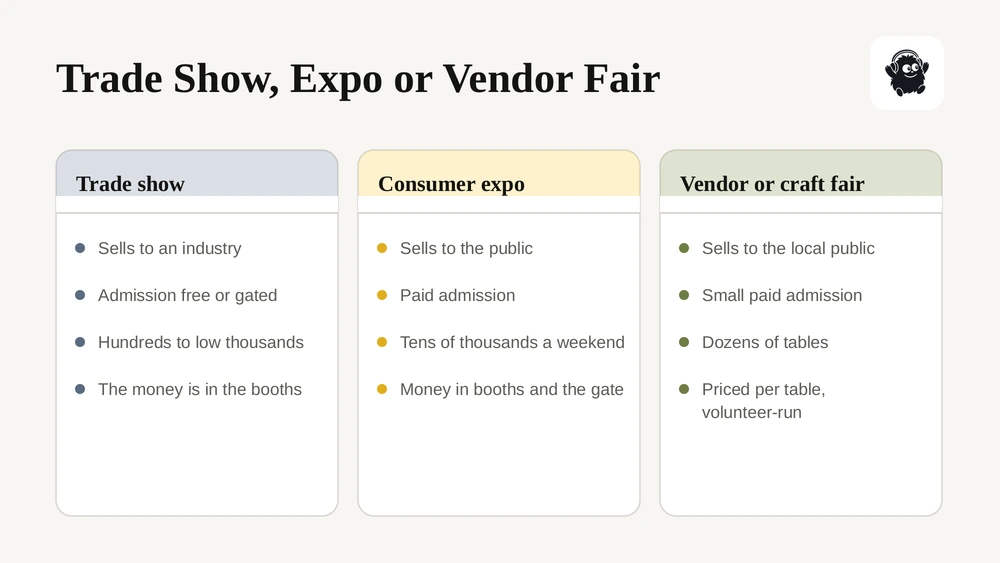
A trade show sells to an industry. Admission is usually free or low cost but gated by registration, attendance is in the hundreds or low thousands, and the money is in the booths.
A consumer expo sells to the public. Admission is usually paid, attendance can run to tens of thousands over a weekend, and the money is in both booths and the gate.
A vendor or craft fair is a small consumer expo: dozens of tables rather than hundreds of booths, often run by a volunteer committee, and usually priced per table.
The software consequence is simple. A platform built for trade shows can be thin on ticketing, because trade shows barely sell any. A platform built for ticketing can be thin on booths. An expo needs both to be real. Our guide to trade show management software covers the industry side in more depth.
The floor plan is the product
Everything on an expo floor is inventory with a price and a position. The plan is not a drawing of the show; it is the thing you sell.
| Capability | What to confirm | Why it matters |
|---|---|---|
| Space sells from the plan | Buying 112 marks 112 sold, live, for everyone | The one failure exhibitors never forgive |
| Sizes and types priced apart | 10x10, 10x20, island, corner, table, truck space, outdoor lot | An expo floor is rarely one size of thing |
| Holds with an expiry | Reserve a space for a returning exhibitor until a date | Renewals need a window before general sale |
| Deposits and balances | Deposit now, balance on a date, with reminders | Booth prices are high enough that few pay in one go |
| Add-ons at checkout | Power, water, tables, chairs, listings, extra passes | Every add-on bought separately becomes an invoice |
| Aisles, zones and categories | Group exhibitors into themed zones a visitor can browse | How a consumer expo is navigated and sold |
| Move the plan late | Resize or relocate a space after it is sold | Plans always change in the last month |
The last row is the one most demos skip. Ask the vendor to sell you a space and then move it, and watch what the exhibitor sees afterwards. Our writeups on pricing and selling booths and interactive venue maps cover the plan itself in more detail.
What public admission adds
This is the part trade-show-first platforms handle badly.
Volume at the gate. A consumer expo can put several thousand people through a door in a morning. That means scanning that works offline, more than one lane, and tickets that are easy to buy on a phone in the parking lot. If your show runs across a weekend, timed entry ticketing is worth reading before you set capacities.
Advance versus door pricing. Most consumer expos sell cheaper online and dearer at the door, which needs tier switching on a date rather than someone changing a price by hand.
Comps and exhibitor allocations. Exhibitors expect a stack of guest passes for their own customers, and you want those traceable back to the exhibitor who handed them out. Ask whether comp codes can be issued per exhibitor and counted per exhibitor afterwards.
Group and family pricing. Consumer expos sell to households. A family rate, a two-day pass and a senior rate are normal, and each is a ticket type rather than a discount code.
Badges for the floor. Exhibitor staff still need badges even when the public gets a wristband or a scan. Our guide to event badge printing covers the stock and printers.
Exhibitor paperwork and the portal
Once space is sold, an expo turns into a deadline-chasing exercise: contracts, insurance certificates, fire marshal forms for anything with a flame or a vehicle, staff names, electrical orders and move-in times.
A portal that shows an exhibitor their space, their position on the plan, their contract to sign, their invoices, their remaining deadlines and their document uploads removes most of the email. Without one, those become hundreds of messages your team answers twice. The detail is in our vendor onboarding portal and vendor contract management guides.
Two expo-specific items worth asking about: whether the platform can hold a document per exhibitor with its own deadline and reminder, and whether move-in and move-out slots can be booked by exhibitors rather than assigned by you.
What exhibitors want back
Renewal is decided on whether the show worked, so give them evidence rather than adjectives.
Leads. Badge or ticket scanning at the booth, exportable by the exhibitor themselves in a format a CRM will take, before they pack up.
Footfall. Admission numbers by day and by hour. A consumer expo that can tell an exhibitor "Saturday 11am to 2pm was a third of the weekend" is selling next year's booth.
Their own numbers. Space cost, passes used, leads captured, on one page. Most expos email a thank-you; the ones that renew well send a short report.
Scanning a visitor's badge hands over personal information, so the visitor should be told at registration that exhibitors will receive it. In Canada, treat that as a consent disclosure rather than a formality.
How to judge a platform
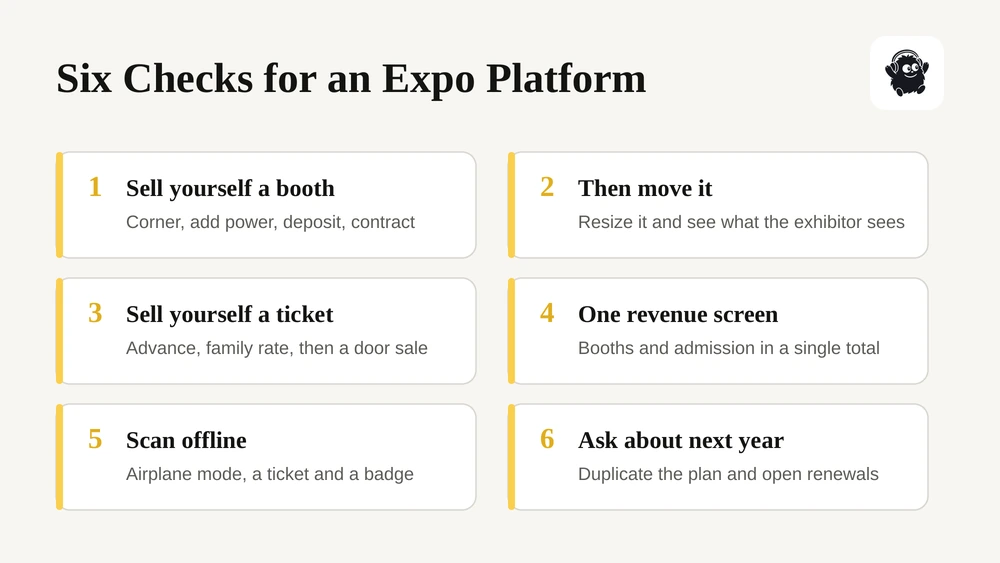
1. Sell yourself a booth. Pick a corner from the public plan, add power, pay a deposit, sign the contract. Time it end to end.
2. Then move it. Change the size or position and look at what the exhibitor sees.
3. Sell yourself a ticket. Advance price, family rate, and then a door sale on the day.
4. Ask for one revenue screen. Booth income and admission income in a single total.
5. Scan offline. Put the device in airplane mode and scan a ticket and a badge.
6. Ask about next year. Can you duplicate the show, its plan and its exhibitor list, and open renewals before general sale?
Most expo platforms quote rather than publish a rate, so run your own numbers. Our breakdown of event management software costs sets the published self-serve rates side by side for comparison.
Where Eventist fits
Eventist sells expo space and admission from the same system. Exhibitors pick their space from the floor plan through their own checkout link, pay a deposit or in full, and land in a portal with their space, its position on the live map, contracts to sign electronically and the documents they still owe. The same interactive map carries markers your crew can hide from the public for power, cabling and staging.
Public admission runs beside it rather than in a second tool, with tiers that switch on a date for advance and door pricing, family and multi-day ticket types, and QR tickets any phone can scan. Badges print to Zebra, Boca, receipt and ordinary office printers. Booth revenue and gate revenue report into one set of numbers, and exhibitors can capture leads at their space.
Pricing is a flat fee per paid ticket rather than a percentage, with no subscription or setup fee on paid ticketing, and card processing runs through your own Stripe or Square account at the processor's published rate.

You can see the detail on our trade shows and expos page, or compare the numbers on pricing.
Frequently Asked Questions
What is expo management software?
It is software that runs both sides of an exposition: selling and assigning exhibit space from a live floor plan, collecting exhibitor contracts, documents and deadlines, and registering or ticketing the public who attend. The distinguishing feature against general event software is that the floor plan is live inventory, so selling a space marks it sold everywhere at once.
What is the difference between expo and trade show software?
Very little in the booth tooling, and quite a lot in admission. Trade shows sell to an industry and barely sell tickets, so trade-show-first platforms can be thin on ticketing. Consumer expos sell to the public in volume, so they need real ticketing: advance and door pricing, family and multi-day types, fast offline scanning and more than one gate lane.
How do expos sell booths online?
Exhibitors open the public floor plan, choose an available space, and check out through a link that takes a deposit or the full amount and attaches the contract. The space is marked sold on the plan at that moment. Add-ons such as power, tables and extra passes are bought in the same checkout rather than invoiced separately afterwards.
What should an expo give exhibitors after the show?
Three things: their captured leads, exportable by them in a format a CRM accepts; footfall by day and hour so they can see when the aisles were busy; and a one-page summary of their own numbers, covering space cost, passes used and leads captured. Shows that send that report renew better than shows that send a thank-you.
How much does expo management software cost?
Most expo platforms quote rather than publish, usually an annual or per-event licence based on modules and expected attendance, sometimes with a per-exhibitor charge. Self-serve ticketing platforms publish per-ticket rates instead, either a flat amount or a percentage plus a fixed fee. Compare the total for one real show including processing, badge hardware and any per-exhibitor charge.
Sources
- Guidelines for obtaining meaningful consent, Office of the Privacy Commissioner of Canada
- Accessibility requirements, Government of Ontario
Recommended
Tags
Ready to simplify your events?
Join hundreds of organizers, studios, and festival directors who trust Eventist to run their events.