Theatre Ticketing Software: What Venues Should Look For
Theatre ticketing software has to do three things general event ticketing does not: sell a specific seat from a map, sell a season rather than a night, and run a box office where staff sell to someone standing in front of them. A platform that only sells general admission online will handle your biggest night badly and your subscription campaign not at all.
This guide covers what separates theatre ticketing from event ticketing, what to check on seat maps, subscriptions and the box office, the questions that matter when leaving an incumbent box office system, and how the pricing models compare. It is written for independent theatres, performing arts centres, community theatres and comedy clubs.
Key takeaways
- Seat maps are the whole job. Check how holds, accessible seating, companion seats and partial-view pricing behave before anything else.
- Subscriptions and season passes are where theatre revenue is predictable. If the software cannot renew a subscriber into next season's equivalent seats, your box office will do it by hand.
- Box office staff sell differently from online buyers. They need a fast internal view, cash and card at the counter, and the ability to override.
- Most incumbent box office systems hold your patron data and your contract. Ask about export and notice period before you ask about features.
- Fees matter more in theatre than people expect, because a subscription renewal is a large single transaction.
Why theatre is not general event ticketing
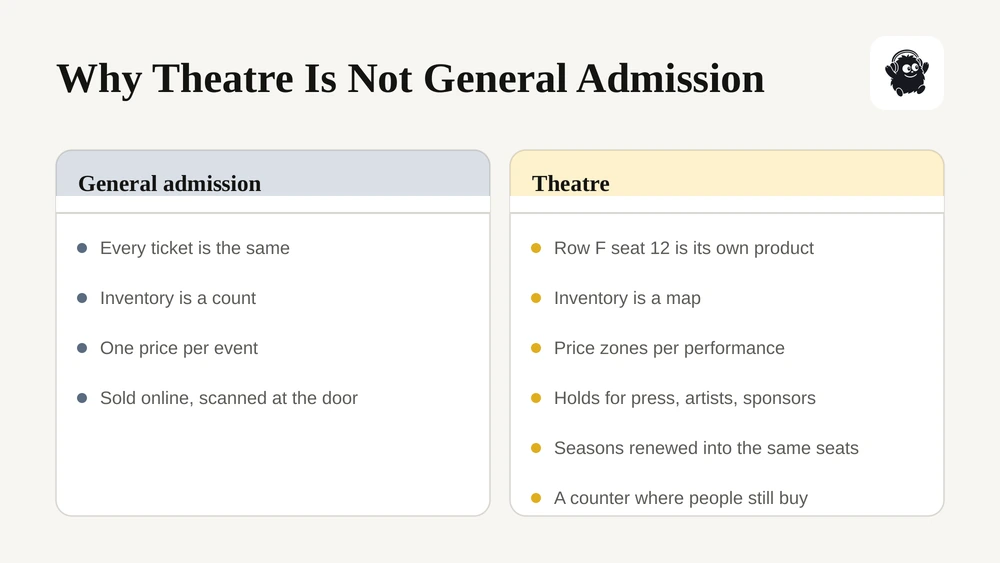
A general admission ticket is interchangeable. A theatre ticket is not: row F seat 12 is a different product from row R seat 3, priced differently, and both are gone once sold.
That one difference cascades. Inventory becomes a map rather than a count. Pricing becomes zones rather than a single figure. Holds matter, because the director, the press, the sponsors and the artists all take seats before the public sees the plan. Exchanges matter, because a subscriber who cannot make Thursday expects to move to Saturday rather than ask for a refund. And the box office matters, because a meaningful share of a theatre's audience still buys from a person.
Our comparison of reserved seating and general admission covers where the line falls if you run both.
Seat maps: what to check
Ask to build your own auditorium in a demo. Not a sample one. Your room, with its real quirks.
| Capability | What to confirm | Why it matters |
|---|---|---|
| Map builder | You can lay out rows, curves, boxes and tables yourself | Every room has something the template does not cover |
| Price zones | Seats grouped into zones you can reprice per performance | Opening night and a Tuesday matinee rarely cost the same |
| Holds and kills | Reserve seats for press, artists, sponsors and production, and kill seats sold as partial view | Held seats released late are real revenue |
| Accessible seating | Wheelchair spaces and companion seats sold online, in the same window as everything else | In the US the ADA requires accessible seats on the same terms; it is also simply better service |
| Social distancing or table seating | Group seats into tables or pods where the room calls for it | Cabaret and comedy rooms are not rows |
| Best available | The system picks good seats for a buyer who does not want to choose | Most online buyers take the suggestion |
Our guide to creating a seating chart walks through building one, and interactive venue maps covers how a plan should behave for the buyer.
Subscriptions and season passes
This is the feature most general ticketing platforms simply do not have, and it is the one that decides whether a theatre's revenue is predictable.
A subscription is a package of performances sold as one product, usually with the same seats each time. What to confirm:
- Can you build a fixed series, a choose-your-own package, and a flex pass that is redeemed later?
- Does renewal carry a subscriber into the equivalent seats next season, and tell you when it cannot?
- Can subscribers exchange a date themselves, within rules you set?
- Are subscriber-only windows supported, so the season goes on sale to them before the public?
- Do subscriber benefits such as a discount on extra tickets apply automatically?
If the answer to renewal is that staff rebuild each subscriber by hand, price that in. It is usually several weeks of box office time every year. Our writeup on season ticket management software covers the mechanics.
The box office counter
Online checkout and counter sales are different jobs. A patron at the window is waiting, often with a question, sometimes paying cash.
Check that staff have an internal sales view rather than the public page, that they can take cash and card at the counter and have both land in the same reports as online sales, that they can apply a comp or an override without a manager unlocking something, and that they can reprint or reissue a ticket on the spot. Our guide to box office software for venues goes further.
The reporting consequence matters at year end. If counter sales live in one system and online in another, someone reconciles them by hand. Event revenue reconciliation covers where those gaps come from.
Leaving an incumbent box office system
Many theatres are not choosing a first platform, they are leaving AudienceView, Tessitura, Spektrix or a legacy system. Three questions come before features.
Can you export everything? Patron records, order history, subscription history, donation history and seat preferences, in a format another system will take. Ask for a sample export file, not a yes.
What is the notice period? Annual licences with automatic renewal and a notice window are common. Find your renewal date before you start demos, because it sets your timeline.
Who owns the patron relationship? Some systems market to your patrons on their own marketplace. Read the data terms.
Then plan the switch for the gap between seasons, never mid-subscription-campaign. Our attendee data residency guide covers where the data sits afterwards, which Canadian boards increasingly ask about.
Pricing models
| Model | How it works | Suits | Watch for |
|---|---|---|---|
| Annual licence | A platform fee, often with modules and implementation | Large performing arts centres with box office staff | Multi-year terms, per-seat licensing, renewal notice windows |
| Percentage per ticket | A share of the ticket price plus a fixed amount | Low-priced tickets and occasional performances | A subscription renewal is a large transaction, so percentages bite |
| Flat fee per ticket | The same amount per paid ticket regardless of price | Theatres with higher-priced seats and their own audience | Confirm whether seat maps and subscriptions are included or extra |
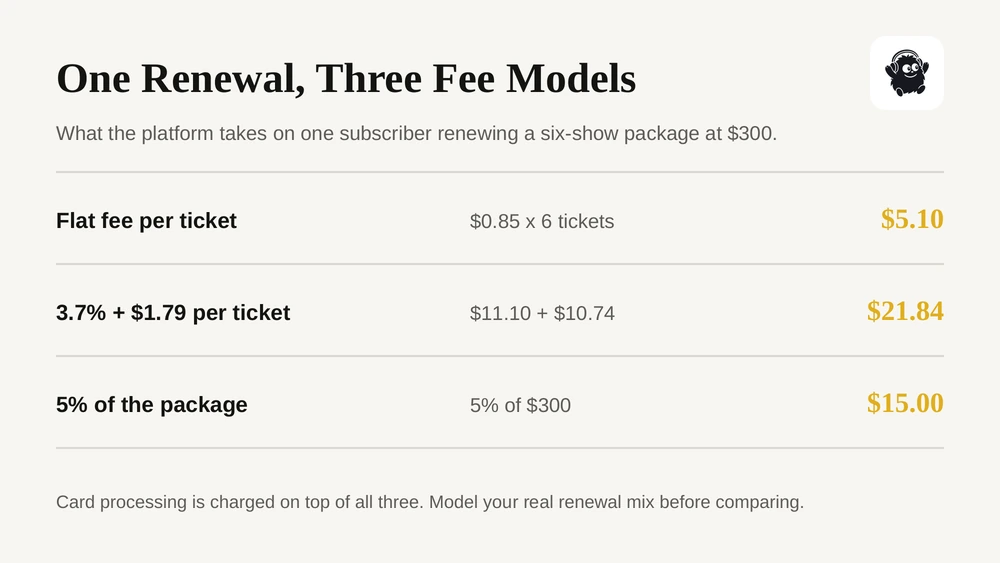
The theatre-specific trap is the subscription renewal. On a percentage model, a patron renewing a six-show package at $300 costs you a percentage of $300 in one go. On a flat fee, it costs the same as a single ticket. Model your real renewal mix before comparing. Our breakdown of event ticketing fees by platform sets current rates side by side, and venue management software pricing covers the venue tier specifically.
Where Eventist fits
Eventist sells reserved seats from a visual seat map you build yourself, with price zones you can set per performance, holds for press and artists, and accessible and companion seats sold online in the same window as everything else. Season passes and multi-performance packages are supported, and a built-in point of sale handles counter sales so cash and card at the window land in the same reports as online orders.
Around the ticketing sit the parts a venue usually buys separately: room and rental scheduling, staff and volunteer roles with their own dashboards, e-signed contracts, and an interactive map. Pricing is a flat fee per paid ticket rather than a percentage, which matters most on a subscription renewal, and there is no subscription or setup fee on paid ticketing. Card processing goes through your own Stripe or Square account at the processor's published rate.

What Eventist does not do: it is not a fundraising CRM, so theatres running major-gift programmes keep that elsewhere. You can see the venue detail on our venues page, or compare the numbers on pricing.
Frequently Asked Questions
What is theatre ticketing software?
It is ticketing built around a seat map rather than a ticket count. It sells a specific seat from a plan of your auditorium, prices seats by zone, holds seats back for press and production, sells subscriptions and season packages, and supports a box office counter as well as online checkout. General event ticketing platforms handle the online sale but usually not the seat map, the season or the counter.
What should a small theatre look for in ticketing software?
Build your own room in the demo, then check four things: that you can hold and release seats, that accessible and companion seats sell online, that a season package can be renewed into equivalent seats without rebuilding it by hand, and that counter sales report alongside online sales. After that, compare total fees on your real mix, remembering that a subscription renewal is one large transaction.
Can theatre ticketing software handle season subscriptions?
Good ones can. Look for fixed series, choose-your-own packages and flex passes, a subscriber-only on-sale window before the public, self-serve date exchanges within rules you set, and renewal that carries a subscriber into the equivalent seats next season. If renewal is manual, budget the box office hours it will take every year.
How do theatres switch ticketing platforms?
Start with the contract, not the features: find your renewal date and notice period, then confirm you can export patron records, order history and subscription history in a usable format. Schedule the move for the gap between seasons rather than during a subscription campaign, and run one small performance end to end on the new system before the season goes on sale.
Is flat-fee or percentage ticketing better for a theatre?
It depends on your prices, and theatre prices tend to favour a flat fee. A percentage grows with the ticket, so it costs most on your best seats and most of all on a multi-show subscription renewal, which is a single large transaction. On low-priced community performances the difference narrows. Model your real season, including renewals, rather than comparing headline rates.
Sources
- ADA guidance on ticket sales, US Department of Justice
- Accessibility requirements, Government of Ontario
- PIPEDA fair information principles, Office of the Privacy Commissioner of Canada
Recommended
Tags
Ready to simplify your events?
Join hundreds of organizers, studios, and festival directors who trust Eventist to run their events.